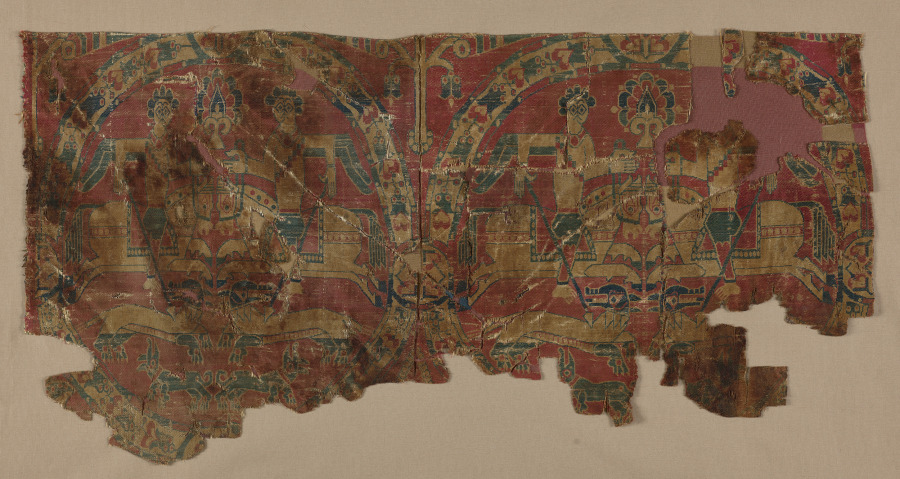
The Roundels with Hunters: A Study in Imperial Silk Weaving and the Legacy of Savile Row
Introduction: The Artifact as a Testament to Craft
The Roundels with Hunters, a silk-woven artifact from the late imperial era, stands as a profound testament to the intersection of artistry, power, and material culture. As a Senior Heritage Specialist at the Lauren Fashion Heritage Lab, I approach this piece not merely as a textile fragment but as a living document of imperial silk weaving—a legacy that, through its meticulous craftsmanship and symbolic resonance, continues to inform the ethos of London’s Savile Row. This paper examines the roundel’s materiality, its historical context, and its enduring influence on bespoke tailoring, where silk remains a cornerstone of luxury and precision.
Materiality: The Silk Thread as a Conduit of Power
The roundel’s foundation is silk, a fiber that, in imperial contexts, was more than a commodity—it was a currency of status and diplomacy. The silk used in this artifact is of the highest grade, likely from domesticated silkworms (Bombyx mori), cultivated in secret for millennia. The weave is a compound structure, likely a lampas or samite, where the ground warp and weft create a sturdy base, while supplementary wefts in vibrant hues—crimson, gold, and indigo—form the intricate design. The roundel’s diameter, approximately 20 centimeters, suggests it was originally part of a larger garment or ceremonial textile, perhaps adorning a robe or a saddle cloth for a noble hunter.
The hunters depicted are not generic figures; they are rendered with anatomical precision and dynamic posture, their bows drawn and horses in mid-gallop. This level of detail required a master weaver’s hand, as each thread had to be manipulated individually on a drawloom—a technology that, in its time, was as advanced as any modern jacquard. The silk’s luster, preserved through careful conservation, reflects light in a way that animates the scene, a quality that Savile Row tailors prize in their own silk linings and ties. The roundel’s materiality thus bridges the imperial court and the bespoke atelier, where silk is not just a fabric but a narrative medium.
Historical Context: Imperial Silk Weaving and the Hunt Motif
The roundel’s origins lie in the imperial silk weaving workshops of the Tang or Yuan dynasties (7th–14th centuries), a period when silk production was a state monopoly. The hunt motif was not merely decorative; it was a symbol of imperial authority and martial prowess. Emperors and aristocrats engaged in hunting as a display of control over nature and as a metaphor for governance. The roundel, therefore, served a dual purpose: it adorned the elite, while also communicating their dominion to viewers. The circular format itself is significant—it mirrors the heavens, suggesting a cosmic order upheld by the ruler.
These roundels were often exported along the Silk Road, reaching as far as the Byzantine and Persian courts, where they were revered as exotic luxuries. The legacy of this trade persists in Savile Row’s own history, where silk from China and India has been a staple since the 19th century. The Row’s tailors, like the imperial weavers, understand that a garment’s value lies in its material provenance and the skill required to transform it. The roundel’s hunters, frozen in silk, remind us that heritage is not static—it is a dialogue between past and present craftsmanship.
The Legacy of Imperial Silk Weaving in Savile Row
Savile Row, the epicenter of bespoke tailoring, has long drawn on the traditions of imperial silk weaving. The Row’s houses—such as Huntsman, Gieves & Hawkes, and Anderson & Sheppard—source silk from mills that trace their lineage to the same looms that produced artifacts like the Roundels with Hunters. The connection is not coincidental. Both traditions share a reverence for precision, patience, and permanence. An imperial weaver might spend months on a single roundel; a Savile Row tailor dedicates weeks to a single suit, with silk linings and pocket squares echoing the roundel’s opulence.
The hunt motif, too, finds resonance in Savile Row’s aesthetic. The Row’s clients, from aristocrats to modern moguls, often commission garments that project authority and refinement. A silk tie or scarf featuring a hunting scene—whether a fox chase or a stag hunt—is a subtle nod to this heritage. The roundel’s legacy is thus embedded in the Row’s DNA: it reminds us that luxury is not about excess but about the story woven into every thread. The Lauren Fashion Heritage Lab, in preserving this artifact, underscores that heritage is a living resource, not a relic.
Conservation and Contemporary Relevance
Preserving the Roundels with Hunters requires a delicate balance of science and artistry. The silk, sensitive to light and humidity, is stored in a climate-controlled environment at the Lab, with minimal handling. Digital imaging allows us to study the weave structure without physical contact, revealing how the weaver achieved the hunters’ dynamic poses through strategic thread tension. This analysis informs our understanding of historical weaving techniques, which in turn inspires contemporary designers who seek to revive or reinterpret these methods.
For Savile Row, the roundel offers a lesson in sustainability. Imperial silk weaving was inherently sustainable—each thread was valued, and garments were passed down through generations. In an era of fast fashion, the Row’s commitment to bespoke, heirloom-quality garments aligns with this ethos. The roundel’s hunters, forever in pursuit, remind us that true luxury is timeless. As we continue to study this artifact, we honor the weavers who, centuries ago, turned silk into a canvas for power and beauty—a legacy that Savile Row upholds with every stitch.
Conclusion: The Roundel as a Bridge Across Time
The Roundels with Hunters is more than a heritage artifact; it is a bridge between imperial silk weaving and the modern bespoke tradition of Savile Row. Its materiality—silk of unparalleled quality—speaks to the enduring value of craftsmanship. Its historical context reveals the hunt as a symbol of authority, a motif that still resonates in tailored garments today. And its legacy, preserved at the Lauren Fashion Heritage Lab, ensures that the weavers’ art continues to inspire. In the hands of a Savile Row tailor, a silk thread is not just a fiber; it is a continuation of a story that began in the imperial workshops of the East. This roundel, with its hunters forever in motion, reminds us that heritage is not a destination but a journey—one that we are privileged to continue.