The Embroidered Tree of Life: A Silk Hanging and the Legacy of Imperial Weaving
Materiality and Provenance: The Silk Itself
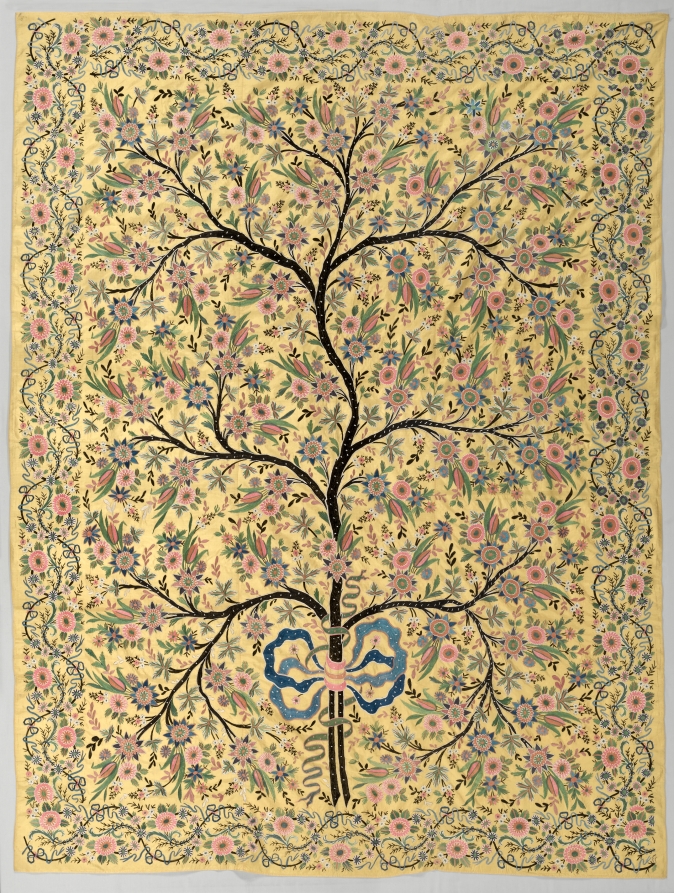
This silk hanging, executed in a richly saturated, deep indigo ground, presents a singular artifact of the imperial weaving tradition. The materiality of the silk is paramount. It is not merely a textile; it is a document of a lost world of artisanal mastery. The weave is a tightly packed, warp-faced satin, a structure that speaks to the highest standards of the imperial workshops. The silk threads themselves, lustrous and unblemished by time, reveal a meticulous degumming process, ensuring a surface that absorbs and reflects light with an almost liquid depth. The weight of the fabric—substantial, yet supple—suggests a fabric intended not for daily use, but for ceremonial display, perhaps within a palace or a temple of significant stature.
The embroidery, executed in a technique known as *kesi* (cut silk) or, more precisely, a refined form of *suzhou* embroidery, is a tour de force. The tree of life motif, a universal symbol of vitality, immortality, and the connection between heaven and earth, is rendered here with a precision that borders on the obsessive. The branches, sinuous and organic, are worked in a gradient of gold and silver threads, their metallic sheen catching the light to mimic the shimmer of leaves in a breeze. The roots, depicted as if plunging into a stylized, rocky base, are embroidered in a deep, almost black silk, creating a stark contrast that anchors the composition. The leaves, each one distinct, are stitched in a variety of greens—from emerald to celadon—using a technique that creates a subtle, three-dimensional effect. The flowers, perhaps peonies or lotuses, are rendered in a palette of pinks and whites, their petals layered with such delicacy that they appear to have been painted rather than stitched.
Context: The Imperial Silk Weaving Legacy
To understand this hanging, one must place it within the broader context of imperial silk weaving, a tradition that reached its zenith during the Ming (1368–1644) and Qing (1644–1912) dynasties. The imperial workshops, particularly those in Suzhou, Nanjing, and Hangzhou, were not merely factories; they were academies of craft, where generations of weavers and embroiderers refined techniques passed down through centuries. The production of such a piece would have been a state-sponsored endeavor, overseen by eunuchs or officials of the Imperial Household Department. Every thread, every stitch, was subject to a rigorous standard of perfection. The tree of life motif, while common across many cultures, held particular significance in Chinese cosmology, where it symbolized the axis mundi, the bridge between the mortal and the divine. Its presence on a silk hanging of this quality suggests a commission for a space of profound spiritual or political importance—perhaps a throne room, an ancestral hall, or a Buddhist temple.
The legacy of this tradition is not merely one of aesthetic achievement. It is a legacy of economic and political power. Silk was a currency of diplomacy, a symbol of status, and a driver of global trade. The Silk Road, which connected China to the Mediterranean, was named for this very fabric. The imperial workshops controlled the secrets of sericulture and weaving with an iron grip, ensuring that the finest silks remained a monopoly of the court. This hanging, therefore, is not just a beautiful object; it is a relic of a system of power that shaped the course of world history. The decline of the imperial system in the early 20th century led to the dissolution of these workshops, and with them, the loss of many of these techniques. Today, the surviving examples, like this hanging, are treasured not only for their beauty but for their role as primary sources for understanding a lost world of craft.
Technical and Artistic Analysis: The Embroidery as a System of Knowledge
The embroidery of the tree of life is not a random arrangement of stitches; it is a systematic application of a complex visual language. The use of gold and silver threads, for instance, is not merely decorative. In Chinese symbolism, gold represents the yang, the masculine, the sun, and the emperor. Silver, by contrast, represents the yin, the feminine, the moon, and the empress. Their interweaving in the branches suggests a harmonious union of opposites, a theme central to Daoist philosophy. The choice of the indigo ground is equally deliberate. Indigo, derived from the *Indigofera* plant, was a color associated with the heavens and with immortality. The deep, almost nocturnal hue creates a backdrop that makes the embroidered elements seem to float, as if suspended in a celestial void.
The stitching technique itself is a testament to the skill of the artisan. The use of long, satin stitches for the trunk and branches creates a smooth, unbroken surface, while shorter, more varied stitches for the leaves and flowers introduce texture and movement. The gold threads are couched—laid on the surface and secured with small, invisible stitches—a technique that allows the metallic threads to catch the light without being distorted by the weave. The overall effect is one of controlled opulence, a balance between the sumptuous and the restrained that is the hallmark of the finest imperial textiles. The hanging is not merely a picture; it is a system of knowledge, encoded in thread, that speaks to the philosophical and spiritual concerns of its creators.
Preservation and Contemporary Relevance
The conservation of such an artifact is a matter of profound importance. Silk is a protein fiber, vulnerable to light, humidity, and pests. The hanging must be stored in a controlled environment, ideally in a dark, climate-controlled vault, mounted on a padded support to prevent stress on the fibers. Any restoration must be undertaken with the utmost care, using reversible techniques and materials that do not compromise the original. The goal is not to make the hanging look new, but to stabilize it, to preserve its integrity as a historical document.
In the context of contemporary fashion and design, this hanging offers a lesson in the power of heritage. The tree of life motif, with its universal resonance, continues to inspire designers from Savile Row to the runways of Paris. The techniques of *kesi* and *suzhou* embroidery, though rare, are not lost. A handful of master artisans in Suzhou still practice these crafts, and their work is increasingly sought after by luxury houses seeking to imbue their collections with a sense of history and authenticity. The hanging, therefore, is not a relic of a dead past, but a living testament to the enduring power of craft. It reminds us that the finest textiles are not merely products; they are stories, woven and stitched into existence by hands that understood the profound connection between material and meaning.
This silk hanging, with its embroidered tree of life, is a masterwork of the imperial weaving tradition. It is a document of a lost world, a system of knowledge, and a source of inspiration. To study it is to engage with the legacy of a civilization that elevated the art of textile production to its highest form. It is, in the truest sense, a heritage artifact of the first order.