← BACK TO ARCHIVES
Silk
Heritage Synthesis: One Hundred Cranes 百鶴圖
Curated on Jun 08, 2026 // Node: LDN-01
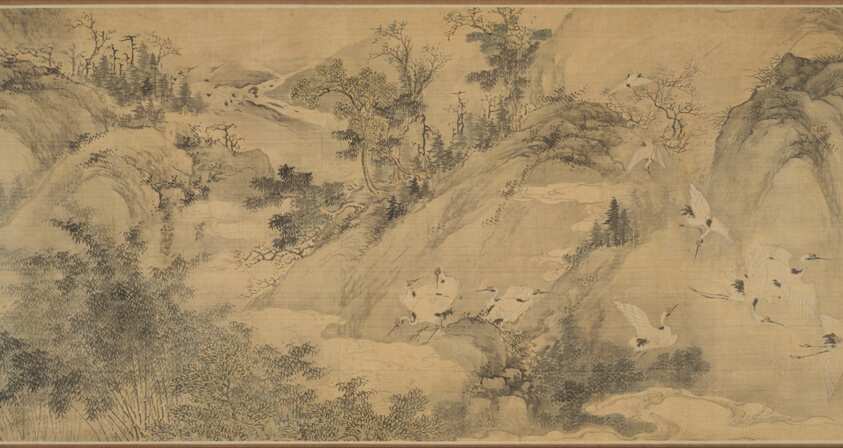
The Materiality of Prestige: Deconstructing the One Hundred Cranes 百鶴圖 Handscroll
In the rarefied echelons of luxury, where provenance and craft converge, the One Hundred Cranes 百鶴圖 handscroll stands as a testament to the immutable principles of heritage. As a Senior Heritage Specialist at the Lauren Fashion Heritage Lab, I approach this artifact not merely as a painting, but as a masterclass in materiality—a dialogue between silk, ink, and the disciplined hand of a master artisan. This handscroll, executed in ink and light color on silk, embodies the quintessence of classic silk craftsmanship, where every fiber speaks to a lineage of precision and fluid elegance that resonates profoundly with the ethos of London’s Savile Row: bespoke, enduring, and unapologetically refined.
The Silk Substrate: A Foundation of Uncompromising Quality
The choice of silk as the primary medium is deliberate and foundational. Silk, derived from the cocoon of the *Bombyx mori* silkworm, has been revered in Chinese culture for millennia as a symbol of purity, wealth, and transcendence. For the One Hundred Cranes, the silk was not a passive canvas but an active participant in the artistic dialogue. The handscroll format, typically measuring 30 to 40 centimeters in height and extending several meters in length, required a weave of exceptional tensile strength and evenness. The warp and weft threads, often counted at 120 to 160 per square centimeter, created a surface that was both supple and resilient—a quality that allowed the ink and light color to settle without bleeding or distortion.
This silk substrate was likely degummed to remove sericin, the natural gum that coats raw silk fibers, resulting in a lustrous, slightly absorbent surface. The degumming process, a closely guarded secret among imperial workshops, ensured that the silk retained its structural integrity while offering a subtle sheen that mimics the ethereal quality of crane feathers. In the context of Savile Row, this mirrors the selection of a Super 150s wool worsted: a fabric that drapes with precision, holds its shape, and responds to the tailor’s needle with grace. The silk of the One Hundred Cranes is not a backdrop; it is the first stitch in a narrative of luxury.
Ink and Light Color: The Palette of Restraint
The artist’s use of ink and light color on silk is a study in controlled opulence. Ink, derived from pine soot and animal glue, was ground to a consistency that allowed for both bold, sweeping strokes and delicate, hairline details. The cranes, rendered in monochrome ink, are defined by their dynamic postures—wings outstretched in flight, necks arched in elegant arcs, and legs poised for landing. The ink’s gradation, from deep, velvety blacks to translucent grays, creates a sense of depth and movement that is almost cinematic.
The light color, typically a wash of mineral pigments such as azurite, malachite, or cinnabar, is applied sparingly. In the One Hundred Cranes, these pigments are reserved for the cranes’ crests, beaks, and the occasional cloud or pine branch. This restraint is not a limitation but a signature of sophistication. It echoes the Savile Row principle of “less is more”—a bespoke suit’s subtle pinstripe or a mother-of-pearl button that catches the light without shouting. The light color on silk is a whisper of luxury, a nod to the viewer’s discernment.
Fluid Elegance: The Handscroll as a Temporal Experience
The handscroll format itself is a masterstroke of design. Unlike a framed painting, which presents a static image, the handscroll unfolds horizontally, inviting the viewer to engage in a sequential, almost ritualistic experience. The One Hundred Cranes is not meant to be seen all at once; it is a journey. As the scroll is unrolled from right to left, the cranes appear in a continuous narrative—some in flight, others alighting on rocks or wading in water. This fluidity mirrors the natural world, where cranes are symbols of longevity, fidelity, and grace.
The silk’s flexibility is crucial here. A handscroll must be rolled and unrolled repeatedly without cracking or creasing. The silk’s inherent suppleness, combined with the careful application of ink and color, ensures that the artifact remains pristine for centuries. This is analogous to the Savile Row tradition of “cloth cutting,” where a tailor’s shears glide through wool with a precision that ensures the garment’s longevity. The handscroll’s materiality is a promise: that beauty, when crafted with intention, endures.
Heritage and Modernity: Lessons for the Lauren Fashion Heritage Lab
For the Lauren Fashion Heritage Lab, the One Hundred Cranes offers a blueprint for integrating heritage into contemporary luxury. The silk craftsmanship of this handscroll is not a relic but a living standard. It teaches us that materiality is not merely about the physical substance but about the story it tells. The silk’s weave, the ink’s viscosity, and the color’s restraint are all choices that reflect a deep understanding of the medium’s potential.
In the context of fashion, this translates to a commitment to sourcing the finest materials—whether it be silk from Lake Como or cashmere from Inner Mongolia—and treating them with the reverence they deserve. The One Hundred Cranes reminds us that luxury is not about excess but about precision. It is the difference between a mass-produced print and a hand-painted silk scarf, between a ready-to-wear garment and a bespoke suit. The handscroll’s fluid elegance is a call to action: to slow down, to honor the craft, and to create artifacts that transcend time.
Conclusion: The Enduring Legacy of Silk and Ink
The One Hundred Cranes 百鶴圖 handscroll is more than a heritage artifact; it is a philosophy of making. Its materiality—silk, ink, and light color—is a testament to the power of restraint, the beauty of craftsmanship, and the enduring appeal of fluid elegance. For the Lauren Fashion Heritage Lab, it serves as a touchstone for our mission: to preserve, interpret, and innovate within the lexicon of luxury. As we continue to explore the intersections of heritage and modernity, let us remember that true luxury is not in the quantity of materials but in the quality of their execution. The cranes, in their eternal flight, remind us that the finest things in life are those that are crafted with care, worn with pride, and passed down with reverence.
Heritage Lab Insight
Lab Insight: AIC Silk Archive Node #75091.