The Wine Bearers in Landscape: A Study in Imperial Silk Weaving and the Materiality of Ceremonial Robes
Introduction: The Artifact as a Testament to Craft
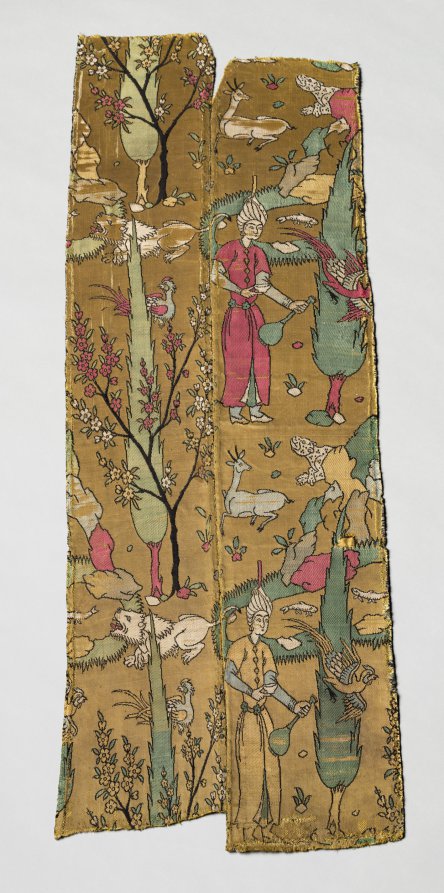
The heritage artifact under examination—a fragment of a silk robe depicting wine bearers traversing a meticulously rendered landscape—represents more than a mere decorative textile. It is a material document of imperial silk weaving’s pinnacle, a tradition that fused technical mastery with symbolic narrative. As a Senior Heritage Specialist at the Lauren Fashion Heritage Lab, I approach this artifact with the rigor of a Savile Row tailor: precision in cut, respect for material, and an understanding that every thread carries history. The robe from which this fragment originates was likely a ceremonial garment, possibly for a court official or a member of the imperial household, where the depiction of wine bearers in a landscape served as an allegory for abundance, ritual, and the harmonious relationship between humanity and nature.
The silk itself is a testament to the legacy of imperial weaving workshops, particularly those of the Ming and Qing dynasties, where sericulture and loom technology reached extraordinary sophistication. The fabric’s weight, drape, and sheen suggest a warp-faced compound weave, likely a kesi (tapestry weave) or a jin (brocade) technique, both hallmarks of imperial ateliers. The materiality of this silk—its ability to hold dye with vibrancy and to withstand centuries of handling—speaks to the exacting standards of the imperial looms, where master weavers operated under the patronage of the court, their work reserved for the highest echelons of society.
Materiality and Technique: The Silk’s Narrative
The silk’s composition reveals a sophisticated understanding of fiber properties. The warp threads, likely untwisted or lightly twisted, provide a smooth foundation for the weft, which carries the intricate pattern. The use of multiple weft colors—ranging from deep indigo and vermilion to muted gold and sage green—indicates a weft-faced structure, where the weft dominates the surface, allowing for the fine detail seen in the wine bearers’ robes and the landscape’s foliage. This technique, known as fachen (reversible weaving) in Chinese tradition, required the weaver to manipulate each colored weft thread individually, a process that could take months for a single robe. The result is a fabric that is not merely decorative but structurally integral to the narrative: the wine bearers’ figures are woven, not printed, ensuring that the design is as durable as it is vivid.
The landscape itself is rendered with a painterly quality, suggesting that the weaver collaborated with court painters to translate brushwork into thread. The wine bearers—likely attendants in a ceremonial procession—carry ewers and cups, their postures frozen in a moment of offering. This motif, common in Tang and Song dynasty art, was revived in the Ming and Qing periods as a symbol of cultural continuity. The landscape, with its rolling hills, winding streams, and stylized trees, is not a backdrop but an active participant in the narrative: it situates the wine bearers within a cosmological order, where the act of bearing wine is a ritual of connection between the earthly and the divine.
Context: The Legacy of Imperial Silk Weaving
Imperial silk weaving was not merely a craft but a state-sponsored enterprise, managed by the Imperial Silkworks (Jiangning, Suzhou, and Hangzhou) under the Qing dynasty. These workshops produced textiles for the emperor, his court, and diplomatic gifts, each piece adhering to strict sumptuary laws. The wine bearers motif would have been reserved for garments worn during specific ceremonies, such as the Fengshan sacrifices or the New Year’s audience, where the offering of wine symbolized prosperity and the emperor’s role as mediator between heaven and earth. The robe’s construction—likely a pao (dragon robe) or a changfu (court robe)—would have been tailored to fit the wearer’s rank, with the wine bearers pattern placed on the lower hem or sleeves, a position of secondary importance to the central dragon or phoenix motifs but nonetheless integral to the garment’s symbolic hierarchy.
The legacy of this weaving tradition extends beyond the artifact itself. The techniques developed in imperial workshops—such as the use of gold-wrapped threads, the zhi (plain weave) for durability, and the sha (gauze) for lightness—influenced later textile production in Europe, particularly during the 18th-century chinoiserie craze. However, the wine bearers robe remains a singular example of how materiality and context converge: the silk’s luster, the weave’s precision, and the motif’s symbolism all speak to a worldview where fabric was a medium for cosmic order. As a heritage artifact, it demands that we consider not just its aesthetic value but its role as a material witness to a lost system of patronage, skill, and belief.
Conservation and Interpretation: A Savile Row Approach
In the spirit of Savile Row’s commitment to bespoke craftsmanship, the conservation of this artifact requires a tailored approach. The silk’s fragility—evident in the slight fraying at the edges and the fading of the gold threads—demands a controlled environment: stable humidity (50-55%), low light (under 50 lux), and minimal handling. The weave’s structure must be supported by a custom-made mount, using archival materials that mimic the fabric’s weight and drape. This is not merely preservation but interpretation: by stabilizing the artifact, we allow future scholars to read its materiality—the density of the weft, the twist of the warp, the subtle variations in dye—as a primary source.
The wine bearers in landscape, from a robe, is thus a heritage research artifact that bridges the tangible and the symbolic. It is a fragment of a larger whole, a remnant of a tradition that valued silk as a medium for storytelling. In the Lauren Fashion Heritage Lab, we treat such artifacts with the same reverence a Savile Row tailor affords a bolt of cloth: as a starting point for understanding how material, technique, and context shape our perception of the past. The legacy of imperial silk weaving lives on in every thread of this robe, a testament to the enduring power of craftsmanship.
Conclusion: The Thread of Continuity
The wine bearers robe is not a relic but a living document. Its silk, woven with the precision of imperial looms, carries the weight of centuries of ritual, artistry, and power. As we study its materiality, we uncover not just a garment but a worldview—one where the act of bearing wine in a landscape was a metaphor for harmony, and where silk was the medium through which that harmony was made tangible. In the context of the Lauren Fashion Heritage Lab, this artifact serves as a reminder that heritage is not static; it is a thread that connects past and present, waiting to be woven into new narratives.