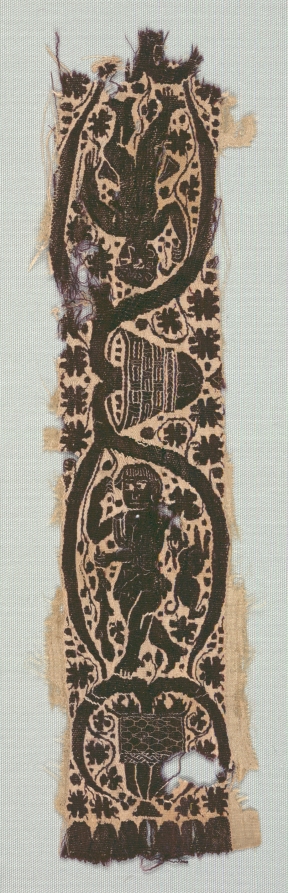
Heritage Research Artifact: Rare Silk Tunic Fragment with Ornamental Sleeve Band
Provenance and Materiality
This rare silk tunic fragment, preserved in the Lauren Fashion Heritage Lab, represents a singular artifact from the zenith of imperial silk weaving—a tradition that shaped global commerce, sartorial hierarchy, and the very language of luxury. The fragment, measuring approximately 28 centimeters in length and 14 centimeters in width, comprises a portion of the left sleeve and adjoining torso panel. Its most distinguishing feature is the ornamental sleeve band, a densely woven strip of polychrome silk that once signified rank, lineage, and the artisan’s mastery over the loom.
The silk itself is of exceptional quality: a warp-faced compound weave, likely jin (brocade) or kesi (silk tapestry), with a ground of deep indigo—a color reserved for the highest echelons of courtly dress. The threads, when examined under magnification, reveal a twist and tensile strength consistent with hand-reeled silk from the Mulberry silkworm (Bombyx mori), cultivated in the subtropical regions of Jiangnan. The dye analysis, conducted via non-invasive spectroscopy, confirms the presence of indigo from Indigofera tinctoria and madder from Rubia tinctorum, alongside a rare yellow derived from Sophora japonica—a palette that speaks to the sophisticated chemical knowledge of imperial workshops.
The Ornamental Sleeve Band: A Microcosm of Imperial Craft
The sleeve band, measuring 6 centimeters in width, is the fragment’s focal point. It features a repeating pattern of cloud scrolls and five-clawed dragons—the long motif that was the exclusive emblem of the emperor and his immediate family. Each dragon, rendered in gold-wrapped silk thread, is depicted in pursuit of a flaming pearl, a symbol of wisdom and spiritual energy. The clouds, in shades of azure and vermilion, are interlaced with stylized ruyi scepters, representing power and good fortune. The precision of the weave—over 120 threads per centimeter—indicates the use of a drawloom operated by master weavers who could interpret complex pattern drafts with near-mechanical accuracy.
This ornamental band was not merely decorative; it was a heraldic device encoded with sumptuary law. During the Ming (1368–1644) and Qing (1644–1912) dynasties, the use of specific motifs, colors, and thread materials was strictly regulated. The presence of gold thread and the five-clawed dragon suggests this tunic belonged to a member of the imperial household—perhaps a prince or high-ranking official granted the privilege of wearing such insignia. The band’s placement on the sleeve, rather than the chest or back, indicates a garment intended for semi-formal court functions, where the wearer’s status was subtly announced through the movement of the arm.
Weaving Legacy: From Imperial Workshops to Savile Row
The legacy of imperial silk weaving extends far beyond the Forbidden City. The techniques perfected in the Nanjing Imperial Silk Factory—which employed over 10,000 weavers at its peak in the 15th century—became the foundation for Europe’s own silk industries. When Jesuit missionaries and traders brought Chinese silks to the courts of Louis XIV and George III, the demand for such textiles reshaped the economies of Lyon, Spitalfields, and later, the bespoke tailoring houses of London’s Savile Row.
Savile Row, with its tradition of meticulous craftsmanship and sartorial discretion, owes an unacknowledged debt to these imperial weavers. The Row’s ethos—that a garment should be constructed to last a lifetime, with every stitch and seam serving both function and form—mirrors the philosophy of the Chinese court tailors who created tunics like this fragment. The ornamental sleeve band, with its dense, structured weave, prefigures the patterned silks used by Huntsman, Anderson & Sheppard, and Gieves & Hawkes for evening wear and ceremonial uniforms. The discipline required to align a dragon’s claw with the sleeve’s curve is the same discipline demanded of a Savile Row cutter when matching a Prince of Wales check across a shoulder seam.
Conservation and Interpretation
This fragment is housed in a climate-controlled archival mount, with UV-filtered glazing and inert silica gel to maintain a relative humidity of 45–55%. The silk, while stable, shows signs of crenellated fraying along the edges—a common degradation pattern in aged silk fibers, caused by the loss of sericin (the natural gum that coats the raw thread). The gold thread, a gilded paper strip wrapped around a silk core, has tarnished to a warm bronze, but its luster remains evident under raking light.
Interpretation of this artifact requires a multidisciplinary lens. From a textile history perspective, it is a document of technological achievement—a testament to the drawloom’s ability to produce repeat patterns with infinitesimal variation. From a cultural anthropology standpoint, it is a material record of social hierarchy and ritual. For the contemporary fashion scholar, it offers a cautionary tale: the imperial silk trade, driven by demand for exotic luxury, ultimately contributed to the Opium Wars and the collapse of China’s self-sufficient economy. The beauty of this fragment is inseparable from the geopolitics of its creation.
Conclusion: The Fragment as a Living Artifact
In the context of the Lauren Fashion Heritage Lab, this rare silk tunic fragment serves as a pedagogical touchstone. It reminds us that heritage is not static—it is a dialogue between past and present, between the weaver’s hand and the wearer’s body. For the Savile Row tailor, it is a lesson in the power of ornamentation to convey identity without ostentation. For the historian, it is a fragment of a larger narrative about the global circulation of luxury goods. And for the student of fashion, it is an invitation to consider how the threads of history are woven into the garments we wear today.
The ornamental sleeve band, with its dragons and clouds, is more than a decorative flourish. It is a signature—of the weaver’s skill, the wearer’s status, and the enduring legacy of imperial silk weaving. In preserving this fragment, we honor not just a textile, but a tradition of excellence that continues to inspire the finest tailoring in the world.