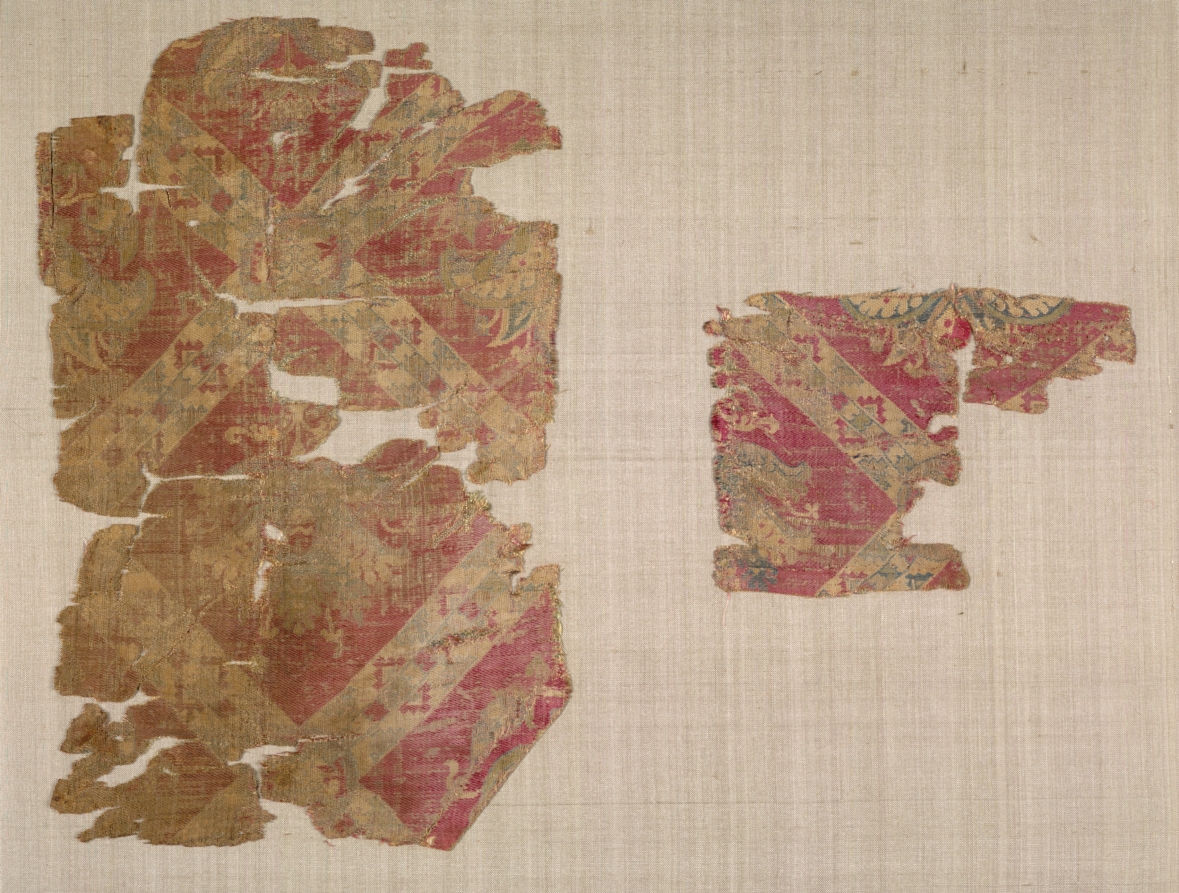
The Enduring Thread: Silk Fragments with Palmette Blossoms as Artefacts of Imperial Legacy
Introduction: A Material Testament to Power
Within the hushed, wood-panelled ateliers of Savile Row, where the cut of a jacket is a matter of honour and the drape of a trouser a declaration of intent, we understand that true luxury is never accidental. It is the product of lineage, of technique passed through generations, and of materials that carry the weight of history. The silk fragments bearing the palmette blossom motif, now housed within the Lauren Fashion Heritage Lab, are not merely remnants of fabric. They are primary documents of a vanished world, a tangible lexicon of imperial ambition, and a profound lesson in the materiality of power. This paper examines these fragments as critical heritage artefacts, decoding their technical mastery, their symbolic language, and their enduring influence on the principles of bespoke craftsmanship that define our own métier.
Materiality and the Imperial Hand: The Silk Itself
The first and most arresting quality of these fragments is their materiality. The silk is not a uniform, lifeless surface. It possesses a substantial hand, a dense, almost granular weight that speaks to a weave of exceptional integrity. This is not the flimsy, mass-produced silk of modern commerce; it is a compound weave, likely a lampas or a samite, where a ground weave supports a pattern weave of bound, floating threads. The result is a fabric of remarkable structural depth. To the touch, it is cool, smooth, yet with a palpable resistance—a textile engineered for endurance, not for a single season, but for centuries. The warp and weft are of a fineness that suggests a cultivated silkworm, fed on the best mulberry leaves, its filament reeled with a precision that borders on the obsessive. This is the silk of imperial workshops, where the raw material was treated as a strategic resource, as precious as gold bullion.
The dyeing is equally telling. The palette is not one of gaudy spectacle but of controlled opulence. The ground is a deep, resonant crimson, a colour derived from the kermes insect or, in later iterations, from cochineal—a pigment so costly it was reserved for the highest echelons of court and clergy. The palmette blossoms themselves are woven in threads of tarnished gold and a faded, yet still potent, sapphire blue. The gold is not a flat metallic foil; it is a gilt strip wrapped around a silk core, a technique that creates a shimmering, three-dimensional effect as the light catches each minute turn. This is a material that demands to be seen in motion, to be observed as it catches the flicker of candlelight in a throne room. It is a fabric that performs power.
The Palmette Blossom: A Symbolic Lexicon of Authority
The motif itself—the palmette blossom—is far from a simple decorative flourish. It is a visual shorthand for imperial dominion, a symbol that traversed cultures and centuries. Originating in ancient Mesopotamia and Egypt, the palmette—a stylized, fan-shaped palm frond or lotus flower—was adopted by the Achaemenid Persians, then by the Hellenistic Greeks, and eventually became a cornerstone of Byzantine and Sassanian art. In the context of these silk fragments, likely woven in the great imperial workshops of the Byzantine Empire or, later, the Islamic Caliphates, the palmette is not a mere botanical representation. It is a hieratic symbol, a formalized emblem of the Tree of Life, of renewal, and of the divine right of the ruler to command the natural world.
Observe the specific arrangement. The blossoms are not scattered randomly; they are organized in strict, repeating registers, often enclosed within medallions or pearl-bordered roundels. This is a geometry of control. The infinite repeat of the pattern speaks to the idea of an eternal, unchanging order—the order of the empire itself. The palmette is often flanked by symmetrical, stylized leaves or confronted by mythical beasts like the semnurv (a dog-bird hybrid) or the griffin. This is not a design for private contemplation; it is a public declaration. To wear such a fabric was to clothe oneself in the very architecture of the state. The symmetry and repetition are not aesthetic choices; they are political statements. They assert that the wearer is a part of a vast, ordered, and unassailable system.
Weaving the Empire: The Legacy of Imperial Silk Workshops
These fragments cannot be understood in isolation. They are the products of a highly organized, state-controlled industry. The imperial silk workshops—the gynaikeia of Byzantium, the tiraz factories of the Islamic world—were not merely places of production; they were instruments of policy. The raw silk was imported from China along the Silk Road, a trade route that was itself a theatre of imperial competition. The weaving techniques, particularly the use of the drawloom, were closely guarded secrets, often protected by law and punishable by death. To possess such a silk was to possess a piece of the empire’s technological and economic might.
The legacy of this system is profound. The technical vocabulary developed in these workshops—the understanding of warp-faced weaves, the manipulation of multiple weft systems, the use of metal threads—became the foundation for the great textile traditions of Europe. The velvet weavers of Lucca, the silk merchants of Lyon, and the brocade makers of Spitalfields all owe a debt to these imperial prototypes. The palmette motif itself would be endlessly reinterpreted, appearing in the Paisley patterns of the 19th century, the Art Deco designs of the 1920s, and even in the jacquard weaves of modern luxury suiting. The thread of influence is unbroken.
Implications for the Modern Atelier: A Lesson in Enduring Craft
For the contemporary practitioner on Savile Row, these fragments offer a vital corrective to the ephemerality of fast fashion. They remind us that true luxury is not about novelty but about permanence. The silk fragment with its palmette blossoms was not designed to be discarded after a season; it was designed to be an heirloom, a testament to the skill of its maker and the status of its wearer. The weight, the hand, the structural integrity of the fabric are not incidental; they are the very essence of its value.
In our own work, we must strive for this same material integrity. The choice of a silk lining for a bespoke jacket, the selection of a wool suiting for a pair of trousers—these are not trivial decisions. They are acts of curation, a continuation of a lineage that stretches back to the imperial workshops. The palmette blossom is a reminder that pattern is not decoration; it is a language. The symmetry and repeat are not just visual devices; they are principles of order and control. To understand these fragments is to understand that the craft of weaving is, at its highest level, a form of architecture—a construction of thread and dye that builds not just a garment, but a world.
Conclusion: The Fragment as a Whole
These silk fragments with palmette blossoms are, in their current state, incomplete. They are torn, faded, and separated from their original context. Yet, paradoxically, they are more powerful as fragments than they could ever be as a whole garment. They force us to read the material, to decode the weave, the dye, the motif. They demand that we imagine the hand that worked the loom, the eye that designed the pattern, and the body that once wore this fabric in a court of immense power. They are a heritage artefact that speaks not of the past as a distant, dead thing, but as a living, breathing influence on the present. For the Lauren Fashion Heritage Lab, and for the tradition of bespoke craftsmanship we represent, these fragments are not a relic to be preserved under glass. They are a masterclass in materiality, a lesson in the enduring power of a well-woven thread. They are, in the truest sense, the fabric of history.