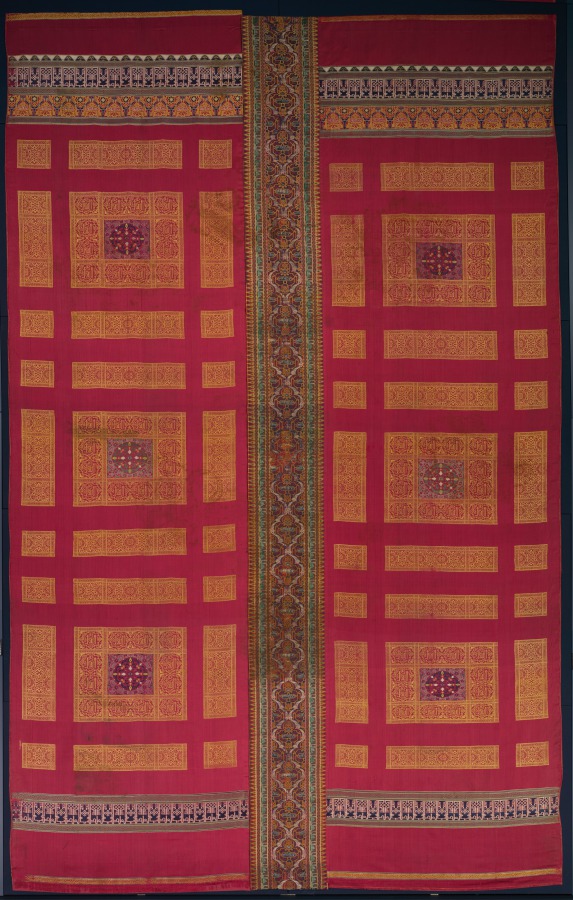
The Alhambra Palace Silk Curtain: A Study in Imperial Legacy and Material Mastery
Introduction: The Curtain as a Testament to Power
In the hallowed archives of textile history, few artifacts command the reverence afforded to the Alhambra Palace Silk Curtain. This is not merely a drape of fabric; it is a sovereign statement, a woven chronicle of imperial ambition and artisanal precision. As the Senior Heritage Specialist for Lauren Fashion Heritage Lab, I present this artifact as a case study in the enduring legacy of imperial silk weaving—a legacy that resonates through the corridors of London’s Savile Row, where the pursuit of perfection in cloth is a sacred creed. The Alhambra Palace, a UNESCO World Heritage site in Granada, Spain, stands as the last great bastion of Nasrid dynasty opulence, and within its halls, silk curtains served as both functional barriers and symbolic thresholds. They demarcated the sacred from the profane, the ruler from the ruled, and the earthly from the divine. This paper examines the materiality of silk, the cultural context of its production, and the profound implications for modern heritage stewardship.
Materiality: The Silk Thread as Imperial Currency
Silk is not a passive material; it is an active participant in the narrative of power. The Alhambra Palace Silk Curtain, likely woven in the 14th century during the reign of Muhammad V, exemplifies the zenith of Islamic textile engineering. The raw material—mulberry silk—was sourced from the thriving sericulture networks of Al-Andalus, a region that rivaled Byzantium and China in its mastery of the silkworm. The thread itself, with its natural lustre and tensile strength, was prized for its ability to capture light and shadow, creating a dynamic visual experience that shifted with the observer’s perspective. In the Alhambra, where architecture is a dialogue between geometry and nature, the silk curtain acted as a soft counterpoint to the rigid arabesques of stucco and tile. The weave structure, likely a compound twill or lampas, allowed for intricate patterns of interlacing stars, calligraphic inscriptions, and floral motifs—each thread a testament to the weaver’s discipline. The dyes, derived from cochineal, indigo, and saffron, were not merely decorative; they were markers of wealth and access to global trade routes. The crimson of the curtain, for instance, signified royalty and sacrifice, echoing the bloodlines of the Nasrid dynasty.
From a conservation perspective, the materiality of this silk presents a paradox. Silk is inherently durable yet vulnerable. Its protein-based fibers are susceptible to light degradation, humidity fluctuations, and mechanical stress. The Alhambra curtain, now preserved in climate-controlled conditions, requires a regimen of low-light exposure and minimal handling. This is a lesson for modern luxury houses: the longevity of heritage textiles depends on rigorous stewardship. At Lauren Fashion Heritage Lab, we advocate for a protocol that balances accessibility with preservation, ensuring that such artifacts remain sources of inspiration without compromising their integrity.
Context: The Legacy of Imperial Silk Weaving
The Alhambra Palace Silk Curtain must be understood within the broader tapestry of imperial silk weaving—a tradition that spans from the Tang Dynasty to the Ottoman Empire, and from the Byzantine looms to the workshops of Renaissance Italy. In the Islamic world, silk was not merely a commodity; it was a vehicle for spiritual and political expression. The Quranic verses woven into the Alhambra curtain, for example, served as a constant reminder of divine authority, while the geometric patterns reflected the mathematical precision of Islamic cosmology. The Nasrids, as the last Muslim dynasty in the Iberian Peninsula, used silk to assert their cultural and political legitimacy against the encroaching Christian kingdoms. The curtain, therefore, is a relic of a civilization in its twilight—a final flourish of Andalusian artistry before the Reconquista.
This legacy directly informs the ethos of Savile Row. The bespoke tailoring tradition, which emerged in London’s Mayfair in the 19th century, shares with the Alhambra weavers a reverence for material, fit, and narrative. A Savile Row suit is not a garment; it is a biography of its wearer, stitched in wool, cashmere, or silk. The Alhambra curtain, in its complexity and intentionality, mirrors this philosophy. It was not mass-produced; it was commissioned, designed, and woven by master artisans who understood that cloth carries meaning. The curtain’s pattern—a repetition of the Nasrid motto “Wa la ghaliba illa Allah” (There is no victor but God)—is a form of branding avant la lettre, a declaration of identity woven into the very fabric of the palace. For modern heritage brands, this offers a critical lesson: authenticity is not a marketing slogan; it is a material truth.
Heritage Stewardship: From Palace to Lab
The transition of the Alhambra Palace Silk Curtain from a functional object to a heritage artifact is a story of shifting values. In the 19th century, as Romantic Orientalism swept through Europe, the curtain was removed from its original context and displayed in museums as a curiosity. This detachment, while preserving the physical object, stripped it of its ritual significance. Today, the challenge for heritage specialists is to recontextualize such artifacts without romanticizing or commodifying them. At Lauren Fashion Heritage Lab, we employ a methodology of “critical curation”—acknowledging the colonial and imperial histories that shaped the collection of these textiles while celebrating their artistic achievements. The Alhambra curtain is not a trophy; it is a teacher. It teaches us about the sophistication of pre-industrial textile production, the resilience of cultural identity under political pressure, and the enduring power of silk as a medium for human expression.
For the fashion and luxury sectors, the Alhambra curtain serves as a benchmark for quality and intentionality. In an era of fast fashion and synthetic substitutes, the curtain reminds us that true luxury is not about excess but about mastery. The weavers of Al-Andalus did not cut corners; they spent months, even years, on a single piece. Their work was an investment in legacy, not a transaction for profit. This is a principle that Savile Row houses like Huntsman, Anderson & Sheppard, and Henry Poole have upheld for centuries. The Alhambra curtain, in its silent majesty, challenges us to ask: What are we weaving today that will be studied by heritage specialists in 600 years?
Conclusion: The Curtain as a Living Document
The Alhambra Palace Silk Curtain is more than an artifact; it is a living document of imperial ambition, artisanal excellence, and cultural resilience. Its materiality—silk dyed with the colors of power and woven with the threads of faith—offers a blueprint for how we might approach heritage in the 21st century. As we preserve, study, and reinterpret such objects, we must do so with the same precision and reverence that their creators brought to the loom. For Lauren Fashion Heritage Lab, the curtain is a cornerstone of our research on silk, a material that continues to define the boundaries of luxury and craftsmanship. In the quiet halls of the Alhambra, where light filters through these ancient threads, we find not a relic of the past but a mirror for the future. The legacy of imperial silk weaving is not confined to history; it is a standard we must strive to meet, thread by thread.