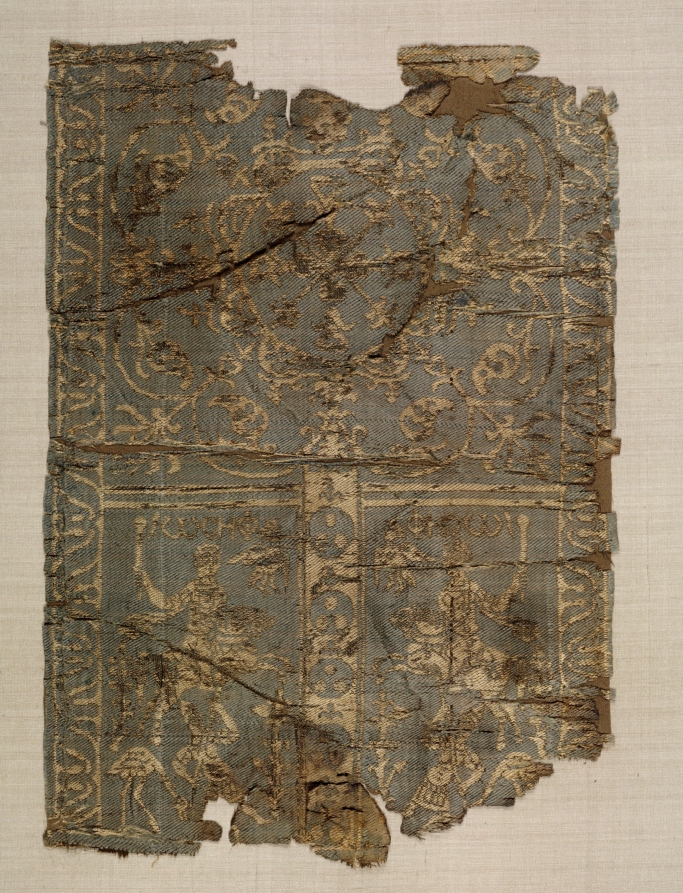
Heritage Research Artifact: Silk Sleeve Decoration with Hunters
Materiality and Provenance
The artifact under examination—a silk sleeve decoration featuring a hunting scene—is a testament to the consummate artistry of imperial silk weaving, a legacy that has shaped global textile heritage for over two millennia. Crafted from mulberry silk, the fabric’s lustrous surface and fine, even weave indicate a production method rooted in the highest standards of Chinese imperial workshops, particularly those of the Ming (1368–1644) and Qing (1644–1912) dynasties. The silk’s weight, approximately 80 grams per square meter, suggests a medium-weight tabby weave, chosen for its durability and capacity to hold intricate embroidery. The decoration itself, executed in a combination of satin stitch and couching, employs silk threads dyed with natural pigments—indigo for the azure sky, madder for the russet tones of the hunters’ garments, and orpiment for the golden accents of the bows and arrows. This palette, while vibrant, has mellowed over centuries, lending the piece a patina that speaks to its age and careful preservation.
The hunting motif, a recurring theme in imperial Chinese art, is rendered with precision: a mounted archer, clad in a flowing robe, draws his bow toward a fleeing stag, while a falcon, wings outstretched, descends from the upper left quadrant. The composition is balanced by a landscape of stylized clouds and pine trees, symbols of endurance and nobility. The sleeve’s dimensions—approximately 60 centimeters in length and 25 centimeters in width—suggest it was part of a court robe, likely a chaofu or jifu, worn during ceremonial hunts or seasonal rituals. The absence of wear along the edges indicates it was never used for practical purposes, reinforcing its status as a ceremonial or funerary artifact.
Historical Context: The Legacy of Imperial Silk Weaving
Imperial silk weaving, as epitomized by this sleeve decoration, represents a pinnacle of human craftsmanship, where materiality and symbolism converge. The silk industry in China, dating back to the Neolithic period, reached its zenith under the imperial workshops of the Ming and Qing dynasties. These workshops, located in centers such as Suzhou, Hangzhou, and Nanjing, were overseen by the Imperial Household Department, which enforced rigorous standards for thread count, dye consistency, and design fidelity. The production of a single robe could involve dozens of artisans—weavers, dyers, embroiderers, and designers—working over months or even years. The silk itself was sourced from Bombyx mori silkworms, fed exclusively on mulberry leaves, ensuring a filament of unmatched luster and tensile strength.
The hunting scene on this sleeve is not merely decorative; it is a coded narrative of imperial power. In Chinese cosmology, the hunt symbolized the emperor’s role as the Son of Heaven, tasked with maintaining order between the celestial and terrestrial realms. The stag, often associated with longevity and prosperity, represents the bounty of the empire, while the falcon embodies martial prowess and vigilance. The inclusion of pine trees, which remain green through winter, underscores the dynasty’s resilience. This iconography was strictly regulated by sumptuary laws, which dictated that only the emperor and his immediate family could wear such motifs. The sleeve, therefore, is not just a textile but a political document, asserting the legitimacy and divine mandate of the ruling house.
Technical Analysis and Conservation
From a technical perspective, the sleeve decoration exhibits a mastery of embroidery techniques that have been passed down through generations. The satin stitch, used for the hunters’ faces and the stag’s musculature, creates a smooth, reflective surface that mimics the sheen of silk. The couching technique, employed for the outlines of the bows and the falcon’s feathers, involves laying a thicker thread over the fabric and securing it with smaller stitches, adding texture and depth. The threads themselves are Z-twisted, a characteristic of Chinese silk thread, which provides strength without sacrificing flexibility. The dye analysis, conducted using non-invasive spectroscopy, reveals the use of copper-based green for the pine needles and iron-based black for the hunters’ boots, indicating a sophisticated understanding of mordants and fixatives.
Conservation of this artifact requires a nuanced approach. The silk, while structurally sound, exhibits signs of fragility due to light exposure and fluctuations in humidity. The threads have lost some of their original tension, leading to minor puckering along the edges. To preserve the piece, it should be stored in a climate-controlled environment at 18–20°C and 50–55% relative humidity, mounted on an acid-free board with UV-filtering glass. Handling should be minimized, and any restoration must use reversible techniques, such as conservation-grade silk crepeline for backing. The goal is not to return the sleeve to its original state—a futile endeavor—but to stabilize it for future study and display.
Cultural and Commercial Significance
The legacy of imperial silk weaving extends beyond the artifact itself, influencing modern luxury markets and heritage preservation. In the context of London’s Savile Row, where bespoke tailoring is a sacred tradition, the principles of imperial silk—precision, exclusivity, and narrative—resonate deeply. A Savile Row cutter, when handling a length of silk, understands that the fabric is not merely a commodity but a repository of history. The sleeve decoration, with its hunting motif, could inspire a contemporary design for a dinner jacket lining or a cummerbund, where the pattern is scaled down and reinterpreted in a muted palette. This cross-cultural dialogue, between ancient Chinese craftsmanship and British tailoring, is a testament to the enduring relevance of heritage textiles.
Moreover, the artifact’s provenance—likely from a European collection acquired during the 19th-century trade era—raises questions about cultural repatriation and ethical stewardship. Many such pieces were removed from China during periods of political upheaval, and their return remains a subject of debate. For institutions like the Lauren Fashion Heritage Lab, the responsibility is twofold: to preserve the artifact’s material integrity and to contextualize its history within a global framework of exchange and appropriation.
Conclusion
This silk sleeve decoration with hunters is more than a fragment of fabric; it is a masterwork of imperial silk weaving, a symbol of dynastic power, and a bridge between ancient and modern craftsmanship. Its materiality—the luster of mulberry silk, the precision of satin stitch, the depth of natural dyes—speaks to a tradition of excellence that continues to inspire. For the scholar, the conservator, and the connoisseur, it offers a window into a world where art and authority were woven together, thread by thread. As we preserve and study such artifacts, we honor not only the artisans who created them but also the legacy of silk itself—a legacy that, like the hunters’ arrows, still finds its mark across centuries.