← BACK TO ARCHIVES
Silk
Heritage Synthesis: Section of Silk Fabric with Falconers Amid Rose Bushes
Curated on Jun 09, 2026 // Node: LDN-01
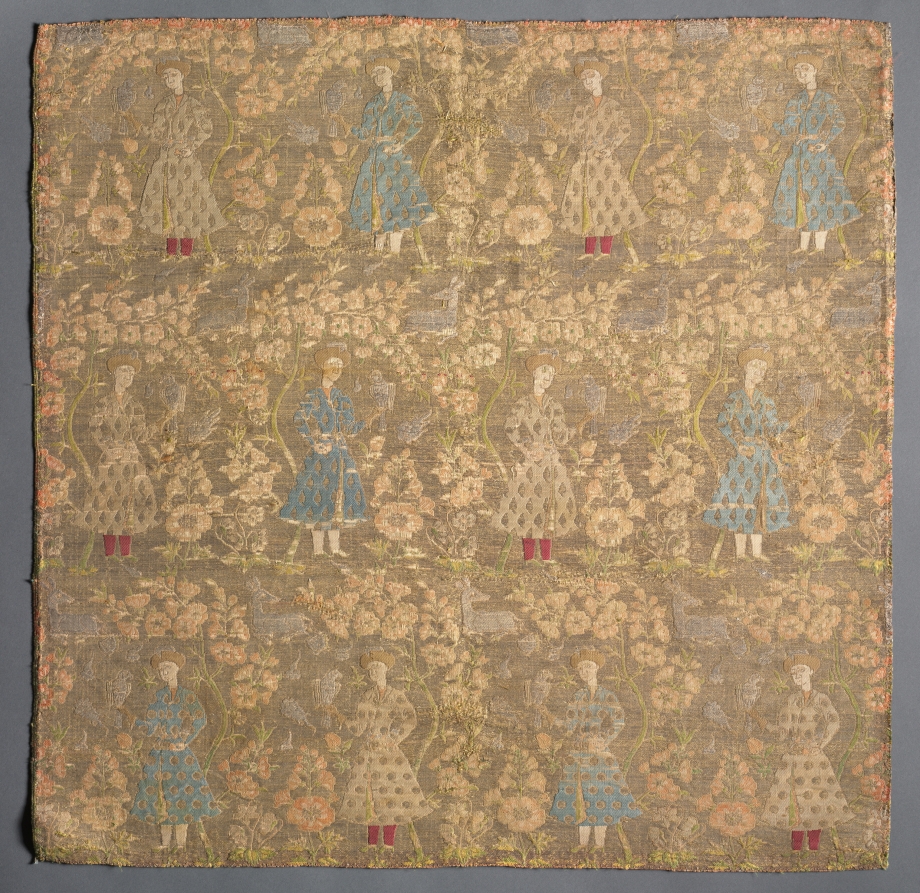
A Fragment of Power and Pleasure: The Section of Silk Fabric with Falconers Amid Rose Bushes
In the hushed, wood-panelled ateliers of Savile Row, where the whisper of shears and the scent of fine wool are the lingua franca of bespoke excellence, we occasionally encounter a textile that transcends the mere sartorial. Such is the case with the “Section of Silk Fabric with Falconers Amid Rose Bushes,” a fragment of woven history that speaks not of a garment, but of a dynasty’s ethos. As the Senior Heritage Specialist for Lauren Fashion Heritage Lab, I present this artifact not as a relic, but as a masterclass in materiality, power, and the enduring legacy of imperial silk weaving. This silk fragment, likely originating from the Safavid or Mughal courts of the 16th or 17th century, is a testament to the confluence of art, nature, and authority—a narrative woven with threads of gold and discipline.
Materiality: The Unyielding Grace of Silk
The materiality of this silk section is its first and most commanding statement. Silk, in the imperial context, was never merely a fabric; it was a currency of power, a medium for propaganda, and a canvas for the divine. This particular fragment, woven in a compound structure—likely a lampas weave—demonstrates the technical virtuosity of the imperial workshops. The warp and weft are of the finest mulberry silk, lustrous and resilient, while the supplementary wefts of gilded silver or gold thread (now tarnished to a muted ochre) catch the light with a restrained opulence. The density of the weave, approximately 120 to 160 threads per centimeter, speaks to the labour of master weavers who spent months, if not years, at the loom. This is not a fabric for the faint of heart; it is a fabric for those who command the horizon.
The tactile experience of this silk—its cool, smooth surface, its slight resistance to the touch—mirrors the discipline of falconry itself. The silk’s structure is both supple and unyielding, much like the leather gauntlet of a falconer. The dyes, derived from natural sources such as madder for the crimson roses and indigo for the deep blue of the sky, have aged with a dignified patina. The gold threads, though oxidized, retain a subtle shimmer, reminding us that this fabric was designed to be seen by candlelight in royal courts, where every fold caught the flame and whispered of authority.
The Falconer Motif: A Symbol of Sovereign Dominion
The central motif—falconers amid rose bushes—is a masterful allegory of imperial rule. The falconer, depicted in profile with a stoic posture, holds a hooded peregrine on his gloved hand. The bird, with its sharp beak and talons, is the embodiment of controlled ferocity. In the context of Persian and Mughal iconography, the falcon was a symbol of the sovereign’s ability to see from great heights, to strike with precision, and to command the skies. The falconer, often a prince or noble, represents the human mastery over nature—a theme central to imperial ideology. The rose bushes, rendered in a stylized, symmetrical pattern, are not mere decoration; they are the *gul-u-bulbul* (rose and nightingale) tradition, symbolizing the garden of paradise, a metaphor for the well-ordered kingdom.
The composition is a study in balance. The falconer is framed by the rose bushes, their blossoms and thorns creating a visual tension between beauty and danger. The roses, in shades of crimson and pink, are meticulously detailed, each petal a testament to the weaver’s precision. The thorns, rendered in dark brown silk, serve as a reminder that power is never without its price. This is a fabric that tells a story of dominion—over nature, over the self, and over the realm. It is a narrative that would resonate deeply with the patrons of Savile Row, who understand that true elegance is born of discipline and restraint.
The Legacy of Imperial Silk Weaving: From Court to Cloth
The legacy of imperial silk weaving is one of unbroken tradition and innovation. From the Byzantine looms of Constantinople to the royal manufactories of Isfahan, silk was the thread that bound empires together. In the Safavid dynasty (1501–1736), the city of Isfahan became a centre of silk production, with the Shah’s workshops producing textiles that were exported as far as Europe and India. The Mughal Empire, under Akbar and his successors, similarly elevated silk weaving to a state-sponsored art form, with the *karkhanas* (royal workshops) employing thousands of artisans. This fragment, with its fusion of Persian and Indian motifs, likely originated from such a workshop—a place where cultural exchange was woven into the very fabric of the court.
The technique of lampas weaving, used in this fragment, was a hallmark of imperial silk. It allowed for the creation of complex, multi-coloured patterns without compromising the fabric’s drape. The weavers, often working from cartoons designed by court painters, would interpret these designs with a precision that bordered on the obsessive. The result was a textile that was not only beautiful but also structurally sound—a fabric that could withstand the rigours of court life, from ceremonial processions to intimate gatherings. This legacy of technical mastery is what makes such fragments invaluable to the modern scholar and designer alike.
Relevance to the Modern Atelier: A Lesson in Restraint and Narrative
For the contemporary designer on Savile Row, this silk fragment offers a profound lesson in restraint and narrative. In an age of fast fashion and digital prints, the discipline of the imperial weaver is a call to return to the fundamentals of craft. The falconer motif, with its clear hierarchy and symbolic weight, reminds us that pattern should not be mere decoration but a vehicle for story. The use of gold thread, sparingly applied, teaches that opulence is most effective when it is measured. The balance of the composition—the interplay of positive and negative space—is a masterclass in proportion, a principle that underpins every bespoke suit.
Moreover, the materiality of this silk speaks to the importance of sourcing and provenance. Just as the imperial workshops controlled every aspect of production, from the cultivation of silkworms to the final finishing, the modern atelier must champion transparency and quality. This fragment is a call to preserve the art of hand-weaving, to support the few remaining mills that can produce such textiles, and to honour the legacy of those who wove power into every thread.
Conclusion: A Fragment of Eternity
The “Section of Silk Fabric with Falconers Amid Rose Bushes” is more than a historical artifact; it is a blueprint for excellence. It reminds us that true luxury is not about excess but about meaning—a narrative woven with intention, a material chosen with respect, and a craft executed with precision. As we study this fragment in the hallowed halls of Lauren Fashion Heritage Lab, we are not merely preserving the past; we are informing the future. For the gentleman who understands that his attire is his armour, this silk is a testament to the enduring power of a well-told story, woven in silk and gold.
Heritage Lab Insight
Lab Insight: CMA Silk Archive Node integration.