The Materiality of Influence: Silk, Gold, and the High-Ranking Courtesan as Artifact
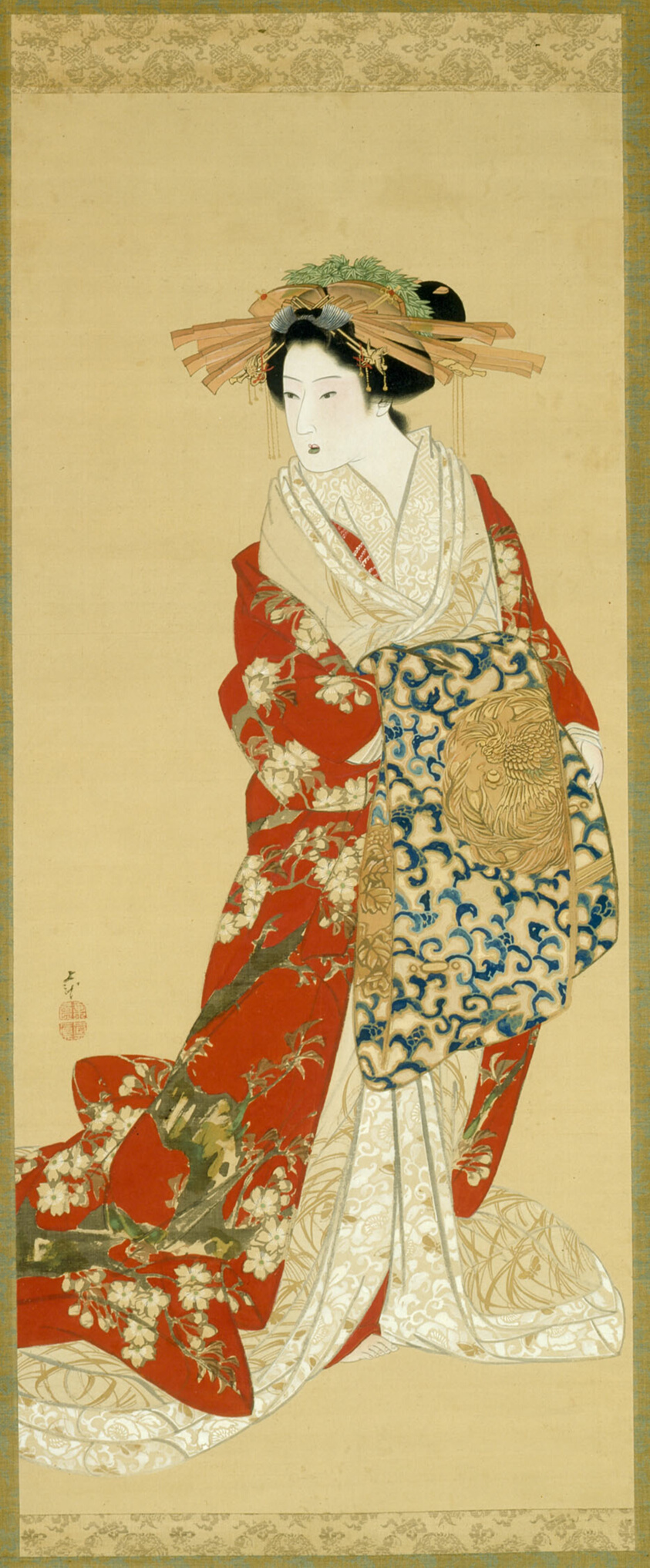
In the rarefied atmosphere of London’s Savile Row, where the cut of a lapel is a language and the weight of a cloth speaks of lineage, we understand that true luxury is never accidental. It is a deliberate architecture of thread, texture, and time. When we turn our gaze to the heritage artifact before us—an ink, color, and gold composition on silk, depicting a high-ranking courtesan—we are not merely examining a painting. We are dissecting a system of power, patronage, and performative elegance. This artifact, rendered on the most demanding of substrates, is a testament to the courtesan’s role as a living, breathing masterpiece of material culture. The silk itself is not a passive canvas; it is an active participant in the narrative of status, sensuality, and exquisite restraint.
The Silk Substrate: A Foundation of Prestige
Silk has long been the textile of empire and intimacy. In the context of this artifact, its selection is a declaration. Unlike paper or wood, silk possesses a luminosity that shifts with light, a tactile memory that retains the pressure of a brushstroke. The high-ranking courtesan, a figure who navigated the treacherous waters of elite society, understood this. Her world was one of controlled revelation—a glimpse of ankle, a whisper of fabric, a scent that lingered. The silk support for this artwork mirrors her own attire: it is fluid, precious, and demanding of a master’s hand. The artisan who applied ink and gold to this silk faced a challenge akin to a tailor working with a recalcitrant cashmere—every mark is permanent, every error unforgiving. The success of this piece lies in the harmony between the medium’s inherent fragility and the subject’s commanding presence.
Ink and Color: The Palette of Persuasion
The application of ink and color on silk requires a discipline that borders on the spiritual. The pigments, often derived from minerals and plants, are suspended in a binder that must flow with the warp and weft of the fabric. In this artifact, the courtesan is rendered in hues that are both bold and subtle. The deep indigo of her outer robe suggests authority, a color reserved for those who could afford the rarest dyes. The carmine accents—perhaps from cochineal or cinnabar—speak of passion and danger, a reminder that her beauty was a commodity traded in the highest echelons. The ink lines are not merely outlines; they are the bones of the composition, defining the drape of her sleeve, the tilt of her chin, the curve of her hand as it holds a fan or a cup of tea. This is not a static portrait. The fluidity of the silk allows the colors to breathe, creating a sense of movement that mirrors the courtesan’s own choreographed gestures. She is caught in a moment of poised stillness, yet the silk suggests she is about to turn, to speak, to enchant.
Gold: The Gilding of Social Currency
Gold on silk is not a mere embellishment; it is a strategic investment. In this artifact, gold leaf or powdered gold is applied to highlight the courtesan’s hair ornaments, the embroidery on her robe, and the edges of her accessories. The gold catches the light, drawing the eye to the points of maximum social significance. A hairpin of gold signifies not just wealth but the patronage of a powerful man. The glint on her sleeve suggests the presence of a hidden poem or a lover’s token. In the context of Savile Row, we understand that gold thread in a bespoke suit is never arbitrary—it is a signature of the house, a mark of the client’s standing. Similarly, the gold on this silk is a signature of the courtesan’s standing. She is not a common pleasure-seeker; she is a connoisseur of luxury, a woman whose very existence is financed by the desire for the unattainable. The gold does not overwhelm the composition; it punctuates it, much like a perfectly placed pocket square or a pair of cufflinks in a tailored ensemble.
Classic Silk Craftsmanship: The Unseen Hand
The creation of this artifact required the collaboration of multiple artisans: the silk weaver, the pigment grinder, the brush maker, and the painter. This echoes the ecosystem of Savile Row, where a single suit passes through the hands of a cutter, a finisher, a buttonhole specialist, and a presser. The silk itself would have been woven on a loom that could produce a fabric of uniform tension, capable of absorbing the ink without bleeding. The craftsmanship is invisible in its perfection—the viewer sees only the courtesan, not the hours of labor that preceded her image. This is the hallmark of true heritage: the erasure of effort in the face of elegance. The courtesan, as a subject, embodies this paradox. Her beauty is naturalized, yet it is the product of rigorous grooming, costly cosmetics, and the strategic deployment of silk and gold. She is a crafted artifact, just as the painting is a crafted artifact. The two mirror each other, each a testament to the power of materiality to shape perception.
Fluid Elegance: The Courtesan as Moving Masterpiece
The term fluid elegance is not a casual descriptor. It is a technical and aesthetic principle. In this artifact, the courtesan’s posture is one of controlled asymmetry—a slight tilt of the head, a hand resting lightly on a lacquered table. The silk, with its natural drape, amplifies this fluidity. The folds of her robe are not rigid; they cascade like water over stone. The ink lines that define her silhouette are thin and responsive, suggesting that she could step out of the frame at any moment. This is the essence of the courtesan’s power: she is never fully captured. She is always in motion, always negotiating the space between desire and distance. For the modern observer, particularly one versed in the language of bespoke tailoring, this fluidity is a lesson in the art of presence. A well-cut suit does not constrain the body; it moves with it, enhancing the wearer’s natural grace. The courtesan on silk is the same—she is not imprisoned by her finery; she is liberated by it.
Conclusion: The Legacy of the Artifact
This heritage research artifact, with its ink, color, and gold on silk, is more than a historical curiosity. It is a manual for understanding the intersection of materiality and identity. The high-ranking courtesan, through the lens of silk craftsmanship, emerges as a figure of immense agency. She selected her fabrics, her pigments, her patrons. She understood that silk could be a weapon, gold a shield, and ink a declaration. For those of us who study heritage in the context of luxury, this artifact reminds us that the finest creations are those that tell a story without speaking. The silk holds the memory of the brush, the gold catches the light of a thousand candles, and the courtesan’s gaze—captured in fluid ink—continues to command attention across centuries. In the world of Savile Row, we call this timelessness. In the world of the courtesan, it was simply survival, rendered in the most exquisite materials available.