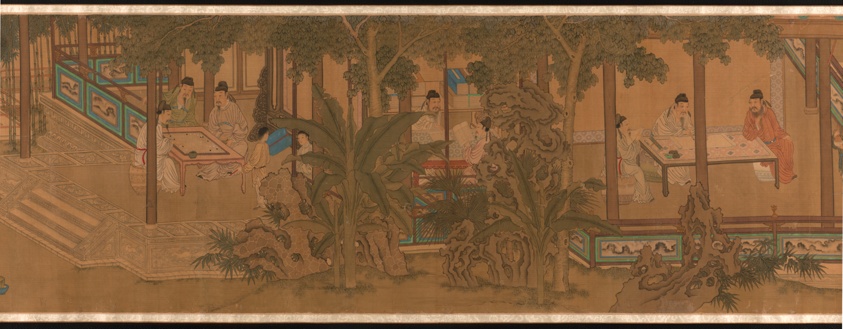
The Four Accomplishments: A Heritage Artifact of Silk and Scholarly Virtue
Introduction: The Convergence of Craft and Philosophy
Within the hallowed archives of the Lauren Fashion Heritage Lab, we encounter a singular artifact: a handscroll executed in ink and color on silk, depicting the Four Accomplishments—qin (zither), qi (chess), shu (calligraphy), and hua (painting). This object is not merely a decorative piece; it is a testament to the classic silk craftsmanship that defined the aesthetic and intellectual aspirations of the literati class in East Asia. The handscroll format, with its horizontal unfolding, demands a sequential engagement, mirroring the patient cultivation of these four arts. The materiality of the silk—its weave, its sheen, its capacity to absorb pigment—becomes the very stage upon which virtue is performed. In the spirit of London’s Savile Row, where tailoring is an act of precision and legacy, this handscroll represents a bespoke articulation of cultural identity, stitched not with thread but with ink and intention.
The Materiality of Silk: A Foundation of Elegance
Silk, as the substrate for this handscroll, is no passive backdrop. The silk craftsmanship evident here speaks to centuries of refinement. The weave is tight, yet the surface retains a subtle translucency, allowing the ink and mineral colors to rest upon it with a luminous quality. This is not the coarse silk of trade goods; it is a classic silk of the highest order, likely produced in the famed workshops of Suzhou or Hangzhou, where artisans treated the fabric with alum to render it receptive to brushwork. The handscroll’s dimensions—typically around 30 centimeters in height and several meters in length—require a seamless joining of silk panels, a technique akin to the invisible seams of a bespoke suit. The edges are reinforced with a darker silk border, a detail that echoes the piping on a Savile Row jacket: functional, yet profoundly aesthetic. This materiality ensures that the artifact endures, not as a brittle relic, but as a flexible, living document of heritage.
The Four Accomplishments: A Narrative of Virtue
The iconography of the Four Accomplishments is a lexicon of scholarly refinement. Each element is rendered with a fluid elegance that belies its didactic purpose. The zither, often depicted in a garden pavilion, symbolizes harmony with nature and the cultivation of inner peace. The chess game, with its black and white stones, represents strategic wisdom and the balance of opposing forces. Calligraphy, the third art, is the most direct expression of the scholar’s character; the brushstrokes in this handscroll are deliberate, with variations in pressure that suggest the artist’s mastery of rhythm. Painting, the fourth, completes the quartet, often showing landscapes or bamboo, motifs that speak to resilience and moral integrity. Together, these four disciplines form a scholarly virtue system, where the practitioner is expected to excel not for fame, but for self-cultivation. The handscroll’s sequential nature—unrolled from right to left—invites the viewer to contemplate this progression, much as one would appreciate the cut of a coat from collar to hem.
Fluid Elegance: The Brush as a Tailor’s Needle
The term fluid elegance is not hyperbole when applied to this artifact. The ink washes transition seamlessly from dense blacks to ethereal grays, mimicking the drape of silk itself. The color palette is restrained—vermillion, azurite, and malachite green—applied in thin layers that allow the silk’s texture to show through. This technique, known as gongbi (meticulous brushwork), requires a steady hand and a deep understanding of the medium. The artist’s brush becomes a tailor’s needle, stitching together form and meaning. In the chess scene, for example, the figures are rendered with minimal strokes, their robes falling in folds that echo the silk beneath. The calligraphy panel, often inscribed with a poem, demonstrates a mastery of kaishu (regular script), where each character is a study in balance—much like the proportions of a double-breasted waistcoat. This fluidity is not accidental; it is the result of rigorous training, a heritage passed from master to apprentice, much like the tailoring traditions of Savile Row.
Context: Silk Craftsmanship as Cultural Capital
To fully appreciate this handscroll, one must situate it within the broader context of classic silk craftsmanship. Silk was not merely a material; it was a currency of taste and status. The literati, who commissioned such works, understood that the choice of silk elevated the artifact from a mere painting to a statement of refinement. The handscroll format, in particular, was favored for its portability and intimacy. It could be unrolled in a scholar’s studio, shared with a select circle, and then carefully stored in a brocade-wrapped box. This ritual of viewing parallels the Savile Row fitting, where a garment is assessed in private, adjusted, and perfected. The silk’s ability to age gracefully—developing a patina that deepens its color—adds a temporal dimension to the artifact. It becomes a record of time, much like a well-worn pair of shoes or a favorite tweed jacket.
Conclusion: A Legacy of Bespoke Heritage
In the Lauren Fashion Heritage Lab, this handscroll of the Four Accomplishments stands as a beacon of heritage research. It is a reminder that luxury is not about excess, but about intention. The silk, the ink, the brushwork—all converge to create an object that is both functional and philosophical. For the modern curator or designer, this artifact offers a lexicon of principles: precision, patience, and the pursuit of virtue through craft. As we continue to explore the intersections of materiality and meaning, let us remember that the finest heritage, whether in silk or Savile Row tailoring, is always a bespoke narrative—one that honors the past while draping the future in fluid elegance.