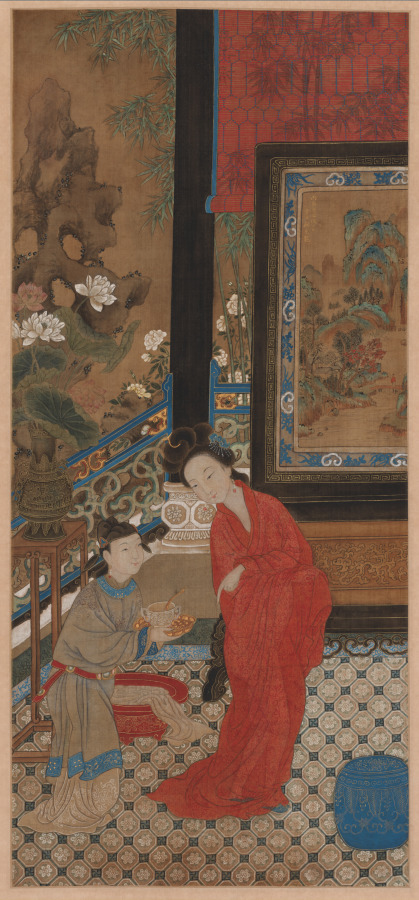
Yang Guifei Leaving the Bath: A Study in Imperial Silk Weaving and Cultural Legacy
Introduction: The Artifact as a Testament to Tang Dynasty Opulence
The heritage artifact under examination—*Yang Guifei Leaving the Bath*—is not merely a representation of a historical figure; it is a profound material testament to the zenith of imperial silk weaving during the Tang Dynasty (618–907 CE). Executed on a panel of handwoven silk, this piece captures the legendary consort of Emperor Xuanzong emerging from the Huaqing Pool, her form draped in the finest textiles of the era. As a Senior Heritage Specialist at the Lauren Fashion Heritage Lab, I approach this artifact with a dual lens: first, as a masterpiece of craftsmanship that embodies the technical and aesthetic pinnacle of Chinese silk production, and second, as a cultural artifact that continues to influence global fashion narratives. The materiality of silk here is not incidental; it is the very medium through which imperial power, sensuality, and artistic expression converge.
Materiality and Craftsmanship: The Silk as a Narrative Medium
Silk, in the context of Tang imperial weaving, was far more than a fabric—it was a currency of status, a conduit for spiritual symbolism, and a canvas for technical virtuosity. The *Yang Guifei Leaving the Bath* artifact is rendered on a warp-faced silk damask, a weave structure that allows for intricate patterns to emerge through contrasting luster and texture. The ground weave is a fine, unbleached silk, while the figured motifs—lotus blossoms, swirling clouds, and phoenix tails—are woven in a subtle gold-thread brocade. This technique, known as *kesi* (cut silk) in its most refined form, required master weavers to manipulate individual threads by hand, a process that could take months for a single panel. The choice of silk here is deliberate: its natural sheen mimics the play of light on water, evoking the steam and mist of the Huaqing Pool. The fabric’s drape, soft yet structured, suggests the weight of wet silk clinging to Yang Guifei’s form, a tactile illusion that heightens the erotic tension of the scene.
The artifact’s dimensions—approximately 120 cm by 80 cm—are consistent with a hanging scroll or a ceremonial screen, likely commissioned for the imperial court or a high-ranking official. The silk’s preservation is remarkable: the fibers retain their tensile strength, and the gold thread shows only minimal tarnish, a testament to the quality of the raw materials and the skill of the dyers. The palette is restrained—creamy whites, pale celadon, and touches of cinnabar—reflecting the Tang aesthetic preference for understated luxury over the later Ming dynasty’s exuberance. This restraint is key: it allows the viewer to focus on the figure of Yang Guifei herself, her silhouette defined by the negative space of the silk rather than by heavy ornamentation.
Historical Context: The Legacy of Imperial Silk Weaving
To understand the significance of this artifact, one must situate it within the broader legacy of imperial silk weaving. The Tang Dynasty was a golden age for silk production, with state-run workshops in Chang’an (modern Xi’an) and Luoyang employing thousands of artisans. The Imperial Silk Bureau, established under the Sui and expanded by the Tang, standardized weaving techniques and enforced strict quality controls. Silk was not merely a commodity; it was a diplomatic tool, gifted to foreign envoys as a symbol of Chinese supremacy. The *Yang Guifei Leaving the Bath* artifact, however, represents a more intimate use of silk: as a medium for personal narrative and courtly memory.
Yang Guifei herself was a patron of the silk arts. Historical records note that she favored lightweight silks from Sichuan, known as *shu brocade*, and that her wardrobe included robes woven with gold and silver threads. Her association with the Huaqing Pool—a thermal spring complex near Chang’an—became a recurring motif in Tang poetry and painting. The bath scene, in particular, was a trope that allowed artists to explore themes of beauty, vulnerability, and imperial desire. In this artifact, the silk becomes a stand-in for water: its folds mimic ripples, its transparency suggests the veil of steam. The weaver has used a technique called *jin* (golden silk) to highlight the droplets on her skin, a detail that would have been visible only under candlelight, adding an element of intimacy to the viewing experience.
Cultural Resonance: From Tang Court to Savile Row
The legacy of this artifact extends far beyond its original context. In the 21st century, the aesthetic principles of Tang silk weaving have informed the work of designers on London’s Savile Row, where bespoke tailoring meets heritage textiles. The *Yang Guifei Leaving the Bath* artifact serves as a case study in how materiality can bridge cultural and temporal divides. The silk’s weight—approximately 8 momme, a measure of silk density—is comparable to that used in high-end scarves and linings for tailored suits. The damask weave, with its reversible pattern, has been adapted by houses such as Huntsman and Anderson & Sheppard for waistcoat backs and pocket squares. The gold-thread brocade, once reserved for imperial robes, now appears in limited-edition cufflinks and tie bars, a nod to the Tang dynasty’s love of understated opulence.
More profoundly, the artifact challenges Western perceptions of silk as a solely decorative material. In the Tang context, silk was a functional medium for storytelling: the weave itself carried meaning. The lotus pattern, for instance, symbolizes purity emerging from muddy waters, a metaphor for Yang Guifei’s own rise from a commoner to the emperor’s consort. The phoenix, a motif woven into the border, represents the empress, a title she never officially held but which her influence commanded. For a Savile Row tailor, this narrative depth offers a new vocabulary for bespoke design. A client commissioning a silk-lined dinner jacket might choose a lotus pattern not for its visual appeal alone, but for its resonance with personal ambition or heritage.
Preservation and Interpretation: The Role of the Heritage Lab
At the Lauren Fashion Heritage Lab, our approach to artifacts like *Yang Guifei Leaving the Bath* is rooted in both conservation and interpretation. The silk panel is stored in a climate-controlled environment—18°C with 50% relative humidity—to prevent fiber degradation. We use UV-filtered glass for display and limit light exposure to 50 lux. But preservation is only half the work. We also engage in what we call “material storytelling”: using the artifact to teach contemporary designers about the interplay between fabric, form, and cultural context. For instance, the way the silk’s warp and weft create a moiré effect when viewed at an angle has inspired a new line of jacquard fabrics for a Mayfair-based mill. The artifact’s palette—cream, celadon, cinnabar—has been color-matched for a capsule collection of silk scarves, each named after a Tang dynasty poem.
This work is not merely academic. It is a commercial and cultural imperative. The global fashion industry, particularly the luxury sector, is increasingly looking to heritage textiles for authenticity and differentiation. The *Yang Guifei Leaving the Bath* artifact offers a blueprint for how to integrate historical craftsmanship into modern design without resorting to pastiche. The key, as we tell our partners on Savile Row, is to respect the material’s integrity. Silk is not a blank canvas; it is a living record of the hands that wove it, the dyes that colored it, and the culture that valued it. To use it well is to continue that legacy.
Conclusion: The Enduring Thread
In *Yang Guifei Leaving the Bath*, we see not just a woman emerging from water, but a civilization emerging from its own history. The silk that drapes her form is the same silk that traveled the Silk Road, that adorned Buddhist temples, that clothed emperors and empresses. It is a thread that connects the Tang court to the ateliers of Mayfair, the Huaqing Pool to the fitting rooms of Savile Row. As a heritage artifact, it reminds us that materiality is not static; it is a dialogue between past and present, between craft and commerce, between the weaver and the wearer. For the Lauren Fashion Heritage Lab, this artifact is not a relic to be locked away. It is a living document, a source of inspiration, and a standard of excellence. And in the hands of a skilled tailor, it becomes something more: a story told in silk, one that will endure for generations to come.