Heritage Research Artifact: Autumn Maples with Poem Slips
Materiality and Provenance
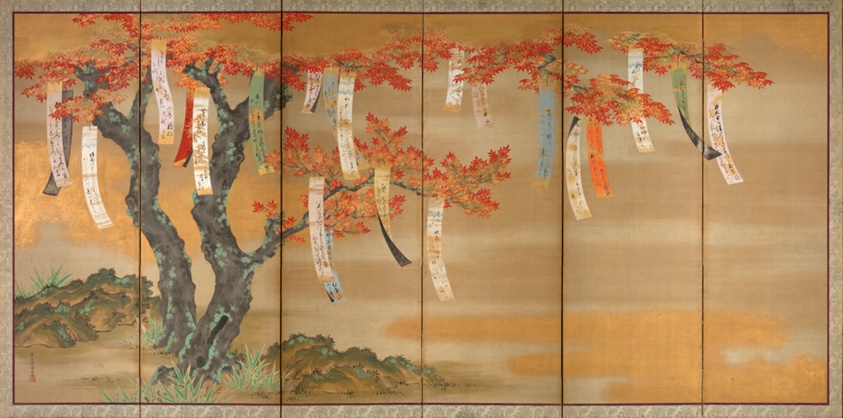
Autumn Maples with Poem Slips is a six-panel folding screen, one of a pair, executed in ink, colors, gold leaf, and gold powder on silk. This artifact, dating to the Edo period (circa 17th–18th century), represents the pinnacle of Japanese byōbu craftsmanship—a tradition that marries pictorial narrative with architectural function. The screen’s materiality is its first and most commanding statement: silk, not merely as a support, but as a medium that breathes with the subtle interplay of light and pigment. The use of gold leaf and gold powder, applied with meticulous precision, creates a luminous surface that shifts with the viewer’s perspective, evoking the transient beauty of autumn leaves. The poem slips, or tanzaku, are inscribed with classical waka poetry, their calligraphy rendered in sumi ink that contrasts with the gilded ground. This is not decoration for its own sake; it is a deliberate orchestration of texture, color, and meaning, demanding the connoisseur’s attention to the hand of the artisan.
The screen’s construction reflects a deep understanding of silk as a living material. The warp and weft of the fabric are chosen for their ability to absorb and reflect pigment, while the gold powder is fixed with animal glue, a technique that ensures durability without sacrificing fluidity. The six panels are joined by silk hinges, allowing the screen to fold into a compact form—a practical elegance that has served Japanese interiors for centuries. In the context of London’s Savile Row, where cloth is cut and tailored to the human form, this screen offers a parallel: it is tailored to space, shaping the atmosphere of a room as a bespoke suit shapes the silhouette of a client. The silk here is not passive; it is an active participant in the artifact’s life, aging gracefully over centuries, its patina telling a story of handling, light, and air.
Artistic and Cultural Significance
The subject matter—autumn maples with poem slips—is a classic motif in Japanese art, symbolizing the fleeting nature of beauty and the passage of time. The maples, rendered in shades of vermilion, gold, and burnt umber, are depicted in various stages of decay: some leaves cling to branches, others drift downward, caught in an eternal fall. This is not a static scene; it is a moment arrested, a meditation on impermanence that resonates with the Buddhist concept of mono no aware. The poem slips, often bearing verses by court poets, add a layer of intellectual engagement. They invite the viewer to read, to reflect, and to connect the visual with the verbal. In a Savile Row context, this interplay mirrors the relationship between fabric and design—each element must complement the other, neither overwhelming nor receding.
The screen’s function as a room divider is also significant. In a traditional Japanese setting, it would have been used to create intimate spaces within larger rooms, controlling the flow of light and air. For the modern collector or curator, it serves a similar purpose: it defines a zone of contemplation, a pause in the relentless pace of contemporary life. The gold leaf, when struck by sunlight, casts a warm glow that transforms the surrounding environment, much like a well-cut jacket can elevate an entire ensemble. This is heritage as lived experience, not as museum artifact.
Craftsmanship and Technique
The technical mastery evident in Autumn Maples with Poem Slips is extraordinary. The gold leaf is applied in thin sheets, each piece burnished to a mirror-like finish, then overlaid with translucent pigments that allow the gold to shimmer through. The gold powder, or fun, is sprinkled onto wet adhesive, creating a textured, granular effect that mimics the roughness of bark or the softness of moss. The ink calligraphy on the poem slips requires a steady hand and a deep understanding of brush pressure; each stroke is a record of the artist’s breath and intention. This is not a craft that can be rushed. It demands patience, discipline, and a reverence for materials—qualities that are increasingly rare in an age of mass production.
For the heritage specialist, this artifact exemplifies the principle of material integrity. The silk, the pigments, the gold—all are chosen for their ability to age with dignity. Conservation of such a piece requires an understanding of these materials: the silk must be kept at stable humidity to prevent brittleness, the gold leaf must be protected from abrasion, and the ink must be shielded from light. This is not merely preservation; it is a dialogue with the past, a commitment to ensuring that future generations can experience the same luminosity that captivated viewers centuries ago.
Relevance to Contemporary Heritage Practice
In the world of luxury and heritage, where the line between art and commerce is often blurred, Autumn Maples with Poem Slips stands as a reminder of what true craftsmanship entails. It is not about branding or trend; it is about the slow, deliberate creation of objects that transcend their time. For the Savile Row client, who values the hand-stitched buttonhole and the perfectly draped shoulder, this screen offers a parallel narrative: it is a bespoke object, made to measure for a specific space and purpose. Its value lies not in its rarity alone, but in the story it tells—of autumn, of poetry, of the hands that shaped it.
As a heritage research artifact, this screen invites us to consider the role of silk in global material culture. It is a thread that connects Japan to the Silk Road, to the workshops of Kyoto, and to the ateliers of London. In preserving and interpreting such objects, we honor not only the artisans of the past but also the enduring power of beauty to shape our understanding of the world. The autumn maples may fall, but the screen remains—a testament to the art of making, and the art of seeing.