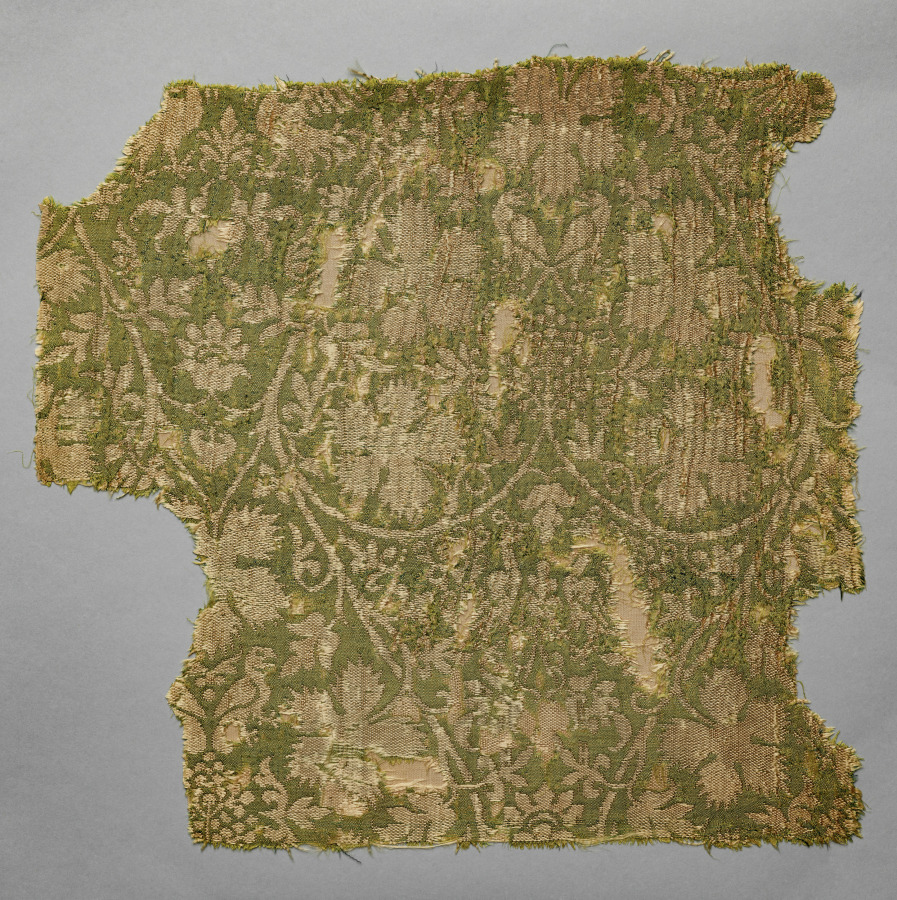
An Examination of Material Excellence: A Silk Fragment from the Imperial Ateliers
One approaches this artifact not as a mere textile remnant, but as a definitive statement of capability. It is a compact, yet profoundly eloquent, testament to a system of production where the very notion of compromise was rendered obsolete. The material, first and foremost, demands our attention: silk, of a grade and finish that speaks of a supply chain perfected over centuries. This is not simply thread; it is the culmination of specialised sericulture, of reelers whose skill ensured the filament remained unbroken, producing a yarn of exceptional tensile strength and a luminosity that is inherent, not applied. The foundation, as any connoisseur would attest, is everything.
The Grammar of Opulence: Decoding the Pattern
The design executed upon this superlative ground is a masterclass in balanced complexity. The primary motif—scrolling vines—establishes the rhythm. These are not wild, untended growths, but rather architectonic forms, their curves and counter-curves governed by a precise, underlying geometry. They provide a continuous, flowing framework, a self-repeating system that implies infinite extension beyond the fragment’s physical borders. This is the very essence of imperial ambition: a pattern designed not for a single garment, but for a court, a dynasty, meant to adorn vast halls and numerous robes, its repetition a visual mantra of perpetual order.
Upon this disciplined scrollwork, the naturalistic elements are deployed with strategic intent. The grape leaves and grapes are more than pastoral decoration. They are symbols of abundance, of fertile harvest, and of poetic leisure, all attributes a ruling house would wish to embody. The leaves, with their carefully articulated lobes and veins, demonstrate the weaver’s ability to translate botanical detail into the language of the loom. The clustered grapes, with their subtle shading, achieve a remarkable degree of plasticity, a suggestion of volume that belies the flat warp and weft of their construction.
The Signature of the Atelier: Aviary Inhabitants
It is, however, the inclusion of the birds that elevates the composition from the merely magnificent to the truly authoritative. These are not generic fowl; they are likely identifiable species—perhaps phoenixes or parrots—each laden with auspicious meaning. Their integration into the vine scrolls is seamless; they perch upon tendrils, their forms curving in harmony with the flow of the pattern. This represents the pinnacle of technical prowess. To engineer the loom’s harnesses to render the delicate, varied lines of a beak, the gradation of plumage, and the alert posture of the creature, all while maintaining the uninterrupted flow of the underlying vine, required a carton—the master pattern—of unimaginable sophistication. This is the point where craft transcends into art, where the atelier’s output becomes its own unassailable argument for supremacy.
Context: The Legacy of Imperial Silk Weaving
To appreciate this fragment fully, one must understand the legacy of imperial silk weaving from which it sprang. This was not a decorative arts cottage industry. It was a state-sponsored enterprise of immense scale and bureaucratic complexity, akin to a modern luxury conglomerate with absolute control over its vertical integration. Imperial workshops, such as those of the Ming and Qing dynasties or the Byzantine *gynaeceum*, operated under direct patronage. They commanded the finest raw materials, aggregated the most skilled artisans—often under one roof—and pursued innovation with a singular focus: the manifestation of power through material splendor.
The patterns produced were not subject to the vagaries of fashion in the common sense. They were codified, their use often dictated by sumptuary laws. To wear or display such silk was to visually articulate one’s position within a rigid hierarchy. The technical achievements—the development of complex draw-looms, the mastery of supplementary weft patterning for raised details, the sophisticated dye chemistry for enduring colours—were driven by this need for unambiguous, legible excellence. The artifact before us is, therefore, a direct product of that ecosystem. It is the result of a culture that viewed the perfection of a tangible object as a reflection of the perfect order of the state.
Conclusion: A Standard for the Ages
In final analysis, this silk fragment serves as an enduring benchmark. It reminds us that true luxury resides in the seamless marriage of the finest material with the most consummate execution of purpose. The scrolling vines provide structure, the grape leaves and grapes offer symbolic resonance, and the birds attest to peerless technical ambition. All is rendered upon the supreme ground of silk.
For the modern purveyor of heritage, the lessons are clear. It speaks of an uncompromising commitment to raw material integrity, of designs that possess both immediate beauty and deep symbolic grammar, and of a manufacturing philosophy where time is not a constraint to be minimised, but a necessary ingredient for mastery. The imperial ateliers understood that their output was their legacy. This fragment, quiet yet eloquent, proves that they succeeded. It remains, as it was intended to be, a definitive standard against which all subsequent endeavours in woven splendour must, inevitably, be measured.