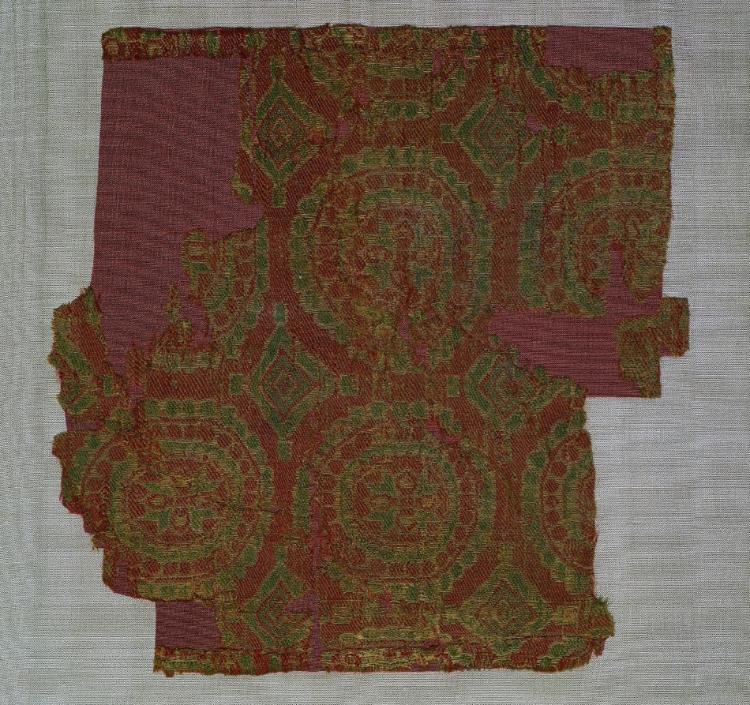
A Fabric of Dominion: The Samite with Rosette Roundels
To comprehend the samite fragment, one must first dismiss the modern conception of cloth as mere covering. This is not textile; it is topography. A cartography of power, woven in the most demanding of fibres, its very existence a statement of reach, of control, of a dominion that extends from the mulberry grove to the furthest trading post. The specimen in question—a samite of pronounced weight and solemn lustre, patterned with assertive roundels enclosing formalised rosettes—speaks not of fashion, but of administration. It is a relic of the imperial workshop, a product of a system where aesthetics were inseparable from authority.
The Substance of Sovereignty: Silk Itself
Consider, if you will, the base material. Silk, in the context from which this fragment hails, was never a commodity. It was a state secret, a technological advantage guarded with a severity reserved for matters of national security. Its production, from sericulture to the complex loom, represented a vertical integration that would be the envy of any modern conglomerate. The cultivation of the Bombyx mori silkworm, the careful unreeling of the continuous filament—these were processes shrouded in protocol. The resulting yarn, possessed of a tensile strength and a capacity for dye absorption unmatched by wool or linen, was the ultimate luxury fibre. But its luxury was secondary to its symbolism. To clothe oneself in silk was to announce one’s position within, or in alliance with, a structure capable of marshalling such meticulous, labour-intensive resources. The sheen of the samite is not mere reflectivity; it is the gloss of concentrated order.
The Grammar of the Loom: Samite and the Roundel
The weave structure, samite, is itself a technical manifesto. A weft-faced compound twill, it represents a significant advancement from simpler weaves. This complexity allowed for the creation of polychrome figurative or geometric patterns—like our rosettes—across vast, uninterrupted fields of fabric. The technique required a draw-loom, a formidable apparatus operated by multiple artisans: a master weaver and a draw-boy, their movements orchestrated with the precision of a military drill. The investment in this technology was not undertaken for whimsy. It was to produce a legible, repeatable iconography.
Which brings us to the pattern: the roundel, or clipeus. This is not a motif; it is a frame, a demarcation. In imperial contexts, the roundel served to isolate and elevate a symbol—be it an eagle, a lion, or, as here, a stylised rosette. It creates a rhythm of self-contained power across the fabric’s surface. The rosette, a radial symmetry of petals, is nature rendered as geometry. It speaks of a perfected, ordered cosmos, a reflection of the ideal state. There is nothing wild or untamed in its execution; it is flora codified into insignia. The repetition of these medallions across the fabric’s expanse is a relentless reinforcement of a central idea: the omnipresence of the imperial ideal. Worn as a garment, the bearer did not merely display pattern; they were enveloped in a field of sanctioned symbols, becoming a moving tapestry of state ideology.
The Legacy of the Loom: From Palace to Protocol
The legacy of this imperial silk weaving is profound, echoing through centuries and reshaping the very fabric of global trade and elite presentation. The Silk Roads were, in no small part, paved by the demand for such artefacts. The technical knowledge of sericulture and complex weaving, once so fiercely protected, became a currency of diplomacy and espionage, slowly migrating westward. The aesthetic language of the roundel, the concept of fabric as a field for emblematic display, was absorbed and adapted by successor empires, from the Byzantine to the Islamic, and eventually into the heraldic traditions of medieval Europe.
More subtly, the samite established a paradigm for how power dresses. It created an expectation that authority should be visually legible, that its raiment should be of a quality unattainable by the general populace, and that its decoration should be symbolic rather than merely decorative. This principle—that the highest levels of attire are a function of governance and identity—transmuted over time. It can be traced in the sumptuary laws of the Renaissance, in the prescribed silks of court dress, and even in the unspoken codes of the modern boardroom, where the depth of a suit’s colour, the fineness of its wool, and the restraint of its pattern serve a not-dissimilar function to the samite’s roundels: signalling membership within a sanctioned order.
The fragment of samite with rosette roundels, therefore, is far more than an ancient textile. It is the progenitor of a sartorial philosophy. It represents the moment when cloth was first engineered as a medium for statecraft, when the loom became an instrument of policy, and when the wearing of a pattern was an act of political alignment. Its value lies not in its antiquity, but in its enduring testament to a simple, potent truth: that those who command the means of production, and the symbols thereby produced, command a language of legitimacy that is, quite literally, woven into the fabric of society.