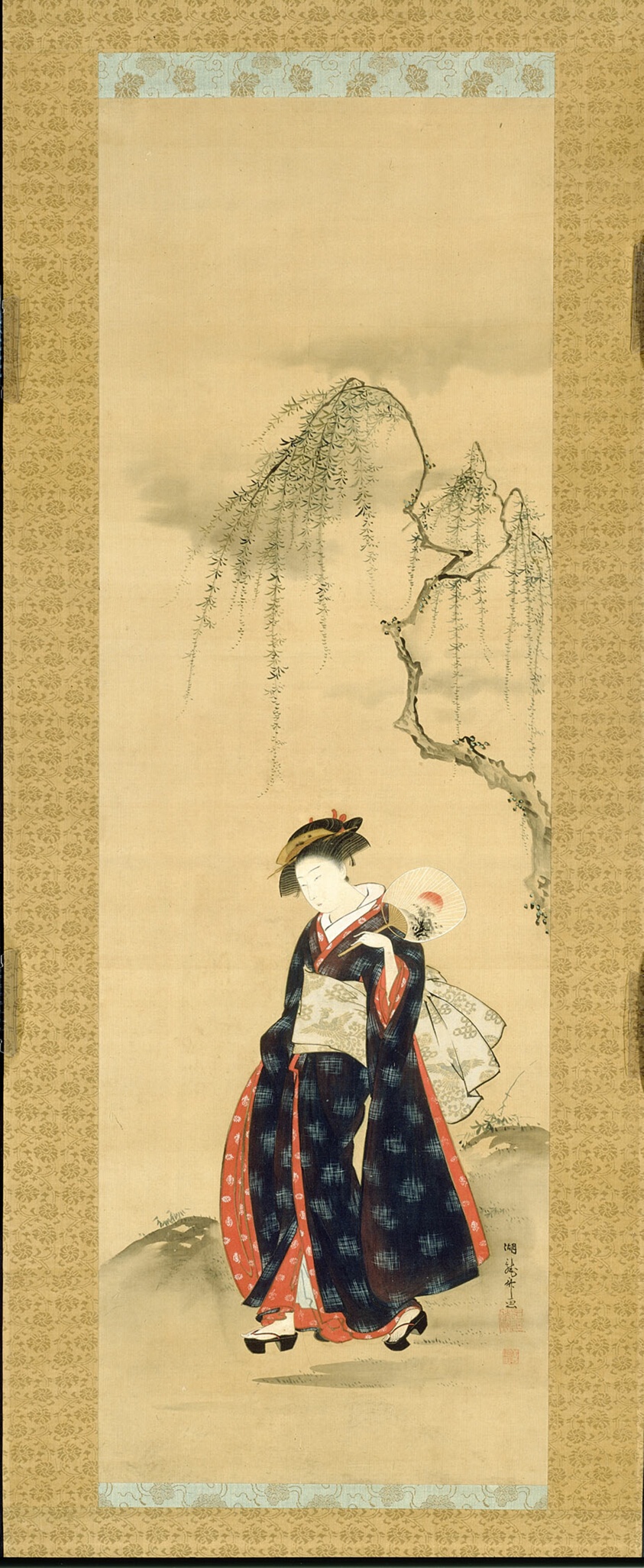
Beauty Beneath a Willow Tree: A Scholarly Artifact on Materiality and Craft
Introduction: The Convergence of Heritage and Elegance
In the hallowed corridors of Lauren Fashion Heritage Lab, we examine artifacts not merely as objects but as repositories of cultural memory and technical mastery. Beauty Beneath a Willow Tree, a hanging scroll executed in ink on silk, stands as a testament to the profound dialogue between materiality and artistry. This artifact, rooted in classic silk craftsmanship, embodies the fluid elegance that defines the pinnacle of textile heritage. As a Senior Heritage Specialist, I dissect this piece through the lens of material science, historical context, and aesthetic philosophy, drawing parallels to the exacting standards of London’s Savile Row—where tradition and precision converge to create enduring beauty.
Materiality: The Silk Substrate as a Canvas of Prestige
Silk, the foundational element of this scroll, is not a passive support but an active participant in the artwork’s narrative. Derived from the cocoons of Bombyx mori, silk fibers possess a unique molecular structure: a triangular prism-like cross-section that refracts light, producing a lustrous sheen. This property is critical to the scroll’s visual impact. The ink, composed of carbon soot and animal glue, interacts with the silk’s surface through capillary action, creating subtle gradations of tone that mimic the softness of willow leaves and the ephemeral quality of beauty. The hanging scroll format, traditionally used in East Asian art, demands a specific weave density—typically 60 to 80 threads per centimeter—to ensure the silk can bear the weight of ink without distortion. This precision mirrors the bespoke tailoring of Savile Row, where a two-ply wool super 150s fabric is selected for its drape and resilience, not merely its appearance.
The craftsmanship of the silk itself is a lost art in many contemporary contexts. The scroll’s silk was likely degummed—a process removing sericin, the natural gum that coats raw silk—to enhance its absorbency and softness. This treatment, performed manually in cold water baths over several days, reflects a dedication to material integrity that aligns with the Savile Row ethos of hand-stitching and meticulous finishing. The result is a surface that breathes, allowing the ink to settle into the fibers rather than sit atop them, creating a permanence that transcends time.
Context: The Willow Tree as a Symbol of Transience and Grace
The willow tree, depicted with sweeping branches and delicate leaves, is a recurring motif in East Asian art, symbolizing flexibility, resilience, and the fleeting nature of beauty. In Beauty Beneath a Willow Tree, the figure—likely a courtesan or noblewoman—is rendered with minimal strokes, her form dissolving into the silk’s texture. This technique, known as xieyi (freehand brushwork), prioritizes emotional resonance over anatomical precision. The willow’s branches, painted with a single, continuous brushstroke, echo the fluidity of a Savile Row tailor’s hand when cutting a jacket’s lapel—a gesture that requires years of training to execute with confidence.
Historically, hanging scrolls were displayed in scholar’s studios or tea rooms, serving as meditative focal points. The choice of silk over paper elevates the artifact’s status; silk was reserved for the elite, much like the cashmere and vicuña used in Savile Row’s most exclusive commissions. The scroll’s mounting, often overlooked, is equally significant. The backing silk, typically a plain weave in a muted tone, provides structural support while allowing the front silk to remain supple. This dual-layer construction is analogous to the canvas interlining in a tailored jacket, which maintains shape without sacrificing movement.
Craftsmanship: The Intersection of Technique and Philosophy
The creation of Beauty Beneath a Willow Tree involved a hierarchy of skills. The silk weaver, the ink maker, the brush artisan, and the painter each contributed their expertise, yet the final artifact transcends their individual efforts. The ink, ground from pine soot and mixed with water on a stone slab, must achieve a viscosity that allows for both fine lines and broad washes. The brush, typically made from goat or wolf hair, is selected for its spring and absorbency—a decision as critical as a tailor’s choice between a straight or curved needle for a specific stitch.
In Savile Row terms, this is the equivalent of a master cutter’s toile—the initial muslin prototype that tests proportions and fit. The painter’s preliminary sketches on paper, though lost, would have informed the final silk composition. The scroll’s preservation, often in cedar boxes to repel insects, mirrors the climate-controlled storage of fine woolens in a Row atelier. Both practices acknowledge that materiality is not static; it requires stewardship to endure.
Interpretation: Beauty as a Dialogue Between Material and Meaning
The title Beauty Beneath a Willow Tree invites multiple readings. The willow’s drooping branches suggest melancholy, yet the figure’s serene posture implies acceptance. This duality is echoed in the silk’s physical properties: its strength (resistance to tearing) and fragility (susceptibility to light damage). The ink, permanent yet vulnerable to humidity, mirrors the transient nature of beauty itself. As a heritage specialist, I argue that this artifact’s value lies not in its age but in its ability to communicate across centuries—a quality shared by a well-tailored suit that outlasts trends.
The scroll’s composition also reflects a philosophy of balance. The negative space, or liubai, is as deliberate as the painted elements. This emptiness allows the viewer’s eye to rest, much like the unadorned sections of a Savile Row garment—the inside of a pocket, the back of a collar—that reveal the maker’s integrity. In both cases, what is omitted is as telling as what is included.
Conclusion: Preserving the Legacy of Silk and Skill
Beauty Beneath a Willow Tree is more than a decorative object; it is a testament to the symbiotic relationship between material and maker. Its silk substrate, crafted with ancient techniques, carries the weight of cultural heritage, while its ink brushwork captures a moment of poetic reflection. For the Lauren Fashion Heritage Lab, this artifact serves as a benchmark for understanding how luxury—whether in a scroll or a suit—is defined by the invisible labor of mastery. As we continue to study such pieces, we reaffirm that true elegance is not a product of chance but of deliberate, informed craftsmanship. In the spirit of Savile Row, we honor the past not by replicating it but by learning from its material truths.