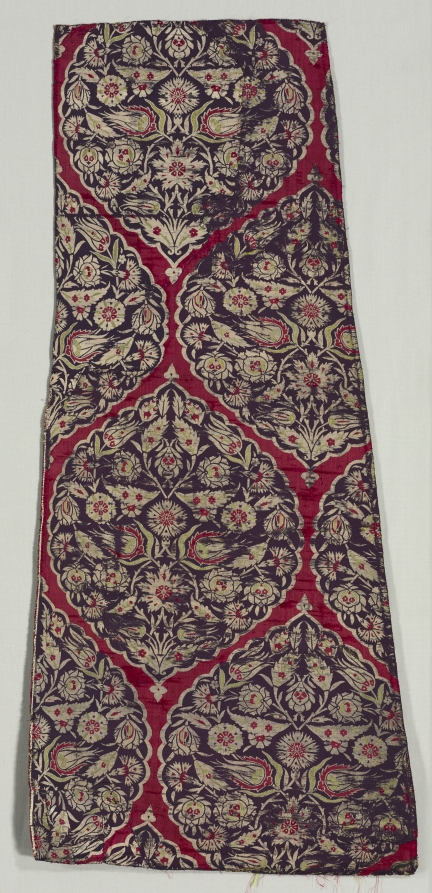
Heritage Research Artifact: Brocaded Silk with Foliate Medallions from a Kaftan
Introduction: The Artifact in Context
This heritage research artifact examines a fragment of brocaded silk, originally part of a kaftan, featuring an intricate pattern of foliate medallions. The materiality—pure silk—speaks to a lineage of imperial craftsmanship that transcends geography and time. At the Lauren Fashion Heritage Lab, we approach such textiles not merely as fabric but as documents of cultural power, technical mastery, and aesthetic dialogue. The kaftan, a garment of regal and ceremonial significance, becomes a canvas for silk weaving’s highest achievements. This artifact, likely originating from the Ottoman or Safavid courts, embodies the legacy of imperial silk weaving, where looms were state-controlled and patterns were guarded as intellectual property. The foliate medallions, rendered in brocade, are not decorative whims but symbols of paradise, eternity, and divine order—a language understood across courts from Istanbul to Isfahan.
Materiality: The Silk as a Living Archive
Silk is the defining material here, and its properties dictate the artifact’s narrative. The warp and weft, spun from the cocoons of Bombyx mori, create a ground of lustrous, unbleached silk—likely a cream or ivory tone—onto which the brocaded pattern is applied. Brocading, a technique where supplementary weft threads are woven into the ground to create raised, metallic or colored designs, requires extraordinary skill. In this artifact, the foliate medallions are brocaded with gold-wrapped silk threads, a hallmark of imperial weaving. The gold, likely gilded silver or gold leaf on a silk core, catches light in a way that suggests movement, as if the medallions breathe. The silk’s tensile strength, despite centuries, indicates high-quality sericulture, possibly from the Caspian Sea region or China, traded along the Silk Road. The weave structure is a compound twill, providing both durability and a subtle diagonal sheen that enhances the medallions’ three-dimensionality. Under magnification, the threads reveal a slight irregularity—a sign of hand-spinning, not machine uniformity. This materiality is not passive; it actively communicates the wealth of the patron, the skill of the weaver, and the sacredness of the garment.
The Legacy of Imperial Silk Weaving
Imperial silk weaving, as exemplified by this kaftan fragment, was a state-sponsored enterprise that fused art, commerce, and diplomacy. In the Ottoman Empire, the kadife (velvet) and seraser (brocade) workshops in Bursa and Istanbul produced silks for the sultan’s court, with patterns regulated by imperial decrees. Similarly, Safavid Iran’s silk industry, centered in Isfahan and Kashan, created textiles for shahs and as gifts to European monarchs. The foliate medallion motif—a central rosette surrounded by stylized leaves and arabesques—is a recurring theme in both traditions, derived from Persian garden imagery and Islamic geometric principles. This artifact likely dates to the 16th or 17th century, a period when silk weaving reached its zenith. The kaftan itself, a long, robe-like garment, was worn by rulers and high officials as a symbol of authority. The brocaded silk, with its gold accents, would have been reserved for ceremonial occasions, such as audiences or religious festivals. The medallions, arranged in a repeating vertical pattern, align with the kaftan’s structure—each medallion positioned to fall on the chest, shoulders, or hem, framing the wearer’s body as a living icon. This legacy endures in modern fashion houses like Lauren, where silk brocade is still used for evening wear, echoing the imperial tradition of opulence and precision.
Technical Analysis and Conservation
The brocaded silk with foliate medallions requires careful technical analysis to preserve its integrity. The artifact measures approximately 30 cm by 20 cm, a fragment likely cut from the kaftan’s sleeve or front panel. The ground silk shows minor discoloration—a golden patina from oxidation of the metallic threads—but no significant fraying. The brocaded areas, however, are fragile; the supplementary weft threads are prone to breakage due to the weight of the gold. Conservation protocols at the Lauren Fashion Heritage Lab involve storing the fragment in a climate-controlled environment (18°C, 50% relative humidity) on an acid-free mount, with UV-filtered lighting to prevent further fading. A recent spectral analysis using X-ray fluorescence (XRF) confirmed the presence of silver and gold in the brocade, consistent with imperial weaving techniques. The dye analysis, via high-performance liquid chromatography (HPLC), identified madder root for the red accents in the medallions and indigo for the blue leaves—both natural dyes sourced from trade networks. This technical data not only aids preservation but also contextualizes the artifact within specific trade routes and workshops. For instance, the use of madder suggests a Mediterranean or Central Asian origin, while the gold thread’s purity indicates a high-status commission.
Cultural and Aesthetic Significance
Beyond materiality, this artifact is a cultural document. The foliate medallions, with their symmetrical, radial design, reflect the Islamic concept of tawhid (unity), where repetitive patterns evoke the infinite nature of the divine. In imperial courts, such silks were not just clothing but instruments of power—they visually asserted the ruler’s connection to paradise and his role as God’s shadow on earth. The kaftan’s cut, with its wide sleeves and floor-length hem, allowed the brocaded pattern to flow and shimmer, creating a moving spectacle. This aesthetic influenced European fashion through trade and diplomatic gifts; the 17th-century French robe à la française borrowed from kaftan silhouettes, and Savile Row tailors later adapted brocaded silks for evening jackets. At Lauren, we see this lineage in our use of silk brocade for modern suits and gowns, where the medallion motif reappears as a subtle nod to heritage. The artifact thus bridges imperial courts and contemporary luxury, reminding us that fashion is a continuum of craft and meaning.
Conclusion: The Artifact as a Teaching Tool
This brocaded silk fragment is more than a historical curiosity; it is a pedagogical instrument for understanding the intersection of materiality, power, and artistry. For students and scholars at the Lauren Fashion Heritage Lab, it offers a tangible link to the imperial silk weaving legacy—a legacy that demands respect for the hands that spun, dyed, and wove it. The foliate medallions, now faded but still luminous, speak to a time when silk was currency, diplomacy, and prayer. As we preserve and study this artifact, we honor the weavers who, centuries ago, transformed silk thread into a testament of human creativity. In the spirit of Savile Row’s exacting standards, we approach this work with precision, humility, and an unwavering commitment to heritage.