An Examination of Imperial Authority Woven in Silk
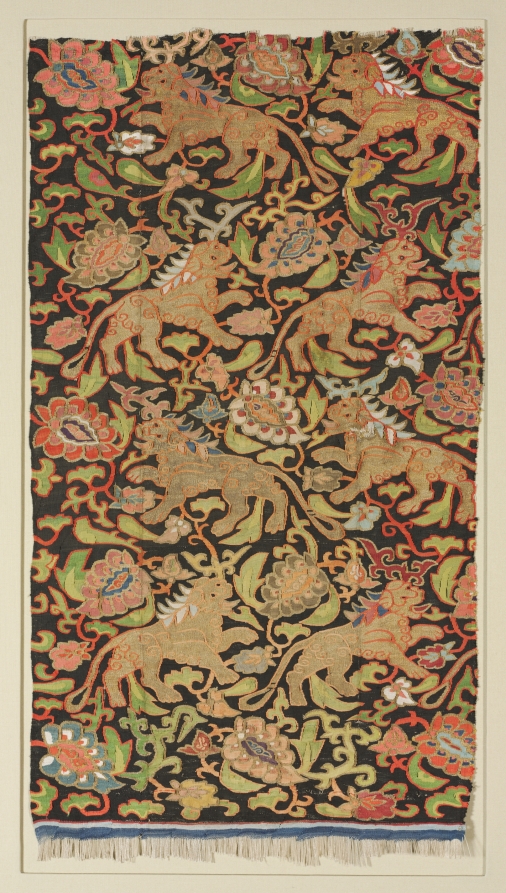
One does not merely look at such an artifact; one is received by it. The tapestry fragment presented for consideration—a symphony in silk, depicting golden lions *rampant* amidst a formal garden of stylised palmettes—is not a mere textile. It is a document. A proclamation of power, rendered not in ink upon vellum, but in the most precious of threads upon a loom of state. Its materiality is its first and most profound statement: silk. This was never a fibre for the common realm. Its very presence speaks of a supply chain meticulously controlled, from the secret husbandry of the silkworm to the hands of master weavers whose craft was as much a guarded secret of state as any cipher. To commission such a work was to demonstrate a command over resources, both natural and human, that was the exclusive purview of empire.
The Grammar of Power: Iconography as Imperial Dialect
The iconography deployed here is a language, and we must become fluent in its grammar. The lion, an ancient and universal symbol of regal authority and martial courage, is not simply depicted; it is heraldically enunciated. Rendered in gold thread—likely a silk core wrapped with gilt membrane—the beast is captured in a state of perpetual, controlled aggression. The posture is deliberate, a calculated display of potency held in reserve. This is not the lion of the hunt, but the lion of the throne, a symbol integrated into the very fabric of the realm's identity.
Surrounding this potent emblem, the palmette motif provides the essential counterpoint. A stylised derivation of the palm tree, a classical symbol of victory and eternal life, its repeated, rhythmic arrangement establishes order and perpetuity. It forms the serene, unchanging backdrop against which the dynamic force of the lion is displayed. This juxtaposition is the core of the message: raw imperial power is given context and legitimacy by the enduring structures of civilisation. The lion conquers; the palmette signifies that the conquest is eternal, cultured, and divinely sanctioned. The composition leaves no room for chaos; every element is subservient to a grand, symmetrical design, mirroring the ideal of a perfectly ordered state.
The Loom as a Instrument of Statecraft
To appreciate the full weight of this legacy, one must understand the apparatus that produced it. Imperial silk weaving was never an artistic freehold. It was a vertically integrated industry, a state monopoly in all but name. Consider the ateliers impériaux, the designated imperial workshops. These were not mere manufactories; they were citadels of craft, often situated within palace precincts or closely governed cities. The patterns woven—such as our lions and palmettes—were frequently prescribed by a court bureau, a ministry of imagery. The weaver was executing a state document, his virtuosity measured by his fidelity to the authorised design and the flawless density of his weave.
The technical execution visible in this fragment speaks of a loom of formidable complexity, likely a draw-loom. This machinery allowed for the precise replication of intricate, non-repeating patterns across vast lengths of cloth. The investment in such technology, and in the years of training required to master it, was a strategic one. The resulting tapestries and silks were the ultimate luxury goods, used not for trade in the common sense, but for diplomatic articulation. They were bestowed upon favoured ambassadors, loyal vassals, and allied potentates as tangible evidence of the empire's sophistication, wealth, and reach. To wear or display such silk was to align oneself visually with the source of this power.
A Legacy Measured in Threads per Inch
The legacy of this imperial silk-weaving tradition is twofold, residing in both material and metaphor. Materially, it established an unimpeachable standard of technical excellence—a benchmark for fibre quality, dye fastness, and structural ingenuity that defined luxury for subsequent centuries. The very expectation of what a luxury textile should be was set within these imperial workshops.
Metaphorically, and perhaps more profoundly, it cemented the relationship between woven splendour and sovereign authority. This tapestry fragment is a precursor to the sumptuary laws of later eras, and indeed to the modern concept of the heritage brand. The iconography—the lions, the palmettes—functions as a proto-logo, a consistent visual language asserting provenance and prestige. It communicates a lineage of power that is both awe-inspiring and exclusionary. The message is clear: this beauty, this order, this palpable demonstration of command, flows from a single, central source.
In conclusion, to examine this tapestry is to conduct an audit of imperial ambition. The silk is its foundation, the gold thread its accent of divine right, the iconography its public proclamation, and the peerless craftsmanship its unanswerable argument. It represents a moment where art, industry, and statecraft were woven into a single, inseparable fabric. The lions may be static, but their message continues to resonate across the centuries: true authority is that which successfully translates raw power into an enduring, and beautifully ordered, legacy.