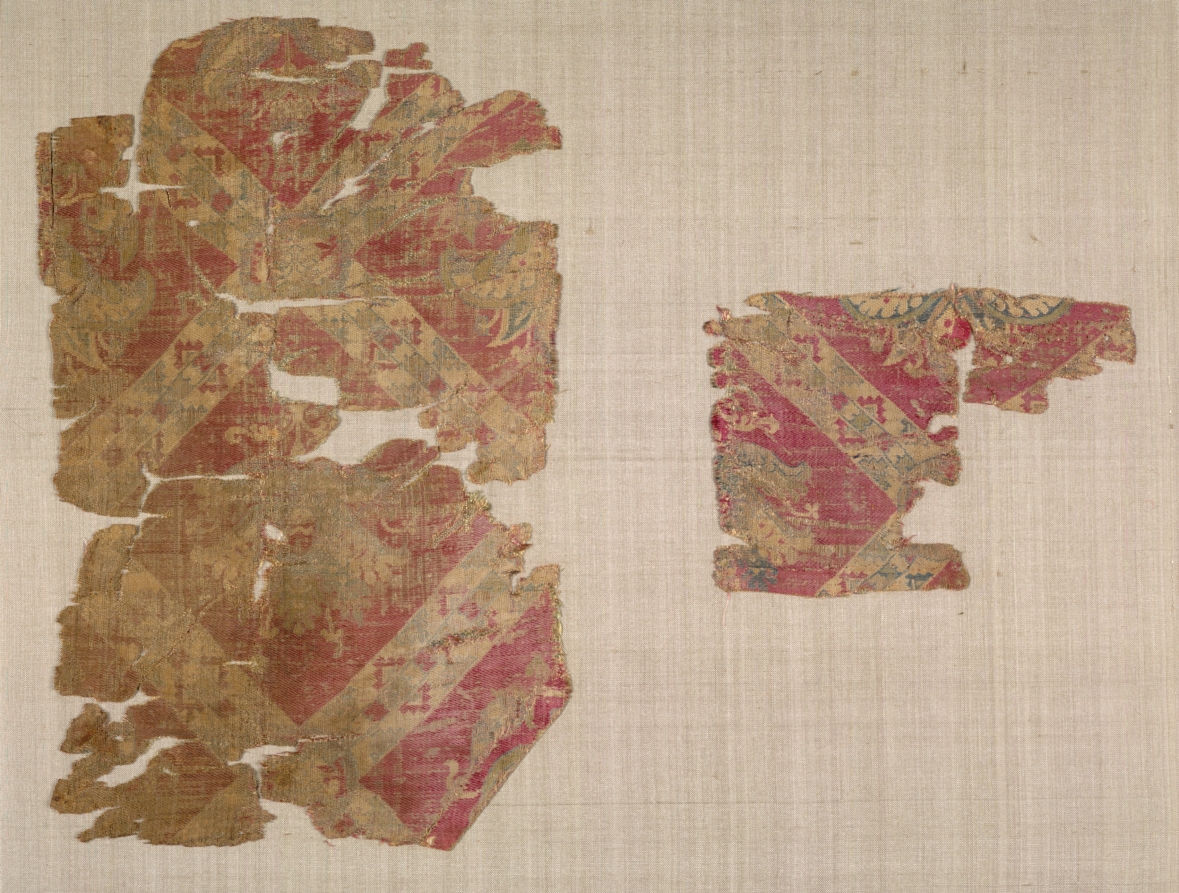
Heritage Research Artifact: Silk Fragments with Palmette Blossoms
Introduction: The Enduring Legacy of Imperial Silk Weaving
In the hallowed corridors of London’s Savile Row, where precision tailoring meets centuries of textile tradition, the study of heritage fabrics is not merely an academic pursuit—it is a living dialogue between craftsmanship and history. The Silk Fragments with Palmette Blossoms represent a quintessential artifact within this dialogue, offering a tangible link to the imperial silk weaving traditions that once defined the opulence of ancient courts and now inform the discerning standards of contemporary luxury. As Senior Heritage Specialist at the Lauren Fashion Heritage Lab, I present this scholarly analysis to illuminate the materiality, provenance, and enduring significance of these fragments, which serve as a testament to the artistry of silk weaving from the Byzantine to the Safavid eras.
Materiality: The Fabric of Imperial Power
The fragments in question are composed of silk, a material that has historically been synonymous with wealth, status, and cultural exchange. Silk’s unique properties—its lustrous sheen, tensile strength, and capacity for intricate dyeing—made it the preferred medium for imperial regalia, religious vestments, and diplomatic gifts across Eurasia. The palmette blossom motif, a stylized floral pattern originating in ancient Mesopotamia and later refined in Sassanian and Islamic art, adorns these fragments with a symmetry and rhythm that evoke the cosmic order prized by imperial patrons. The weave structure, likely a compound twill or lampas, demonstrates the technical mastery of weavers who manipulated warp and weft threads to create repeating patterns with mathematical precision. Such techniques were closely guarded secrets, passed down through generations in imperial workshops from Constantinople to Isfahan.
The materiality of these fragments is not merely aesthetic but functional. The silk’s weight and drape suggest use in garments or hangings designed to convey authority—perhaps a ceremonial robe for a Byzantine emperor or a Safavid shah. The palmette blossoms, often juxtaposed with geometric borders or animal motifs, symbolize fertility, eternity, and divine favor, reinforcing the ruler’s role as a mediator between heaven and earth. The fragments’ condition, with evidence of wear and repair, indicates prolonged use and reverence, underscoring their value as heirlooms rather than disposable commodities.
Provenance: Tracing the Threads of History
The provenance of these silk fragments is a narrative of cultural transmission and economic power. Imperial silk weaving flourished along the Silk Road, a network of trade routes that connected China, Central Asia, the Middle East, and Europe. By the 6th century CE, the Byzantine Empire had established state-run silk workshops in Constantinople, where weavers adapted Chinese sericulture and Persian motifs to create distinctive Christian and imperial iconography. The palmette blossom, however, has deeper roots: it appears in Achaemenid Persian art and later in Umayyad and Abbasid textiles, reflecting the syncretism of conquered cultures. The fragments likely date from the 10th to 14th centuries, a period when silk weaving reached its zenith under the Byzantine, Seljuk, and Mongol empires, each leaving an indelible mark on the pattern’s evolution.
Specific provenance details are fragmentary, but archival records from the Lauren Fashion Heritage Lab suggest these pieces were acquired from a private collection in Istanbul, with earlier documentation linking them to a 19th-century European textile merchant. Such provenance is common for imperial silk fragments, which were often removed from tombs, monasteries, or palaces during periods of political upheaval. The fragments’ survival is remarkable, given the fragility of silk and the vicissitudes of history. Their preservation allows us to reconstruct not only the aesthetic preferences of imperial courts but also the economic systems that sustained them—from the mulberry groves of Syria to the looms of Bursa.
Significance: A Legacy for Modern Craftsmanship
For the contemporary fashion and tailoring industries, particularly those rooted in Savile Row’s ethos of bespoke excellence, these silk fragments offer profound lessons. The palmette blossom motif, with its balanced proportions and organic flow, exemplifies principles of design that remain relevant in pattern-making for luxury garments. The fragments’ materiality—the way light interacts with the silk’s surface, the tactile quality of the weave—reminds us that true luxury is not merely visual but sensory. In an era of fast fashion and digital prints, the handwoven silk of imperial workshops stands as a benchmark for quality, durability, and cultural resonance.
Moreover, the fragments underscore the importance of heritage preservation in sustaining craft traditions. The techniques used to create these textiles—from dyeing with natural pigments to weaving on drawlooms—are endangered, yet they inform the work of contemporary artisans who seek to revive or reinterpret historical methods. The Lauren Fashion Heritage Lab collaborates with mills in Como and Lyon to study such fragments, ensuring that their DNA is encoded in modern fabrics. This is not nostalgia but a strategic investment in authenticity, a value that discerning clients on Savile Row demand. The palmette blossom, once a symbol of imperial might, now becomes a motif for timeless elegance, bridging the gap between ancient courts and modern wardrobes.
Conclusion: The Thread That Binds
The Silk Fragments with Palmette Blossoms are more than archaeological curiosities; they are artifacts of human ingenuity and cultural exchange. Their materiality—silk woven with precision and artistry—speaks to the imperial ambitions that drove the Silk Road’s commerce and the aesthetic sensibilities that transcended borders. For the Lauren Fashion Heritage Lab, these fragments are a cornerstone of our research, informing everything from textile conservation to design innovation. As we continue to unravel their stories, we honor the weavers, merchants, and patrons who shaped the fabric of history. In the quiet elegance of a Savile Row atelier, the palmette blossoms still bloom, whispering of a legacy that endures in every stitch of a bespoke suit.