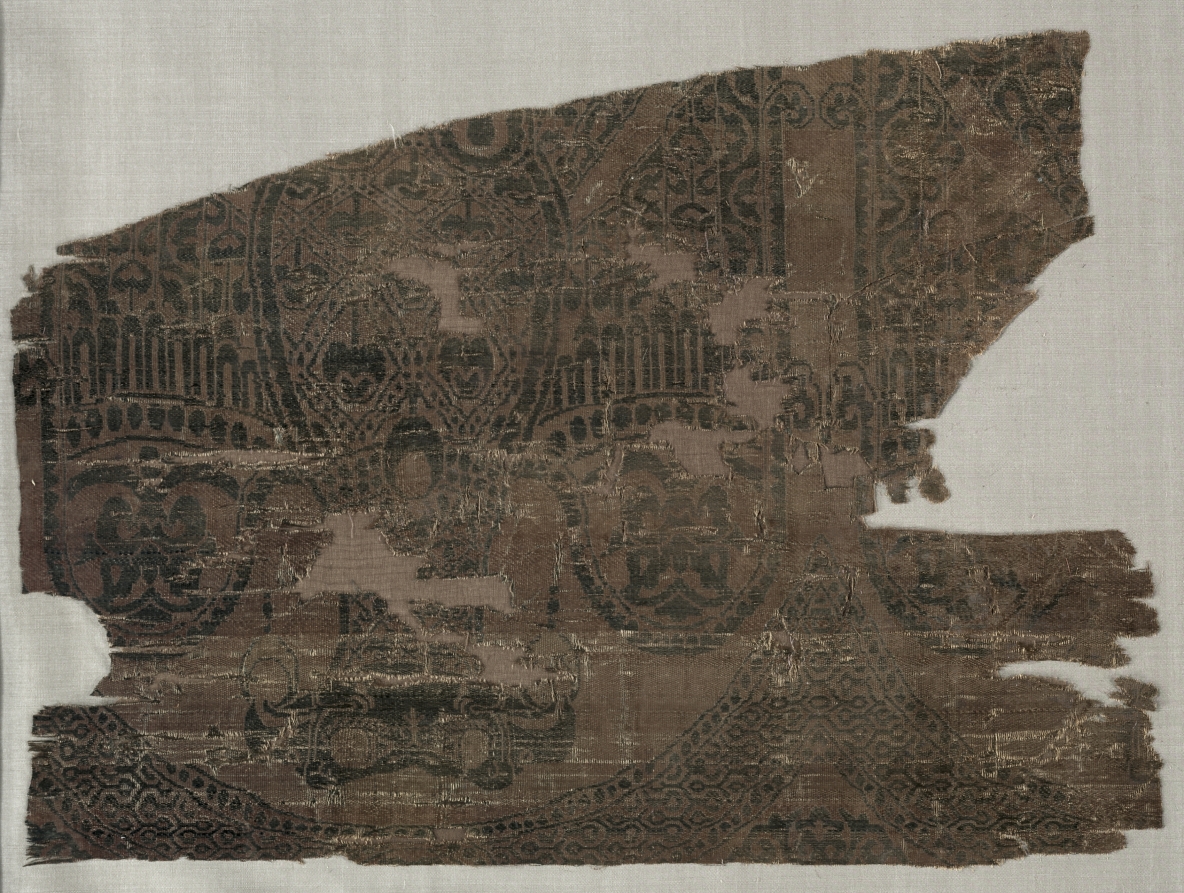
Heritage Research Artifact: Samite Fragments with Double-Headed Eagles, Tomb of Saint Bernard Calvo
Provenance and Contextual Significance
These samite fragments, recovered from the tomb of Saint Bernard Calvo, Bishop of Vic (Catalonia, d. 1243), represent a rare and tangible link to the apex of medieval imperial silk weaving. The double-headed eagle motif, a symbol of Byzantine and later Holy Roman imperial authority, situates these textiles within a sophisticated network of trade, diplomacy, and ecclesiastical patronage. The fragments, now housed in the Museu Episcopal de Vic, are not merely decorative remnants; they are a material testament to the transmission of power, faith, and artistry across the Mediterranean world during the 13th century.
Materiality: Silk as a Medium of Imperial Legacy
The fragments are woven in samite, a luxurious, weft-faced compound twill silk that was the pinnacle of medieval textile technology. Samite, derived from the Greek *hexamiton* (“six threads”), required complex looms and highly skilled artisans, often operating in imperial workshops in Constantinople, Palermo, or Almería. The silk fibers themselves, lustrous and resilient, were imported from China via the Silk Road, refined in Byzantine or Islamic centers, and woven into patterns that conveyed status and sanctity. The double-headed eagle, rendered in contrasting colors—likely gold and crimson against a deep indigo or green ground—demonstrates a mastery of dyeing and weaving that was reserved for the most elite commissions. The fragments’ condition, while fragmentary, reveals a tight weave and a density of thread that speaks to the textile’s original opulence and durability.
Iconography: The Double-Headed Eagle as a Symbol of Temporal and Spiritual Power
The double-headed eagle is one of the most enduring and potent symbols in heraldic and imperial iconography. Its origins trace back to the Hittite civilization, but its medieval resurgence is tied to the Byzantine Empire, where it symbolized the emperor’s dominion over both East and West. By the 13th century, the motif had been adopted by the Holy Roman Empire, the Seljuk Turks, and various European dynasties. In the context of Saint Bernard Calvo’s tomb, the eagle’s presence is deeply layered. As a bishop, Calvo was a spiritual leader, but his tomb’s inclusion of imperial silk suggests a deliberate alignment with earthly authority—perhaps reflecting the political alliances between the Crown of Aragon and the Holy Roman Empire during the Reconquista. The eagle, with its dual heads, also evokes the dual nature of Christ (divine and human) and the bishop’s role as a mediator between heaven and earth. This iconographic choice elevates the fragments from mere funerary adornment to a theological and political statement.
The Legacy of Imperial Silk Weaving
The samite fragments are a microcosm of a broader historical phenomenon: the imperial silk weaving industry that flourished from the 4th to the 14th centuries. Byzantine Constantinople was the epicenter, with state-run workshops (*gynaikia*) producing silks for the court, the church, and diplomatic gifts. After the Fourth Crusade (1204), these techniques migrated to Norman Sicily, where King Roger II established a royal silk workshop in Palermo, blending Byzantine, Islamic, and Latin influences. The double-headed eagle motif appears in Sicilian silks, such as the famous “Sicilian Eagle” textiles, which were exported across Europe. The fragments from Calvo’s tomb likely originated from such a workshop, given Catalonia’s close ties to the Mediterranean silk trade. The legacy of these weavings extends beyond their original function; they influenced later European textile traditions, from Italian *lucchese* silks to French *brocatelle*, and their motifs echoed in Renaissance heraldry and ecclesiastical vestments.
Conservation and Scholarly Value
The fragments’ survival is remarkable. Buried for centuries in a stone tomb, they were preserved by the dry, stable microclimate of the cathedral crypt. However, their exposure to air and light during excavation has necessitated careful conservation. Current preservation protocols at the Museu Episcopal de Vic involve controlled humidity, UV-filtered lighting, and minimal handling. The fragments are mounted on acid-free supports to prevent further degradation. For scholars, these textiles offer a rare opportunity to study medieval weaving techniques through non-invasive methods such as digital microscopy and multispectral imaging. The analysis of dye compounds—likely derived from madder (red), woad or indigo (blue), and oak gall (black)—can reveal trade routes and technological exchanges. The weave structure, with its characteristic weft-faced twill, confirms the samite classification and provides data for comparative studies with other surviving fragments from the same period.
Implications for Heritage and Luxury
In the context of Lauren Fashion Heritage Lab, these fragments serve as a foundational artifact for understanding the intersection of luxury, power, and craftsmanship. The double-headed eagle is not merely a historical curiosity; it is a precursor to the modern fashion house crest, the corporate logo, and the emblem of exclusivity. The silk itself—its weight, its sheen, its tactile richness—embodies the sensory experience of luxury that contemporary brands strive to replicate. The fragments remind us that heritage is not static; it is a living dialogue between past and present. For a Savile Row clientele, accustomed to bespoke tailoring and the finest materials, these textiles represent the ultimate benchmark: a fabric so precious it was reserved for emperors and saints. The fragments challenge us to consider how modern luxury can honor such traditions without descending into mere imitation. They invite a reexamination of materiality—the choice of silk, the precision of weave, the intentionality of motif—as a form of storytelling that transcends time.
Conclusion
The samite fragments from the tomb of Saint Bernard Calvo are more than archaeological curiosities; they are a masterclass in the legacy of imperial silk weaving. Their materiality—silk, samite, double-headed eagle—encapsulates a world of trade, faith, and power. For the Lauren Fashion Heritage Lab, they offer a profound case study in how textiles can encode identity, authority, and artistry. As we continue to explore the intersections of heritage and fashion, these fragments remind us that the finest fabrics are not merely worn; they are inherited, interpreted, and reimagined. In the hands of a skilled tailor or a thoughtful curator, they become a bridge between centuries—a testament to the enduring power of silk to convey what words cannot.