The Fragment as Testament: Decoding Materiality and Craft in a Silk Brocade Artifact
Introduction: The Fragment as a Complete Narrative
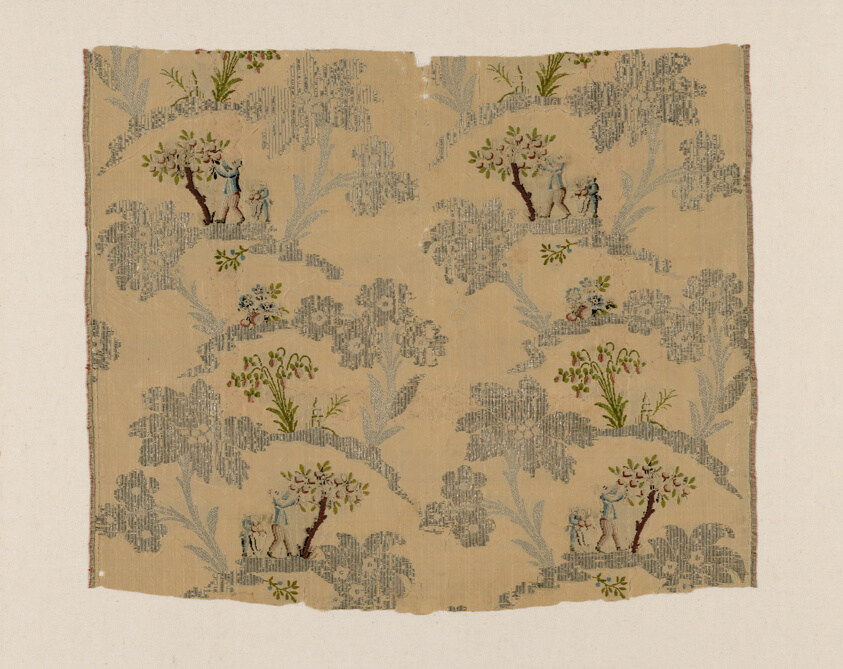
In the lexicon of heritage, the fragment is often misconstrued as a remnant—a whisper of a once-whole garment, a shadow of a lost era. Yet, within the Lauren Fashion Heritage Lab, we approach the fragment not as a deficit, but as a concentrated artifact of mastery. The subject of this analysis—a weft-rib plain weave silk, interwoven with silvered-metal strips and silvered-metal-strip-wrapped silk, and punctuated by supplementary brocading and patterning wefts—is not merely a piece of cloth. It is a microcosm of classic silk craftsmanship, a testament to fluid elegance, and a material archive of the very principles that define Savile Row’s enduring reverence for structure and ornament. This artifact, though partial, speaks with the authority of a complete narrative, revealing the rigorous interplay between materiality, technique, and aesthetic philosophy.
Materiality: The Architecture of Silk and Metal
The foundation of this fragment is a weft-rib plain weave, a structure that prioritizes stability and a subtle, horizontal ribbing. This base is not a passive ground; it is a disciplined grid, a silent partner to the opulence that rests upon it. The silk itself—a protein fiber known for its tensile strength, lustrous sheen, and remarkable drape—provides the canvas. Yet, it is the introduction of silvered-metal strips that elevates this textile from the merely luxurious to the architecturally significant. These strips, likely cut from thin sheets of silver or silver-plated metal, are not applied as embellishment; they are woven into the very structure of the cloth, functioning as wefts that catch and fracture light. The silvered-metal-strip-wrapped silk—where a core silk thread is enveloped in a spiraling metal strip—creates a hybrid yarn. This technique, known as “filé” or “passementerie” in its most refined form, marries the flexibility of silk with the rigidity and reflectivity of metal. The result is a yarn that can be woven with precision, yet retains a sculptural quality, holding its shape and creating a surface that is at once soft and armorial.
The choice of silvered metal is not arbitrary. Unlike gold, which projects warmth and permanence, silver evokes a cooler, more ethereal luminosity—a moonlight quality that aligns with the fragment’s fluid elegance. The metal’s inherent tarnishability, often seen as a flaw, becomes a feature of heritage; it records the passage of time, the touch of air, the history of display. In this fragment, the silvered strips retain a patina that suggests careful preservation, yet their subtle oxidation adds depth, preventing the surface from being merely garish. This is a materiality that demands respect: it is not for the casual garment, but for the ceremonial, the celebratory, the transcendent.
Craftsmanship: The Discipline of Brocading and Patterning
The supplementary brocading wefts and patterning wefts are the virtuoso elements of this fragment. Brocading, in its essence, is a technique of addition—where extra wefts are introduced to create raised, discontinuous patterns that float on the surface of the ground weave. In this artifact, the brocading wefts are not random; they are meticulously placed to build a rhythmic, almost architectural motif. The silvered-metal-strip-wrapped silk is used as a brocading weft, creating areas of dense, metallic relief that contrast with the smoother, silk-rich ground. The patterning wefts, likely composed of fine silk in a complementary hue—perhaps a deep ivory or a muted celadon—introduce a secondary layer of design, a counterpoint to the metal’s brilliance. This is not a simple floral or geometric repeat; the fragment suggests a more organic, flowing pattern, perhaps inspired by natural forms such as leaves or water currents, rendered with a restraint that is quintessentially classic.
The weft-rib plain weave structure is critical to the success of this brocading. The pronounced ribs provide a stable, linear foundation that prevents the heavy metal wefts from distorting the fabric. Each brocading weft is locked into place by the ground weave, ensuring that the pattern remains crisp and does not shift with wear or display. This is the hallmark of Savile Row’s philosophy: that craftsmanship is not merely about decoration, but about the intelligent integration of ornament into structure. The weaver, likely working on a drawloom or a jacquard mechanism, would have needed to calculate the tension of the metal strips against the silk, ensuring that the fabric retained its drape while supporting the weight of the brocading. The fragment’s surviving edges, though frayed, show no sign of puckering or distortion—a testament to the weaver’s mastery.
Fluid Elegance: The Paradox of Weight and Movement
One might assume that a fabric incorporating metal strips would be stiff, unyielding, and heavy. Yet, this fragment defies that assumption. The term “fluid elegance” is not a poetic indulgence; it is a technical observation. The weft-rib structure, combined with the fine silk ground, allows the fabric to drape with a liquid quality, cascading in soft folds rather than rigid pleats. The silvered-metal strips, though present, are woven with a density that permits movement; they catch the light as the fabric shifts, creating a shimmering, kinetic surface. This is a fabric designed for motion—for the sway of a gown, the lift of a sleeve, the fall of a train. The brocading wefts, raised as they are, do not impede this fluidity; they act as accents, like highlights on a wave, rather than barriers.
The elegance lies in the restraint. There is no excess of metal, no overbearing pattern. The silvered strips are used sparingly, as a counterpoint to the silk’s natural luster. The patterning wefts introduce a subtle color differentiation that prevents the surface from becoming a monochromatic glare. This is a fabric that commands attention without shouting—a quality that aligns perfectly with the understated opulence of classic Savile Row tailoring, where the cloth itself is the statement, and the cut is merely its servant.
Heritage and Context: The Fragment in the Continuum of Craft
This fragment is not an isolated curiosity; it belongs to a lineage of silk craftsmanship that spans continents and centuries. The use of silvered-metal strips in silk weaving has historical precedents in the opulent textiles of Renaissance Italy, the brocades of 18th-century France, and the ceremonial silks of Imperial China. Yet, the specific combination of weft-rib plain weave with supplementary brocading wefts suggests a later, more refined iteration—perhaps from the late 19th or early 20th century, when industrial weaving techniques allowed for greater precision and complexity. The fragment’s condition—clean edges, minimal fraying, preserved luster—indicates that it was likely part of a larger, carefully stored garment or furnishing textile, possibly a court dress, a liturgical vestment, or a ceremonial hanging. Its survival is a gift to scholarship, offering a tangible link to the hands that wove it and the culture that valued it.
Within the Lauren Fashion Heritage Lab, this fragment serves as a pedagogical tool, a research catalyst, and a source of inspiration. It reminds us that heritage is not about preserving the past in amber, but about understanding the principles that made it exceptional. The materiality of silk and silver, the discipline of brocading, the paradox of fluid elegance—these are not historical curiosities; they are enduring standards. For the contemporary designer, this fragment offers a lesson in how to integrate opulence with structure, how to balance weight with movement, and how to let the material speak. For the scholar, it is a primary source, a document of technique and taste. For the connoisseur, it is a fragment of beauty, a whisper of a more deliberate age.
Conclusion: The Fragment as a Whole
In the end, this fragment is not a remnant of something lost; it is a complete statement of craft. It embodies the tension between the rigid and the fluid, the metallic and the organic, the structural and the ornamental. It is a testament to the weaver’s intelligence, the designer’s vision, and the culture’s reverence for material excellence. As we preserve and study it, we do not mourn its incompleteness; we celebrate its wholeness as an artifact of heritage. This is the fragment as it should be seen: not as a piece of the past, but as a permanent lesson in the art of making.