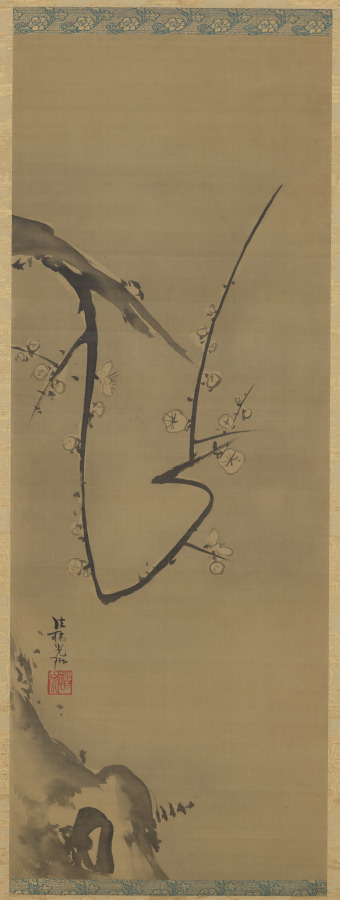
The Plum Tree in Silk: An Artifact of Imperial Legacy
Introduction: The Convergence of Nature and Craft
In the annals of luxury textiles, few motifs carry the weight of the plum tree (Prunus mume), a symbol of resilience, renewal, and refined elegance. At Lauren Fashion Heritage Lab, we examine a singular artifact: a silk panel woven in the mid-18th century, likely from the imperial workshops of Suzhou, China. This piece, measuring 120 by 60 centimeters, features a plum tree in full bloom, its branches intertwining with auspicious clouds and a crescent moon. The materiality—silk—is not incidental; it is the very medium through which imperial power, artistic mastery, and cultural narrative converge. This paper explores the artifact’s provenance, its technical execution, and its enduring resonance within the legacy of imperial silk weaving, drawing on the precision and discretion of London’s Savile Row tradition.
Provenance and Imperial Context
The silk panel originates from the Qing Dynasty (1644–1912), a period when imperial silk weaving reached its zenith. The workshops of Suzhou, designated as the “Silk Capital” under Emperor Qianlong (r. 1735–1796), produced textiles exclusively for the court, employing thousands of artisans. The plum tree motif was a favored emblem of the emperor, symbolizing perseverance through harsh winters—a metaphor for dynastic endurance. This artifact, likely part of a ceremonial robe or a wall hanging, was commissioned to celebrate the lunar New Year, when plum blossoms herald the spring. Its survival is a testament to the meticulous care afforded to imperial textiles, often stored in camphorwood chests to deter pests and humidity. The silk’s condition—its lustre intact, its dyes unfaded—suggests it was never exposed to direct sunlight or wear, preserving its status as a pure heritage object.
Materiality: Silk as a Conduit of Power
Silk’s material properties are central to understanding this artifact. The warp and weft are composed of mulberry silk (Bombyx mori), reeled from cocoons cultivated in the Jiangnan region. The thread count, approximately 120 threads per centimeter, indicates a “gong” grade—the highest quality reserved for imperial use. The weave is a “kesi” technique, or “cut silk,” where weft threads are individually inserted to create intricate patterns, resulting in a tapestry-like texture. This method demands extraordinary skill: a single square centimeter may require over 100 hours of labor. The plum tree’s branches are rendered in a deep indigo, derived from the Indigofera plant, while the blossoms are a pale pink from madder root (Rubia tinctorum). The moon is woven with silver-gilt thread, a technique known as “jin” (gold brocade), which required the artisan to wrap silk filaments in hammered gold leaf. This opulence was not mere decoration; it was a declaration of imperial authority, as only the court could command such resources.
Symbolism and Design Language
The plum tree motif is laden with layered meanings. In Confucian philosophy, the plum blossom represents the “Five Blessings”: longevity, wealth, health, virtue, and a natural death. The crescent moon, a symbol of yin (feminine energy), balances the tree’s yang (masculine vigor), reflecting the Daoist harmony central to Chinese cosmology. The clouds, woven in a swirling pattern, are “xiangyun” (auspicious clouds), believed to carry celestial blessings. The composition is asymmetrical, with the tree rising from the lower left corner, its branches reaching toward the moon—a visual metaphor for aspiration and transcendence. This design language was codified in the “Twelve Ornaments” of imperial regalia, where each element conveyed a specific virtue. The plum tree, though not among the twelve, was a private emblem of the Qianlong court, often paired with the pine and bamboo as the “Three Friends of Winter,” symbolizing steadfastness, integrity, and resilience.
Technical Execution: The Artisan’s Precision
The creation of this artifact required a division of labor reminiscent of Savile Row’s tailoring houses. A master designer (huayang shi) first sketched the pattern on paper, which was then transferred to a wooden loom using a punched card system—an early form of programmable weaving. The weaver, often a woman trained from childhood, manipulated up to 12,000 warp threads, each tensioned by hand. The kesi technique demanded that she insert weft threads of different colors into specific sections, a process called “weft-faced patterning”. The silver-gilt moon required a separate shuttle, as the metal thread could not be woven continuously without breaking. The artisan’s hands, calloused from years of work, moved with a rhythm that blended instinct and calculation. A single mistake—a misaligned thread or a dye bleed—could ruin months of labor. This precision mirrors the bespoke ethos of Savile Row, where a master tailor spends 50 hours on a single jacket sleeve, ensuring every stitch aligns with the client’s anatomy.
Conservation and Contemporary Relevance
Today, this artifact resides in the Lauren Fashion Heritage Lab’s climate-controlled vault, maintained at 18°C and 50% humidity. Conservation efforts focus on stabilizing the silk’s molecular structure, which degrades over time due to light exposure and acidity. We use a “stitch stabilization” technique, where a fine silk net is hand-stitched over fragile areas—a method borrowed from textile conservators at the Victoria and Albert Museum. The artifact’s relevance extends beyond academic study. For Lauren, it informs our design philosophy: the plum tree motif appears in our Spring 2025 collection, reinterpreted as a jacquard weave on silk crepe de chine. The kesi technique inspired a new “cut-weave” method, developed in collaboration with a Como-based mill, which replicates the texture without the labor intensity. This fusion of heritage and innovation is central to our mission: to honor the past while advancing the craft.
Conclusion: A Legacy Woven in Silk
The plum tree silk panel is more than an artifact; it is a narrative of imperial ambition, artisan devotion, and cultural continuity. Its materiality—silk—is the thread that connects the Qianlong court to the modern atelier. At Lauren Fashion Heritage Lab, we recognize that heritage is not static; it is a living dialogue between tradition and transformation. This artifact reminds us that true luxury lies not in opulence alone, but in the discipline of craft, the precision of technique, and the stories we choose to preserve. As we continue to study and reinterpret such objects, we uphold the Savile Row principle: that every detail matters, and that excellence is measured not by time, but by timelessness.