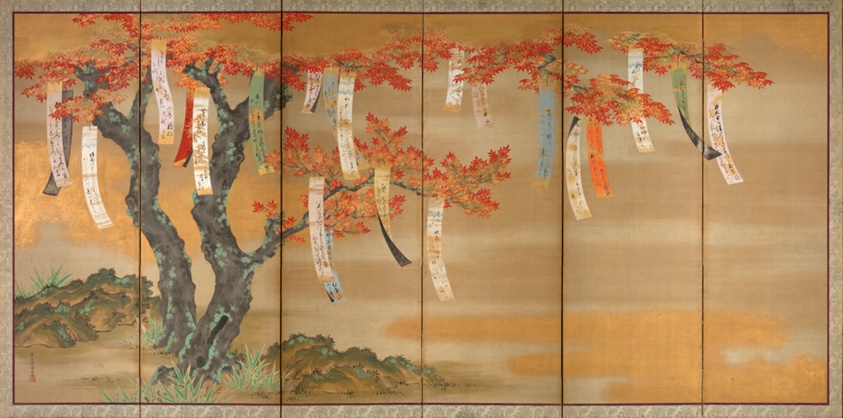
Heritage Research Artifact: Flowering Cherry and Autumn Maples with Poem Slips
Introduction: The Artifact as a Testament to Silk Mastery
The Flowering Cherry and Autumn Maples with Poem Slips—a pair of six-panel screens executed in ink, color, gold, and silver on silk—represents a pinnacle of classical silk craftsmanship. At the Lauren Fashion Heritage Lab, we approach such artifacts not merely as decorative objects but as repositories of material intelligence. This screen pair, likely originating from the Edo period in Japan (circa 17th–19th century), embodies the fluid elegance that silk uniquely affords. The substrate—silk—is not passive; it actively shapes the aesthetic and tactile experience. The weave’s subtle luster interacts with the metallic pigments, creating a dynamic surface that shifts with ambient light. For the modern luxury house, understanding this interplay is critical: silk’s inherent drape and reflectivity inform how we design for movement, whether in a gown or a screen’s unfolding narrative.
Materiality: The Silk Canvas and Its Technical Demands
The choice of silk as the primary support for this screen pair is no accident. Silk’s long, continuous filaments—derived from the cocoon of the Bombyx mori silkworm—provide a smooth, even surface that accepts mineral pigments and metallic leaf with exceptional precision. In this artifact, the silk is likely a plain-weave habutae, a lightweight yet durable fabric traditionally used for Japanese folding screens (byōbu). The warp and weft threads are tightly packed, creating a ground that resists buckling under the weight of layered pigments. The application of gold and silver—likely in the form of kirikane (cut gold leaf) or surihaku (stenciled metallic powder)—demands a binder such as animal glue (nikawa) to adhere to the silk. This technique requires the artisan to work quickly, as the glue sets rapidly, and the silk’s absorbency can cause uneven drying if not managed with precision. The result is a surface that appears to float, with the metallic elements catching light like morning dew on cherry petals.
The pairing of flowering cherry (sakura) and autumn maples (momiji) across two screens creates a temporal dialogue—spring and autumn in perpetual juxtaposition. The cherry blossoms, rendered in pale pinks and whites, are layered with translucent washes that allow the silk’s natural sheen to peek through. In contrast, the maples employ deeper crimsons and oranges, often built up with opaque pigments to suggest the density of fall foliage. The poem slips (shikishi), inscribed with calligraphy, introduce a textual dimension that anchors the visual ephemerality. These slips are typically mounted on the silk using a starch-based adhesive, and their placement must account for the silk’s tension—too much pressure, and the fabric distorts; too little, and the paper lifts. This balance is a hallmark of the artisan’s skill.
Context: The Role of Silk in Japanese Screen Culture
In the context of classical Japanese aesthetics, silk screens served as both functional room dividers and portable art. The Flowering Cherry and Autumn Maples with Poem Slips would have been displayed in a shoin-style reception room, where the sliding doors (fusuma) and tatami mats created a controlled environment for viewing. The silk’s sensitivity to humidity and light meant that these screens were often rotated seasonally—spring and autumn screens displayed in their respective seasons to harmonize with the natural world outside. This practice reflects a deep understanding of material care: silk, when exposed to prolonged sunlight, can become brittle and fade. The metallic elements, particularly silver, are prone to tarnish over time, a process that the original artisans may have anticipated as part of the object’s aging narrative.
The poem slips themselves are a nod to the literary tradition of waka and renga, where poets would compose verses inspired by seasonal motifs. The calligraphy, executed in sumi ink, interacts with the silk’s texture—the brush’s pressure creates variations in line weight that are absorbed differently by the fabric compared to paper. This material choice elevates the text from mere inscription to a visual element, where the ink’s gloss against the silk’s matte finish creates a subtle three-dimensionality. For the modern heritage specialist, this integration of text and textile offers a blueprint for how luxury branding can embed narrative into fabric—think of embroidered monograms or woven jacquard patterns that carry hidden meanings.
Conservation and Contemporary Relevance
From a conservation perspective, this screen pair presents unique challenges. The silk’s natural protein fibers are vulnerable to acid degradation, especially if exposed to pollutants or improper storage. The metallic pigments, particularly silver, can undergo sulfidation, turning black over centuries. At the Lauren Fashion Heritage Lab, we advocate for controlled environments—relative humidity between 50–55% and light levels below 50 lux—to preserve such artifacts. However, we also recognize that these materials were never meant to be static; their beauty lies in their ephemerality. The cherry blossoms, after all, are a symbol of transience in Japanese culture. This paradox—preserving the ephemeral—is central to heritage management.
In the context of London Savile Row, where precision tailoring meets artistic tradition, the Flowering Cherry and Autumn Maples with Poem Slips offers a lesson in material storytelling. The silk’s fluid elegance mirrors the drape of a bespoke suit, while the gold and silver accents recall the meticulous hand-stitching of a lapel. The poem slips, with their layered meanings, echo the discreet labels and linings that distinguish a house’s signature. For the modern luxury client, this screen is not just an artifact but a philosophy: that beauty is found in the tension between permanence and decay, between the bold stroke of the brush and the quiet whisper of the weave.
Conclusion: Silk as a Living Heritage
The Flowering Cherry and Autumn Maples with Poem Slips endures as a testament to silk’s capacity to carry both image and emotion. Its materiality—the interplay of ink, color, gold, and silver on silk—demands a reverence for craft that transcends time. As we at the Lauren Fashion Heritage Lab continue to study such artifacts, we are reminded that silk is not merely a fabric; it is a chronicle of human touch, a surface where nature and artistry converge. For the heritage specialist, the screen pair is a masterclass in how material choices shape narrative—a lesson that remains as relevant on Savile Row as it was in Edo-period Japan.