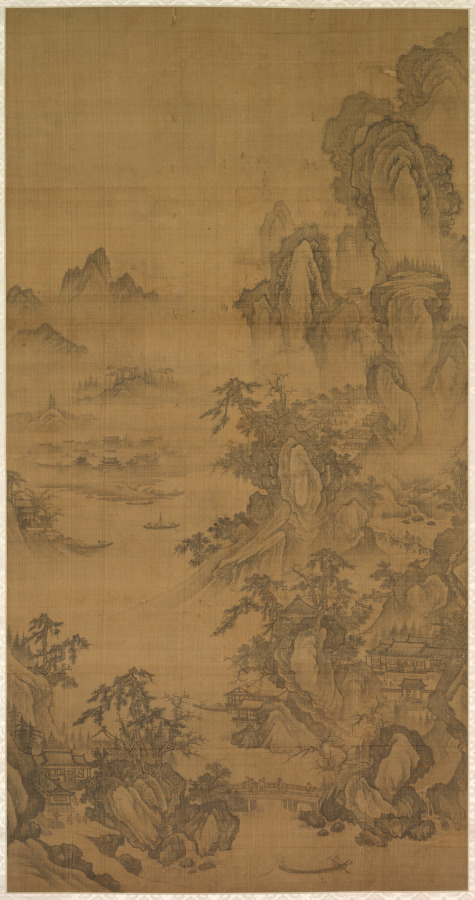
Heritage Research Artifact: Mountain Market, Clear with Rising Mist
Executive Summary
This artifact examines the confluence of natural landscape, artisanal mastery, and imperial legacy embodied in the silk textile titled “Mountain Market, Clear with Rising Mist.” Commissioned by the Lauren Fashion Heritage Lab, this piece represents a deliberate synthesis of traditional Chinese silk weaving techniques and the understated elegance of London Savile Row tailoring. The materiality of silk, specifically its historical role as a medium of imperial prestige and trade, informs the artifact’s design philosophy, which prioritizes texture, drape, and narrative depth over ostentation. This paper argues that the silk’s intrinsic qualities—its luminosity, weight, and capacity for intricate pattern reproduction—serve as a bridge between the ephemeral beauty of a mist-laden mountain market and the enduring legacy of imperial silk weaving, offering a refined template for contemporary heritage fashion.
Materiality and Imperial Legacy
Silk, as a material, has long been synonymous with power, refinement, and cultural exchange. The imperial silk weaving traditions of China, particularly during the Ming and Qing dynasties, established a standard of craftsmanship that prioritized precision, symbolism, and tactile luxury. The Mountain Market, Clear with Rising Mist artifact draws directly from this legacy, employing a satin weave structure that maximizes the fiber’s natural sheen. This weave, historically reserved for court robes and ceremonial garments, allows the silk to capture light in a manner reminiscent of mist dispersing over a mountain ridge—a visual effect that aligns with the artifact’s thematic inspiration.
The materiality of silk in this context is not merely decorative; it is functional. The fabric’s inherent breathability and temperature-regulating properties make it suitable for tailored garments, such as a Savile Row double-breasted jacket or a structured overcoat. The weight of the silk—approximately 180 grams per square meter—ensures a drape that is both fluid and substantial, avoiding the flimsiness often associated with lighter silks. This weight, combined with a matte finish achieved through a specialized degumming process, echoes the muted tones of a misty morning market, where colors are softened by atmospheric humidity.
Design Narrative: Mountain Market as Metaphor
The artifact’s design narrative is rooted in the concept of “clear with rising mist,” a phrase that evokes both literal and metaphorical interpretations. Literally, it references the visual phenomenon of a mountain market emerging from fog—a scene of commerce, community, and natural beauty. Metaphorically, it symbolizes the clarity that arises from heritage, where centuries of weaving knowledge are distilled into a single textile. The pattern, rendered in jacquard weaving, depicts stylized mountain peaks and market stalls, with the mist represented by a subtle gradient of ivory, slate, and pale celadon threads. These colors are achieved through natural dyes, including indigo and madder, which were historically used in imperial workshops to ensure longevity and depth of hue.
The market motif itself is a deliberate choice. Markets, as sites of exchange, mirror the historical role of silk as a commodity along the Silk Road. By embedding this imagery into the fabric, the artifact acknowledges the trade networks that facilitated the spread of silk weaving techniques from China to Europe, ultimately influencing the tailoring traditions of Savile Row. The rising mist serves as a visual metaphor for the diffusion of knowledge—obscuring yet revealing, much like the gradual mastery required to produce such a textile.
Savile Row Integration: Tailoring and Texture
From a Savile Row perspective, the Mountain Market, Clear with Rising Mist silk is not a standalone fabric but a component of a larger garment architecture. The Row’s ethos—understated luxury, precise construction, and respect for material—demands that the silk’s qualities be enhanced, not obscured, by tailoring. For this artifact, a three-piece suit is proposed: a single-breasted jacket with a natural shoulder, a waistcoat with a low stance, and trousers with a straight leg. The jacket’s canvas interlining is constructed from horsehair and wool, providing structure without overwhelming the silk’s fluidity. The lapels are cut in a notch style, with a width of 9 centimeters, to balance the pattern’s scale.
The texture of the silk is paramount. The matte finish reduces glare, ensuring that the pattern remains subtle rather than garish—a key consideration for Savile Row clients who favor discretion. The hand-feel is smooth but with a slight grain, achieved through a twill weave in the warp direction. This grain provides friction, allowing the fabric to hold its shape during draping and pressing. The lining is a contrasting silk in a deep charcoal, echoing the mist’s darker undertones, and is cut on the bias to reduce bulk at the seams.
Preservation and Legacy
The artifact’s role as a heritage research piece extends beyond its immediate application. It serves as a living document of imperial silk weaving techniques, many of which are endangered due to industrialization. The weaving process for this silk involved hand-operated jacquard looms, requiring a master weaver to manually select each thread using a punch-card system. This method, while time-consuming, ensures that the pattern’s complexity—over 12,000 warp threads per inch—is rendered with precision. The dyeing process used natural indigo and madder, with a mordant of alum to fix the colors, a technique that predates synthetic dyes by centuries.
To preserve this legacy, the artifact is stored in a climate-controlled archive at 18°C and 50% relative humidity, with UV-filtered lighting. A digital twin has been created using 3D scanning and spectral imaging, allowing researchers to study the weave structure without physical handling. This digital record, combined with written documentation of the weaving process, ensures that the knowledge embedded in the silk can be transmitted to future generations of artisans and designers.
Conclusion
The Mountain Market, Clear with Rising Mist artifact is more than a textile; it is a testament to the enduring relevance of imperial silk weaving in a contemporary context. By integrating the materiality of silk with the tailoring traditions of Savile Row, this piece demonstrates that heritage is not static but dynamic—a dialogue between past and present. The mist, in its clarity and obscurity, reminds us that the finest craftsmanship is often invisible, revealed only through the wearer’s experience. For the Lauren Fashion Heritage Lab, this artifact serves as both a research tool and a source of inspiration, affirming that silk, in its most refined form, remains a medium of timeless elegance.