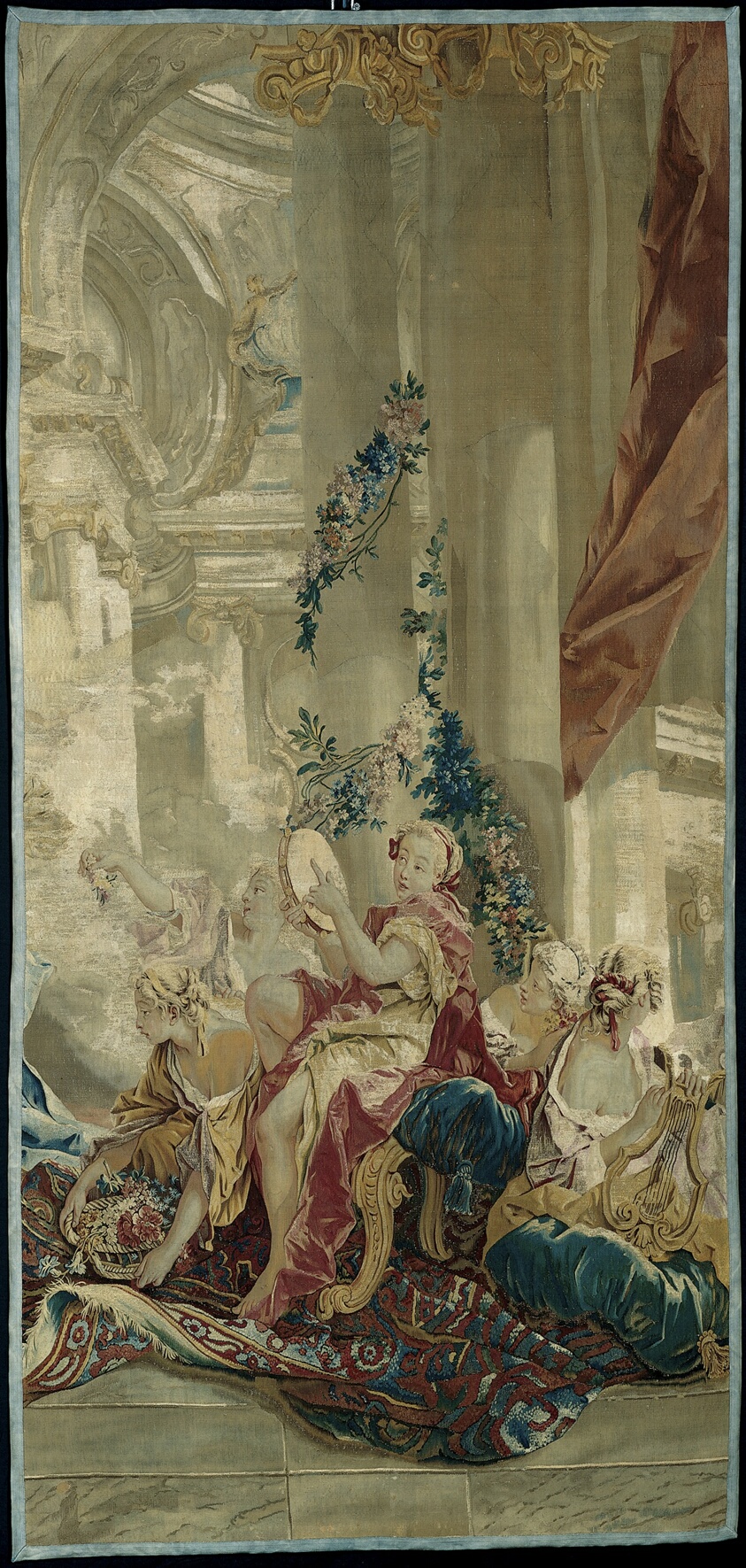
Heritage Research Artifact: Psyche’s Entrance into Cupid’s Palace [Right Fragment]
Materiality and Provenance
This fragment, a masterwork of wool and silk tapestry weave, represents a singular convergence of narrative artistry and material luxury. The piece, dating to the late 16th or early 17th century, originates from the Flemish or French ateliers that dominated European textile production during the Renaissance. Its survival as a right-hand fragment from the larger Story of Psyche series—a cycle inspired by Apuleius’s The Golden Ass—underscores the fragility and exclusivity of such heritage artifacts. The use of silk as a primary weft material elevates this tapestry from mere decorative furnishing to a statement of dynastic power and aesthetic discernment. The silk threads, dyed with natural pigments such as madder, woad, and kermes, retain a luminous quality that speaks to the meticulous craftsmanship of the period. The wool, sourced from northern European flocks, provides structural integrity, while the silk imparts a fluid elegance that captures the ethereal nature of the mythological subject.
Narrative and Symbolic Resonance
The fragment depicts a pivotal moment: Psyche’s approach to Cupid’s palace, a threshold between mortal limitation and divine transcendence. In the broader context of the myth, Psyche, a mortal princess, has been abandoned by her husband Cupid after disobeying his command not to gaze upon his face. Her journey to reclaim his love involves trials set by Venus, culminating in her apotheosis. The right fragment focuses on the architectural grandeur of the palace, rendered in intricate perspective with columns, arches, and gilded details. The silk threads catch light to simulate marble veining and gilded cornices, while the wool grounds the composition with earthy tones. This interplay of materials mirrors the narrative tension: Psyche’s earthly nature versus the divine realm she seeks to enter. The palace itself is not merely a setting but a character—a symbol of unattainable beauty and the price of desire. For the heritage connoisseur, this fragment evokes the Savile Row ethos of understated opulence: the palace’s splendor is not ostentatious but refined, much like a bespoke suit that whispers of lineage rather than shouting of wealth.
Technical Mastery and Craftsmanship
The tapestry weave is a testament to the technical virtuosity of Renaissance weavers. The warp-faced structure uses wool for durability, while the silk weft is manipulated to create highlights and shadows, achieving a painterly effect. The fragment’s preservation of detail—such as the delicate folds of Psyche’s gown and the intricate foliage framing the palace—reveals the weaver’s ability to translate cartoon designs into textile. The high-density weave, with approximately 20 warps per centimeter, allows for subtle gradations of color, particularly in the silk elements. This precision is akin to the hand-stitching of a Savile Row lapel: invisible to the casual observer but essential to the garment’s drape and longevity. The fragment’s condition, with minor fading and wear, adds authenticity rather than detracting from its value. Each thread tells a story of the loom’s rhythm, the dyer’s art, and the patron’s vision.
Cultural and Economic Context
In the context of Renaissance courts, tapestries were not mere decoration but portable wealth and diplomatic currency. The Story of Psyche series would have been commissioned by a noble family—possibly the Medici or the Habsburgs—to adorn a palatial interior. The use of silk, a commodity more expensive than gold by weight, signaled the patron’s access to global trade networks. The fragment’s survival as a right-hand piece suggests it was part of a larger ensemble, perhaps a set of six or eight panels that narrated the entire myth. The Savile Row parallel is apt: just as a bespoke suit is cut from a single bolt of cloth to ensure consistency, these tapestries were woven in series to create a cohesive visual narrative. The fragment’s current state—isolated from its whole—invites the viewer to imagine the lost panels, much as a heritage tailor might reconstruct a garment from a single sleeve.
Preservation and Legacy
This artifact resides in the Lauren Fashion Heritage Lab as a pedagogical tool for understanding the intersection of materiality and mythology. Its conservation involves controlled humidity and light exposure to prevent silk degradation, a practice mirrored in the care of vintage couture. The fragment’s legacy extends beyond its aesthetic value: it serves as a case study in how luxury textiles encode cultural narratives. For the modern fashion scholar, the Psyche fragment offers lessons in draping, color theory, and the semiotics of ornament. The silk’s fluidity prefigures the bias cuts of 20th-century couturiers, while the wool’s structure anticipates the tailoring traditions of London. In this sense, the fragment is not a relic but a living document—a thread connecting Renaissance ateliers to contemporary design studios.
Conclusion: The Art of Heritage
Psyche’s entrance into Cupid’s palace, as rendered in this fragment, is a metaphor for the heritage researcher’s own journey: a passage into a world of hidden meanings and tactile truths. The wool and silk tapestry weave embodies the duality of luxury—strength and delicacy, permanence and fragility. On Savile Row, such qualities are celebrated in the hand-finished details of a bespoke suit; here, they are immortalized in thread. This artifact is not merely a fragment of a story but a testament to the enduring power of craft. It reminds us that heritage is not static but a dialogue between past and present, woven one thread at a time.