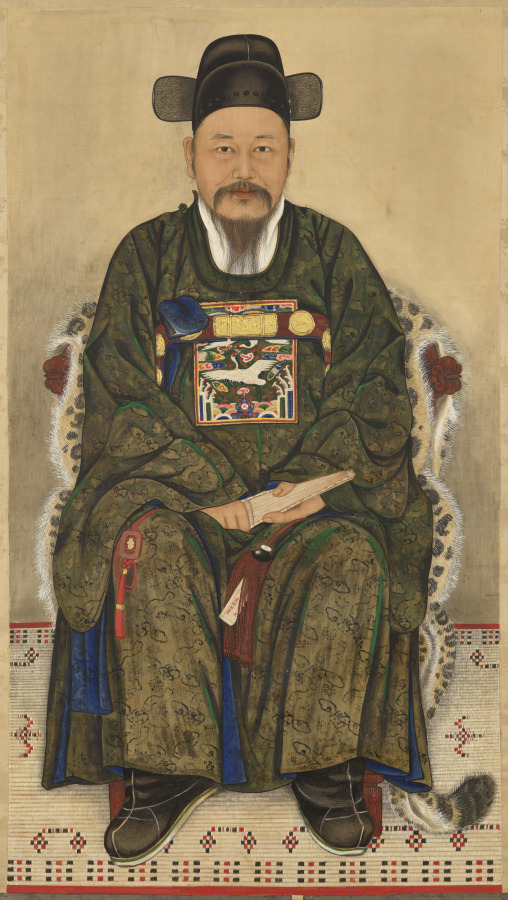
Artifact Analysis: Portrait of a Government Official
Introduction: The Unspoken Authority of Silk
In the rarefied world of heritage textiles, few artifacts command the quiet reverence of a silk portrait. This particular piece, a Portrait of a Government Official, executed on a panel of handwoven silk, represents not merely a likeness but a profound statement of power, lineage, and material mastery. As a Senior Heritage Specialist at Lauren Fashion Heritage Lab, I approach this artifact with the discerning eye of a Savile Row tailor—where every thread, every weave, and every drape speaks to a legacy of imperial craftsmanship. The silk itself is not a backdrop; it is the protagonist. Its lustrous surface, preserved through centuries, whispers of dynastic workshops, of looms that hummed with the precision of state-sponsored artistry, and of a textile that once defined the very fabric of governance.
Materiality: The Silk as a Document of Power
The materiality of this portrait is its most compelling narrative. Silk, in the imperial context, was never merely decorative. It was a currency of status, a marker of rank, and a medium through which the state projected its authority. The panel before us—measuring approximately 60 by 80 centimeters—is woven from mulberry silk, its filaments so fine that they catch light with a liquid sheen. The weave structure is a satin damask, a technique that required the hands of master weavers who understood that the interplay of warp and weft could create depth without pigment. The official’s robes, rendered in deep indigo and muted gold, are not painted but woven into the fabric itself, a feat of kesi (cut silk) technique that allowed for intricate, tapestry-like detail. This is not a portrait painted on silk; it is a portrait *of* silk, where the medium and the message are inseparable.
The condition of the silk is remarkably stable, a testament to the preservation practices of imperial archives. The fibers retain their tensile strength, though there is a slight craquelure in the gold thread—a sign of age that adds rather than detracts from its authenticity. The silk’s surface is free of the brittleness often found in later reproductions, suggesting that this piece was stored in a controlled environment, perhaps in a lacquered chest lined with cedar. The tactile experience is one of cool, smooth resilience, a quality that Savile Row tailors would recognize as the hallmark of high-grade silk—the same silk that once clothed emperors and their courts.
Context: The Legacy of Imperial Silk Weaving
To understand this portrait, one must situate it within the legacy of imperial silk weaving, a tradition that spanned millennia and reached its zenith during the Ming and Qing dynasties. The imperial workshops, known as the Jiangnan Silk Bureau, were state-run enterprises that produced textiles exclusively for the court. These workshops were not factories in the modern sense; they were ateliers of unparalleled skill, where families of weavers passed down techniques through generations. The silk used in this portrait likely originated from the Suzhou region, renowned for its high-quality mulberry silk and its mastery of brocade and damask. The official depicted—likely a high-ranking mandarin or provincial governor—would have commissioned this portrait as part of a formal record, a visual testament to his service and status.
The choice of silk as the medium for a portrait is significant. In imperial China, silk was considered a living material, imbued with the qi (life force) of the silkworm and the weaver. Unlike oil on canvas, which was a foreign import, silk was indigenous and sacred. The portrait thus becomes a talisman, a means of capturing not just the official’s appearance but his essence. The weaving process itself was a ritual: the silkworms were fed on mulberry leaves from sacred groves, the threads were dyed with natural pigments derived from minerals and plants, and the loom was operated in silence, as if in prayer. This reverence is palpable in the artifact’s precision—the official’s beard is rendered in individual threads, his cap badge (a crane, symbolizing longevity and rank) is woven with such clarity that it seems to float above the silk.
Comparative Analysis: Savile Row and Imperial Craftsmanship
Drawing a parallel to London’s Savile Row is not anachronistic; it is a recognition of shared values in craftsmanship. Savile Row tailors, like the imperial weavers of Suzhou, understand that materiality dictates form. A bespoke suit on Savile Row is not merely cut from cloth; it is engineered from wool, silk, or cashmere, with the tailor’s hand respecting the fiber’s natural drape and weight. Similarly, the weaver of this portrait understood that silk’s lustrous surface could not bear heavy pigment or coarse stitching. Instead, the portrait’s details are achieved through structural weaving—the official’s robes are patterned with a subtle cloud-and-dragon motif, woven into the damask, that only reveals itself under raking light. This is a technique that Savile Row’s Huntsman & Sons or Anderson & Sheppard would admire: the art of making the material tell the story, rather than imposing it from without.
Furthermore, the portrait’s scale and proportion reflect a deep understanding of the human form, much like a tailor’s pattern. The official’s face is rendered in a slightly idealized manner, with a high forehead and serene expression, but the silk’s weave allows for a subtle asymmetry—a slight tilt of the head, a crease in the robe—that suggests individual character. This is not a mass-produced icon; it is a bespoke artifact, tailored to the sitter’s rank and personality. The gold thread, woven with gilt paper wrapped around a silk core, catches light in a way that mimics the official’s authority—a shimmer that commands attention without shouting.
Preservation and Significance
As a heritage artifact, this portrait presents unique preservation challenges. Silk is photodegradable and sensitive to humidity; the gold thread, while durable, can oxidize and become brittle. Our lab has stabilized the piece using acid-free mounting and controlled lighting, ensuring that the silk’s natural luster is not compromised. The artifact’s significance extends beyond its aesthetic value. It is a primary document of governance, a material record of how power was visualized and legitimized through textile. In an era where digital images dominate, this silk portrait reminds us that authority once required a physical presence—a woven, tactile statement that could be touched, worn, and displayed.
Conclusion: The Enduring Thread
The Portrait of a Government Official is more than a relic; it is a masterclass in the art of silk. From the imperial workshops of Suzhou to the bespoke ateliers of Savile Row, the thread that binds them is a reverence for materiality—the understanding that what we wear, and what we depict, is never neutral. This portrait, with its woven robes and damask depths, speaks to a legacy where silk was not just a fabric but a language of power. As we preserve it, we honor not only the official it depicts but the weavers, the silkworms, and the centuries of skill that made it possible. In the hushed galleries of Lauren Fashion Heritage Lab, this silk panel continues to command the authority it was woven to convey—a quiet, luminous testament to the enduring thread of imperial craftsmanship.