A Fragment: On the Nature of Excellence
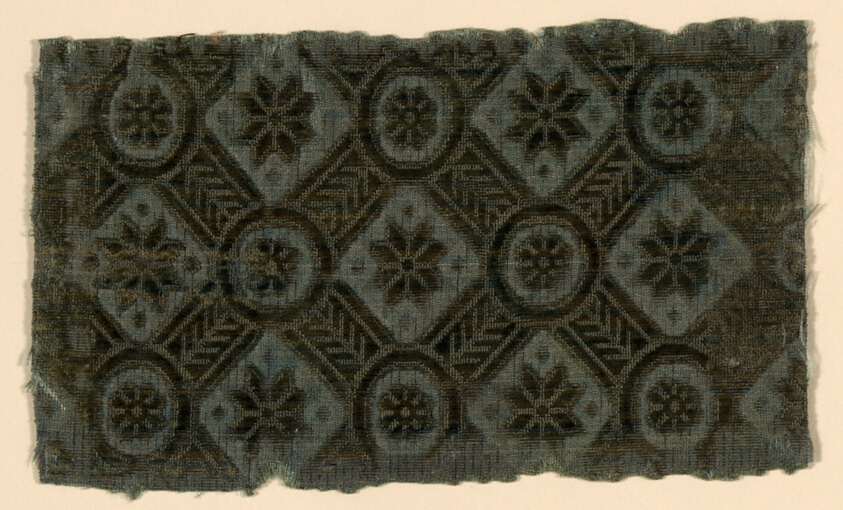
In the considered silence of the atelier, removed from the clamour of the commercial thoroughfare, we examine the fragment. It is not, as the uninitiated might presume, a mere remnant, a casualty of time or use. It is, rather, a distillation. A sovereign declaration of principle. Its dimensions are modest, yet within its confines lies the complete narrative of a craft, a philosophy of making that speaks to the very essence of fluid elegance. The subject is voided velvet; not merely a textile, but a topographical study in silk, light, and shadow.
Material Testimony: The Architecture of Pile and Void
The materiality is explicit, yet its execution is a feat of profound technical orchestration. The ground, a plain weave of the finest mulberry silk, establishes the foundation—a taut, luminous canvas of inherent strength and subtle sheen. Upon this, the narrative is built in two distinct registers. First, the supplementary facing wefts of gilt-metal strip. These are not applied, but woven in, integrated into the very skeleton of the cloth. They catch the light with a restrained, authoritative gleam, tracing geometries that guide the eye, much as the chalk lines of a master cutter map the potential of worsted cloth.
Then, the second and most definitive act: the introduction of supplementary pile warps. This is where the velvet is born. These additional warp threads are raised over rods during the weaving process, creating loops. The decision point—cut and uncut—is where artistry meets exacting science. The cut piles, sheared to a uniform, plush height, create pools of profound, light-absorbing depth. The uncut loops, left intact, offer a textured, resilient crest that reflects light differently. The voided technique is the masterstroke. Here, the pile is deliberately omitted in precise areas, allowing the gleaming ground of silk and gilt to emerge, creating a negative space of brilliance against the positive field of velvet shadow. The pattern is not printed on; it is architected from within the fabric’s very structure.
Contextual Rigour: Classic Silk Craftsmanship as a Discipline
To label this classic silk craftsmanship is to acknowledge a rigorous discipline, one with parallels to our own sartorial traditions. The loom, like a skilled tailor’s bench, is a site of transformation. The weaver, like the cutter, must possess not only manual dexterity but also forward vision—an ability to conceive the finished, three-dimensional form from the binary interplay of warp and weft. Every intersection is a decision; every supplementary thread a commitment to complexity and depth.
This fragment, in its juxtaposition of lush texture with metallic clarity, embodies a balance that is the hallmark of true sophistication. The fluid elegance it references is not a languid, formless drape. It is the controlled, kinetic grace of a fabric that moves with the wearer, its surface alive with a dynamic interplay of matte and shine, recess and relief. It possesses weight and substance, a deliberate hand-feel that communicates quality before a single garment is fashioned. In this, it shares a fundamental ethos with the construction of a Savile Row coat: the inner architecture, though unseen, dictates the grace of the outer form.
The Fragment as a Permanent Reference
Why preserve a fragment? Why study it? It serves as an indelible reference point, a physical benchmark of what is possible. In an age of digital abstraction and surface imitation, this fragment is unassailably authentic. Its truths are tactile. Under magnification, one can trace the precision of the cut, the integrity of the gilt-metal strip, the density of the pile knots per square inch—metrics of excellence as telling as a stitch count or a canvas density.
It stands as a corrective to amnesia. It reminds us that luxury is not an aesthetic but a process; a covenant between material, maker, and time. The patience required to weave such a textile, thread by thread, rod by rod, mirrors the patience required for multiple fittings and silent, meticulous handwork. Both processes reject the industrial tempo in favour of a rhythm that guarantees integrity.
This artifact, therefore, is far more than a sample of historical technique. It is a statement of principles. It argues for depth over superficiality, integration over application, and structured elegance over mere decoration. The voided spaces are as critical as the piled ones; the silence between the notes defines the melody. For the modern house of fashion, such a fragment is not an archive piece to be revered in stasis. It is a challenge, a provocation. It asks: how do these eternal principles of material integrity, structural honesty, and balanced contrast translate into the contemporary idiom?
The answer lies not in replication, but in interpretation. To understand this fragment is to understand that true elegance is never accidental. It is always, as here, constructed.