← BACK TO ARCHIVES
Silk
Heritage Synthesis: King Yu Moving a Mountain to Control the Floods
Curated on Jun 12, 2026 // Node: LDN-01
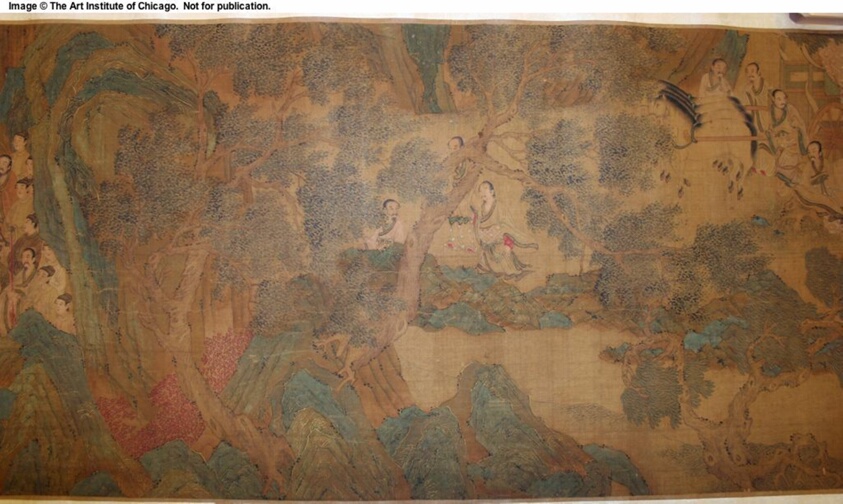
The Materiality of Myth: King Yu Moving a Mountain to Control the Floods
In the rarefied atmosphere of London’s Savile Row, where the whisper of a needle against worsted wool is a language unto itself, we understand that true luxury is not merely seen—it is felt. It is the weight of a cloth, the drape of a fabric, the narrative woven into every thread. So too must we approach the heritage artifact before us: a handscroll of ink and color on silk, depicting the legendary King Yu moving a mountain to control the floods. This is not a mere illustration; it is a testament to materiality as a form of storytelling, where the medium itself becomes the message.
The Silk as Substrate: A Fabric of Imperial Authority
The choice of silk for this handscroll is no accident. In the lexicon of Chinese heritage, silk is the fabric of civilization itself—a material that, like the finest cashmere or vicuña, demands respect through its very nature. The handscroll format, unrolled horizontally like a narrative unfurling, mimics the flow of water and the passage of time. The silk here is not a neutral ground; it is a participant. Its natural luster, achieved through the meticulous cultivation of silkworms and the reeling of filaments into a single, continuous thread, provides a surface that both absorbs and reflects light. This is the same principle that guides a Savile Row tailor when selecting a bolt of Super 150s wool: the fiber must possess a certain *hand*, a tactile quality that responds to the wearer’s movement.
In this artifact, the silk’s weave is a plain tabby, allowing the ink and mineral pigments to settle with a fluid elegance. The warp and weft create a subtle grid, a structural integrity that mirrors King Yu’s own engineering—his canals, his levees, his relentless reshaping of the land. The silk does not fight the artist; it yields, much like the waters Yu sought to tame. This is the hallmark of classic craftsmanship: a dialogue between maker and material, where the latter is honored, not overpowered.
Ink and Color: The Palette of Persistence
The narrative of King Yu is one of monumental labor. According to myth, Yu spent thirteen years diverting rivers and carving mountains, his hands calloused, his body weathered. The artist captures this through a restrained palette: deep, sooty blacks for the mountain’s contours, verdant greens for the ancient pines, and a wash of cerulean blue for the receding floodwaters. The ink, ground from pine soot and animal glue, is applied with a precision that recalls the bespoke cutter’s chalk—each stroke deliberate, each line a commitment.
The mineral pigments, derived from malachite and azurite, are ground to a fine powder and mixed with a binder. They sit atop the silk like a whisper of brocade, their opacity a counterpoint to the ink’s transparency. This is not a painting that shouts; it is one that murmurs, inviting the viewer to lean in, to trace the path of Yu’s shovel with a finger. The color is applied in thin washes, building depth without obscuring the silk’s natural sheen. It is a lesson in restraint—a principle that any tailor on Savile Row would recognize as the difference between a garment that wears the man and one that the man wears.
The Handscroll as a Garment of Time
Consider the handscroll’s physicality. It is not meant to be hung static on a wall; it is meant to be unrolled, section by section, in a ritual of discovery. The viewer becomes a participant, controlling the pace of the narrative. This is analogous to the way a bespoke suit is experienced: not as a single, frozen image, but as a series of moments—the shrug of a shoulder, the turn of a cuff, the fall of a trouser leg. The handscroll’s mounting, with its silk brocade borders and jade roller ends, is the equivalent of a perfectly pitched lapel or a hand-stitched buttonhole. It frames the story, giving it weight and permanence.
The materiality of the scroll also speaks to the concept of *wabi-sabi*—the beauty of imperfection. The silk may yellow with age; the pigments may crack. But these are not flaws; they are patina, the evidence of a life lived. In the same way, a Savile Row suit improves with wear, the fabric molding to the body, the creases telling stories of commutes and celebrations. King Yu’s mountain, rendered in ink on silk, is not a static monument; it is a living document, its surface bearing the marks of time and touch.
Fluid Elegance: The Tailor’s Eye
To the trained eye, the composition of this handscroll reveals a masterful understanding of balance and flow. The mountain, rendered in angular, almost calligraphic strokes, rises like a shoulder pad, imposing yet tailored. The floodwaters, depicted in undulating lines of blue, cascade like the drape of a double-breasted jacket, controlled but never stiff. The figures—Yu and his laborers—are small, almost incidental, yet their placement is precise, like the placement of a pocket square or the alignment of a stripe.
This is fluid elegance: the ability to move through space with grace, whether in a garment or a landscape. The artist has not merely illustrated a myth; he has translated it into a language of line and color that speaks directly to the principles of heritage craftsmanship. The silk’s weave, the ink’s viscosity, the pigment’s opacity—all are chosen with the same care a tailor selects a cloth, a lining, a thread.
Conclusion: The Legacy of Craft
King Yu’s myth is about moving mountains, but this artifact is about moving the soul. It reminds us that heritage is not static; it is a living practice, passed from hand to hand, generation to generation. The silk handscroll, with its ink and color, is a testament to the enduring power of materiality—a power that resonates as much in the ateliers of Savile Row as in the studios of ancient China.
As the Senior Heritage Specialist for Lauren Fashion Heritage Lab, I urge you to consider this artifact not as a relic, but as a reference. It is a masterclass in the marriage of form and function, of narrative and material. In the world of bespoke fashion, we speak of cloth as a second skin. Here, silk becomes a second landscape—a surface upon which the story of human perseverance is written in ink, color, and thread. And that, in the end, is the truest form of luxury.
Heritage Lab Insight
Lab Insight: AIC Silk Archive Node #49025.