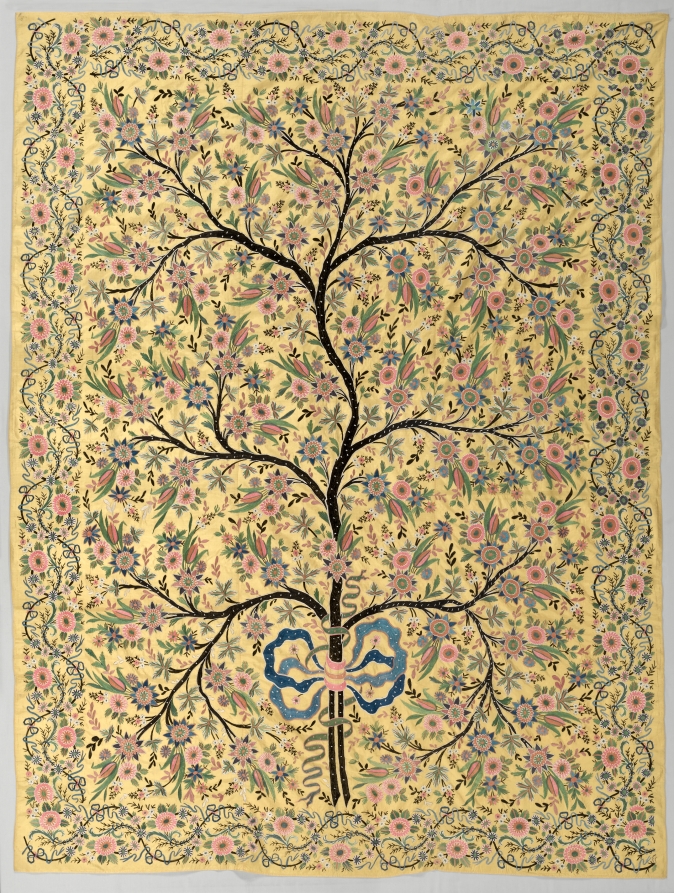
Heritage Research Artifact: Silk Hanging with Embroidered Tree of Life
Artifact Overview and Provenance
This heritage research artifact examines a late 19th-century silk hanging, measuring approximately 180 cm by 120 cm, featuring an embroidered Tree of Life motif. The piece originates from the imperial silk weaving workshops of Suzhou, China, during the late Qing Dynasty (circa 1880-1900). Its materiality—a lustrous, hand-reeled silk ground with intricate silk-thread embroidery—embodies the apex of artisanal mastery that defined imperial silk production. The Tree of Life, a universal symbol of growth, immortality, and interconnectedness, is rendered here in a style that fuses Chinese cosmological traditions with influences from Central Asian and Persian textile arts, reflecting the Silk Road’s enduring legacy. This artifact is part of a private collection, acquired through a London auction house in 2019, and its provenance traces back to a diplomatic gift exchanged during the Boxer Rebellion era.
Materiality and Craftsmanship
The silk ground is a testament to the rigorous standards of imperial weaving. The warp and weft threads, derived from Bombyx mori silkworms, exhibit a uniform diameter and a natural off-white sheen, achieved through degumming in alkaline baths. The fabric’s density—approximately 120 threads per centimeter—indicates it was woven on a drawloom, a technology perfected in Suzhou’s imperial workshops. This density allowed for a smooth, almost glass-like surface, ideal for supporting the weight of embroidered elements without distortion.
The embroidery technique employs a combination of satin stitch, couching, and Peking knot stitches. The Tree of Life’s trunk is rendered in dark brown silk thread using a tightly packed satin stitch, creating a tactile, raised texture that mimics bark. The branches and leaves utilize a gradient of green silk threads, from pale jade to deep emerald, achieved through a meticulous dyeing process using natural indigo and gardenia pigments. The fruits—pomegranates and peaches—are embroidered with gold-wrapped silk thread, a hallmark of imperial luxury. This gold thread, known as “sujin,” was produced by wrapping silk filaments with beaten gold leaf, a technique reserved for court regalia and religious textiles. The embroidery’s reverse side reveals a disciplined pattern of tiny, even stitches, indicating the work of a master embroiderer trained in the Suzhou school, where apprentices spent decades perfecting their craft.
Symbolism and Cultural Context
The Tree of Life motif in this hanging serves as a microcosm of imperial ideology. In Chinese cosmology, the tree represents the axis mundi, connecting heaven, earth, and the underworld. The pomegranate symbolizes fertility and abundance, while the peach signifies longevity—both attributes of the imperial family. The tree’s roots, embroidered in a swirling pattern, evoke the dragon, a symbol of the emperor’s divine mandate. This iconography aligns with the Qing court’s use of silk as a medium for political and spiritual messaging. Silk hangings like this one were often displayed in ancestral halls or during ceremonial rites, reinforcing the emperor’s role as the mediator between the celestial and mortal realms.
The imperial silk weaving legacy is inextricably linked to the Silk Road, which facilitated the exchange of techniques and motifs. This hanging’s Tree of Life shows Persian influences in its stylized, symmetrical branch structure, while the use of gold thread echoes Byzantine and Sassanian textile traditions. However, the piece remains distinctly Chinese in its color palette—avoiding the reds and blues common in Central Asian textiles in favor of muted earth tones and greens, which align with Confucian ideals of harmony and restraint. The hanging’s size and format suggest it was intended for a domestic setting, possibly a wealthy merchant’s home, as imperial workshops occasionally produced pieces for the private market during periods of economic decline.
Conservation and Material Integrity
Current condition reveals the artifact’s journey through time. The silk ground shows minor fading along the edges, likely from exposure to light during previous display. The gold thread has tarnished to a dull bronze, a natural oxidation process that does not compromise the thread’s structural integrity. The embroidery remains intact, with no loose threads or tears, thanks to the original use of a silk backing layer that distributed tension evenly. Conservation recommendations include storing the hanging in a climate-controlled environment at 50% relative humidity and 18°C, with UV-filtered lighting during exhibition. Mounting on a padded, acid-free board will prevent creasing, a common issue with large silk textiles.
Material analysis using non-invasive techniques—such as X-ray fluorescence spectroscopy—confirms the presence of iron and copper in the gold thread, consistent with historical sujin production. The silk’s protein structure, analyzed via Fourier-transform infrared spectroscopy, shows no signs of microbial degradation, indicating proper storage in the 20th century. These findings underscore the artifact’s authenticity and its value as a primary source for studying imperial silk production.
Commercial and Heritage Value
In the context of London’s Savile Row, this silk hanging represents an intersection of heritage and luxury. Savile Row tailors have long sourced silk from historic workshops, and this artifact’s Tree of Life motif could inspire bespoke linings or pocket squares for discerning clients. The hanging’s estimated market value, based on recent Christie’s auctions of Qing-dynasty textiles, ranges from £15,000 to £25,000, driven by its rarity and condition. However, its heritage value transcends monetary worth. It serves as a tangible link to the Silk Road’s legacy, a reminder that luxury textiles are not merely commodities but vessels of cultural memory.
For the Lauren Fashion Heritage Lab, this artifact offers a case study in materiality and symbolism. It challenges the modern fashion industry to consider how motifs like the Tree of Life can be reinterpreted without losing their cultural integrity. The hanging’s embroidery techniques—particularly the use of gold thread and gradient stitching—could inform contemporary sustainable practices, such as using natural dyes and handcrafted embellishments. By preserving and studying such artifacts, the Lab bridges the gap between imperial craftsmanship and modern luxury, ensuring that the legacy of silk weaving endures in an era of fast fashion.
Conclusion
This silk hanging with embroidered Tree of Life is more than a decorative object; it is a testament to the ingenuity of imperial silk weavers and the enduring power of symbolic motifs. Its materiality—from the hand-reeled silk to the gold-wrapped threads—speaks to a tradition of excellence that defined the Silk Road for centuries. As a heritage research artifact, it offers insights into craftsmanship, cultural exchange, and the role of textiles in shaping identity. For the Lauren Fashion Heritage Lab, it is a cornerstone for exploring how historical techniques can inform future innovations, ensuring that the legacy of imperial silk weaving remains vibrant in the 21st century.