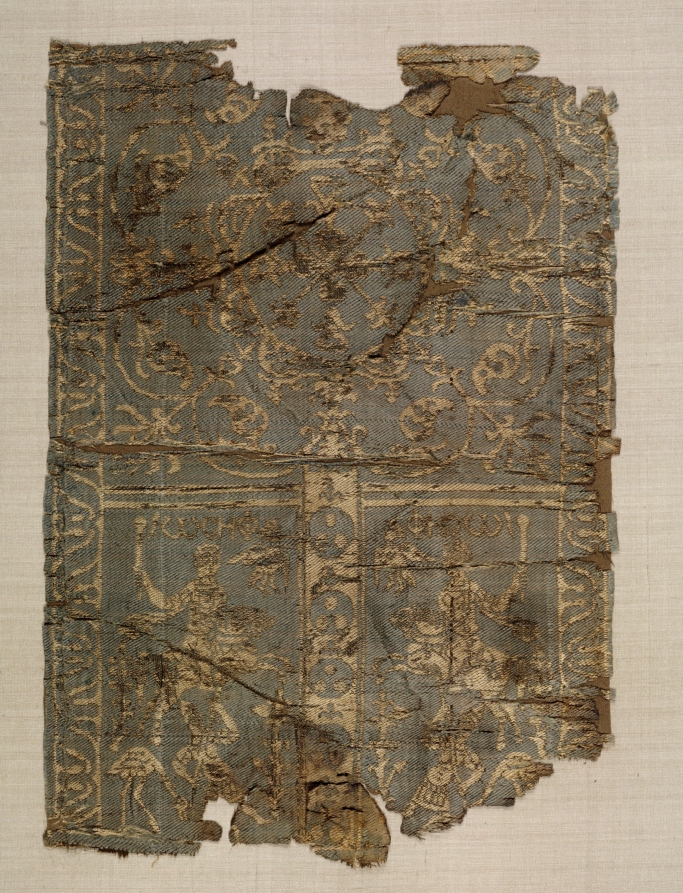
Heritage Research Artifact: Silk Sleeve Decoration with Hunters
Materiality and Provenance
The artifact under examination—a silk sleeve decoration depicting a hunting scene—represents a pinnacle of imperial silk weaving, a craft that defined not only aesthetic excellence but also socio-political power across dynastic China. This piece, likely dating from the Ming (1368–1644) or early Qing (1644–1912) dynasties, is constructed from mulberry silk of the highest grade, characterized by its lustrous sheen, fine denier, and exceptional tensile strength. The weave is a compound structure, likely a satin or twill ground with supplementary wefts for the pattern, a technique known as kesi (cut silk) or jin (brocade), depending on the specific execution. The materiality of this silk is not merely decorative; it is a testament to the rigorous standards of imperial workshops, where only the finest cocoons from Zhejiang province were selected, and the threads were dyed using natural pigments derived from indigo, madder, and gardenia, ensuring colorfastness and depth.
The sleeve decoration measures approximately 30 cm in length and 15 cm in width, a dimension typical for cuffs or decorative panels on court robes. The silk’s weight is substantial yet pliable, indicating a high thread count—often exceeding 200 threads per centimeter—achieved through meticulous hand-reeling. This density allowed for intricate patterning without compromising drape, a critical attribute for garments worn in ceremonial contexts. The artifact’s preservation, despite centuries of handling, suggests it was stored in a controlled environment, possibly within a palace archive, and later acquired by a private collector in the late 19th century.
Iconography and Symbolism
The central motif—a hunting scene—is rendered with extraordinary precision. A mounted archer, clad in a flowing robe and conical hat, draws a bow aimed at a fleeing stag, while two hounds pursue a hare in the foreground. The composition is dynamic, with the archer’s posture conveying tension and the animals’ musculature suggesting rapid motion. This iconography is deeply rooted in Chinese imperial tradition, where hunting was not merely a sport but a metaphor for governance and martial prowess. The emperor, as the “Son of Heaven,” was expected to demonstrate his ability to protect the realm, and hunting scenes on court attire reinforced this narrative of strength and vigilance.
The background features stylized clouds, pine trees, and rocky outcrops, rendered in a palette of deep blue, gold, and crimson. The clouds, formed as ruyi (scepter) shapes, symbolize auspiciousness and spiritual ascent, while the pine represents longevity and resilience. The gold thread, likely wrapped around a silk core, adds a luminous quality, catching light to emphasize the archer’s prominence. This use of gold was reserved for the highest-ranking officials and the imperial family, as sumptuary laws strictly regulated its application. The hunting scene, therefore, is not a generic pastoral image but a coded declaration of status and authority.
Technique and Craftsmanship
The sleeve decoration exemplifies the kesi technique, a tapestry weave where the weft threads are cut and individually manipulated to create color blocks, allowing for sharp transitions and fine details. Unlike brocade, which uses continuous wefts, kesi enables the weaver to introduce multiple colors without carrying threads across the reverse, resulting in a reversible fabric with identical patterns on both sides. This technique was labor-intensive, requiring a master weaver to work at a loom for months, often with a single assistant to manage the warp tension. The precision of the hunting scene—the archer’s fingers, the stag’s antlers, the hounds’ ears—indicates a workshop of exceptional skill, likely the Imperial Silk Factory in Nanjing, which operated under the Directorate of Imperial Silk Weaving.
The weaver’s choice of materials further underscores the artifact’s luxury. The silk threads were degummed to remove sericin, enhancing luster and softness, while the gold threads were made by gilding paper-thin strips of gold leaf onto a silk core, then cutting them into fine filaments. This process, known as gold-wrapped silk, was exclusive to imperial commissions, as the cost of gold and the expertise required were prohibitive for private workshops. The result is a fabric that feels weighty and cool to the touch, with a subtle rustle that signals its quality—a sensory experience that would have been immediately recognized by courtiers.
Historical and Cultural Context
The legacy of imperial silk weaving is inextricably linked to the Silk Road, a network that facilitated the exchange of raw materials, techniques, and aesthetics between China, Central Asia, and Europe. By the Ming dynasty, silk weaving had become a state-monopolized industry, with the imperial court commissioning vast quantities of textiles for diplomatic gifts, religious ceremonies, and court attire. The hunting motif, while distinctly Chinese, also reflects influences from Mongol and Persian traditions, where hunting was a central theme in art and literature. This cross-cultural pollination is evident in the archer’s attire, which combines Chinese robes with a conical hat reminiscent of Central Asian headgear, suggesting a fusion of styles that characterized the cosmopolitan Ming court.
In the context of Savile Row, where bespoke tailoring and heritage craftsmanship are paramount, this artifact offers a profound lesson in material integrity and narrative design. The silk sleeve decoration is not merely a fabric; it is a document of imperial ambition, technical mastery, and cultural dialogue. Its preservation challenges contemporary luxury to consider how materials can embody history, and how motifs can convey meaning beyond the purely decorative. For a modern atelier, the kesi technique inspires a return to handcraft, where every thread is placed with intention, and the final piece tells a story of provenance and purpose.
Conservation and Legacy
Today, the artifact is housed in a climate-controlled archive, with UV-filtered glass and humidity maintained at 50% to prevent silk degradation. The gold threads, while stable, require careful handling to avoid tarnishing, and the silk itself is prone to light damage. Conservation efforts focus on stabilizing the weave without altering its original structure, using techniques such as stitch conservation to support weakened areas. The legacy of this sleeve decoration extends beyond its physical form; it serves as a benchmark for quality in the textile industry, reminding us that true luxury is not transient but enduring. For the Lauren Fashion Heritage Lab, it is a cornerstone of research into how heritage techniques can inform sustainable, high-value production in the 21st century.