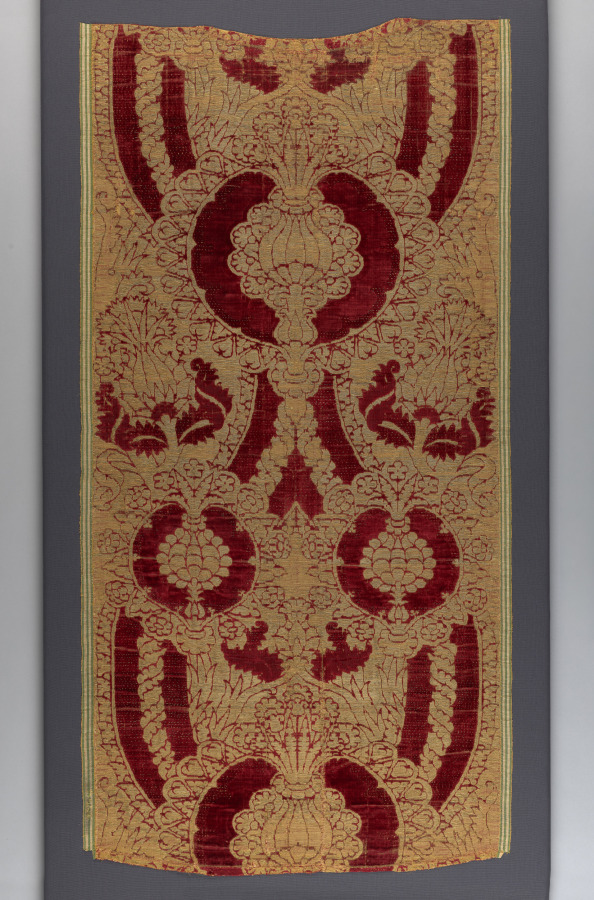
On the Substantive Nature of Silk Velvet: A Consideration of the Pomegranate Pattern in Gold
To engage with a length of silk velvet, particularly one bearing the pomegranate pattern executed in gold thread, is to engage with a treatise on power. It is not merely a textile, but a deliberate articulation of authority, a confluence of technical mastery, botanical symbolism, and economic ambition that defined the legacy of imperial silk weaving. The materiality is the first and final argument: silk velvet represents the apex of the weaver’s art, a deliberate and arduous complication of an already prestigious base. The foundation is the finest mulberry silk, a filament so prized its production was for centuries a state secret guarded under penalty of death. Upon this ground, the velvet pile is created—a process requiring a supplementary set of warp threads drawn over wires, which, when cut, create the dense, plush surface. This is not efficiency; it is conspicuous consumption of labour and skill.
The Pomegranate: A Motif of Consequence
The pattern selected for such a ground is never incidental. The pomegranate, or granada, is a fruit laden with a potent heritage. In the context of imperial silks, particularly those emanating from the workshops of the Byzantine Empire and later the Italian city-states under Ottoman influence, it carried a specific and sophisticated lexicon. It is a symbol not of mere fertility, but of sovereign abundance, dynastic continuity, and the unifying power of empire. Its form—a crowned, leathery husk bursting with a multitude of identical seeds—offered a perfect allegory for a realm containing diverse peoples under a single, divinely sanctioned authority. The motif is rarely presented in isolation; it is ordered, repeated in staggered rows, a disciplined army of symbolism marching across the fabric’s face. This regimented profusion speaks to a controlled, bureaucratic opulence, a natural form rendered geometric by the dictates of state iconography.
The Application of Gold: The Final Assertion
To then execute this pattern in gold is to make the argument incontrovertible. The gold thread, typically a strip of gilt membrane—often silver-gilt—wound around a silk core, performs a dual function. Visually, it captures and refracts light in a manner unlike any dye, creating a luminous, almost metallic sheen that alters with the wearer’s movement. Tactilely, it adds weight and a slight, persuasive rigidity to the cloth. This is not adornment; it is armament. The incorporation of precious metal transforms the textile from a commodity into a treasury asset, wearable capital. It rendered the garment a direct extension of the state’s coffers and a walking declaration of its access to distant trade networks—the silk from the East, the gold from Africa or the Americas, the expertise from captured artisans. The cost of production, astronomical by any measure, was the entire point. It erected a barrier of exclusivity that only imperial or ecclesiastical patronage could surmount.
Context: The Loom as an Instrument of State
To understand this artifact fully, one must appreciate the ecosystem of its creation. Imperial silk weaving was rarely a purely commercial enterprise; it was a strategic industry. From the gynaecea of the late Roman Empire to the state-subsidised ateliers of Lyon under Louis XIV, control over the production of such textiles was a matter of policy. Patterns were regulated, designs copyrighted to specific workshops, and the distribution of the finished product carefully managed as diplomatic currency. A bolt of gold-embroidered velvet with the pomegranate pattern was not simply sold; it was bestowed upon ambassadors, gifted to solidify alliances, or worn by the monarch to visually articulate their place in a divinely ordered hierarchy. The loom, therefore, was as much an instrument of statecraft as the chancery.
Legacy and Connoisseurship
The contemporary appreciation for such a piece, beyond its evident beauty, lies in decoding this layered language. For the modern connoisseur, the examination is forensic. One considers the density of the velvet pile—the number of wires per inch indicating the fineness. The hand must assess the weight and drape, influenced by the proportion of gold thread. The eye must trace the precision of the pomegranate pattern, the sharpness of its outline betraying the skill of the drawboy and the weaver. Authenticity resides in these details, in the minor imperfections that confirm hand production, and in the patina of the gold—the slight tarnishing of the silver beneath the gilt that speaks to age and exposure.
In conclusion, this silk velvet with its gold pomegranate pattern stands as a definitive heritage artifact. It encapsulates a historical moment where textile production was inseparable from projections of sovereignty. Its materiality—the luxury of silk, the complexity of velvet, the audacity of gold—was its message. It communicated an empire’s reach, its wealth, its cultural ambition, and its command over both nature and human artistry. To possess it, or even to study it, is to handle not just a fabric, but the woven embodiment of imperial will. It serves as a masterful reminder that the most enduring statements of power are often those rendered not in stone, but in thread.