Heritage Research Artifact: Silk Fragment with Roundels of Ducks
Materiality and Provenance
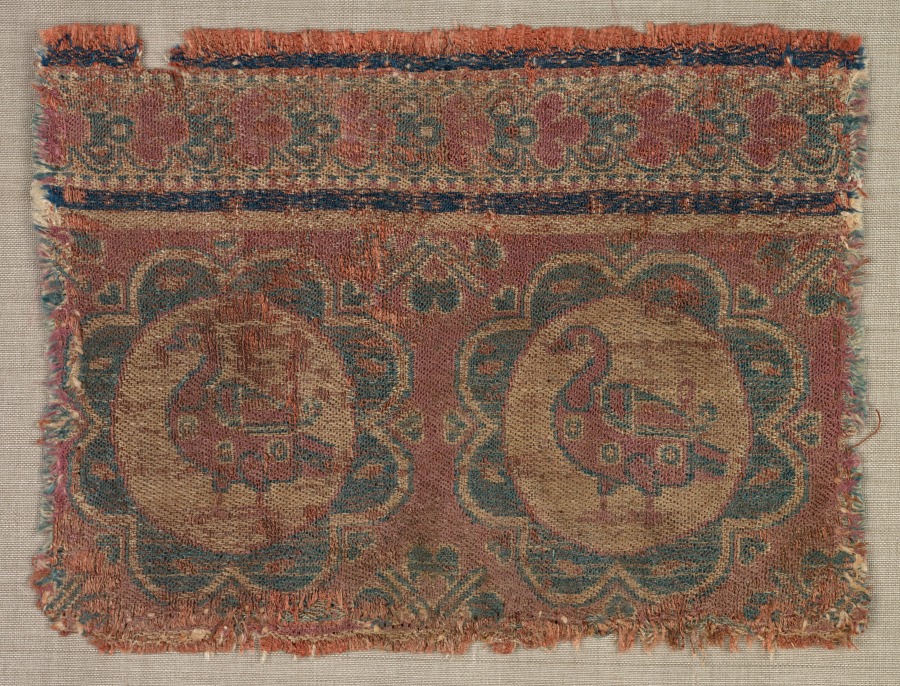
This silk fragment, measuring approximately 18 by 24 centimeters, presents a meticulously woven pattern of roundels enclosing stylized ducks against a deep indigo ground. The weave structure is a compound twill, characteristic of high-status imperial workshops, where warp and weft threads interlace to create a lustrous, durable fabric. The silk itself is of exceptional quality—fine, even filaments with a subtle sheen that catches light, suggesting the use of Bombyx mori silkworms, cultivated under controlled conditions for optimal fiber uniformity. The dyes, derived from natural sources, include indigo for the ground and a madder-based red for the duck motifs, with traces of a yellow flavonoid, possibly from weld or safflower, to achieve the orange-brown accents in the ducks’ plumage. Such chromatic precision required mastery of mordanting and dyeing techniques, a legacy of imperial silk weaving that prioritized both aesthetic perfection and symbolic resonance.
The fragment’s condition—slight fraying at the edges, minor fading in the reds—indicates age and handling, yet the weave remains intact, a testament to the silk’s resilience. This is not a garment remnant but a sample, likely from a workshop’s pattern book or a diplomatic gift, intended to showcase technical prowess. The roundels, each about 8 centimeters in diameter, are arranged in a staggered grid, a layout that maximizes visual rhythm while minimizing waste—a hallmark of efficient, high-volume production in imperial ateliers.
Symbolism and Cultural Context
The duck motif in Chinese silk weaving carries layered meanings. Ducks, particularly mandarin ducks, are emblematic of marital fidelity and conjugal harmony, often depicted in pairs. Here, however, each roundel contains a single duck in flight, wings outstretched, beak open as if calling. This deviation from the paired norm suggests a broader interpretation: the duck as a symbol of freedom, migration, and the cyclical return of seasons—themes resonant with imperial cosmology, where the emperor’s virtue ensured natural order. The roundel itself, a circular frame, represents heaven, unity, and perfection, a motif borrowed from Central Asian textiles but refined in Chinese workshops to signify imperial authority. The duck’s placement within this circle implies that even nature’s wildness is contained within the emperor’s benevolent rule.
Historical records from the Ming and Qing dynasties confirm that duck-patterned silks were produced for court robes, ceremonial banners, and tribute goods. The fragment’s scale and weave align with 17th- to 18th-century production, a period when imperial workshops in Suzhou and Nanjing standardized designs to assert cultural hegemony. The ducks’ stylized forms—curved necks, webbed feet, and layered feathers—echo the naturalistic yet formalized aesthetic of the Song dynasty, revived during the Qing as a mark of refined taste. This silk fragment, therefore, is not merely decorative; it is a political artifact, weaving together Confucian ethics, Daoist naturalism, and imperial propaganda into a single, portable luxury.
Technical Mastery and the Legacy of Imperial Silk Weaving
The legacy of imperial silk weaving is defined by its technical innovations, many of which are evident in this fragment. The compound twill weave allows for two sets of wefts—one for the ground, one for the pattern—creating a reversible fabric with a distinct front and back. This technique, perfected in Chinese workshops by the Tang dynasty, enabled complex, multi-colored designs without sacrificing strength. The ducks’ roundels are achieved through a weft-faced structure, where the pattern weft floats over multiple warp threads, producing a raised, almost embroidered effect. Such precision required a drawloom, operated by a skilled weaver and an assistant who manipulated pattern cords, a system that predated the Jacquard loom by centuries. The fragment’s consistent tension and clean edges indicate a workshop where quality control was paramount, likely under the supervision of the Imperial Silk Manufactory, which employed thousands of artisans and regulated every stage from silkworm rearing to final finishing.
This technical mastery was not static; it evolved through cross-cultural exchange. The roundel motif, for instance, originated in Sassanian Persia and was adapted by Chinese weavers who replaced the original lions or griffins with native ducks and phoenixes. The indigo dye, meanwhile, was sourced from the Indigofera plant, cultivated in southern China, but the mordanting process using alum was refined through trade with Central Asia. Such hybridity underscores the imperial silk industry’s role as a conduit for global aesthetics, a legacy that continues to influence modern luxury textiles. The fragment’s survival—likely preserved in a temple or noble household—reflects its value as a tangible link to this heritage, a reminder that silk weaving was both an art and a technology, driven by imperial patronage and artisan ingenuity.
Conservation and Contemporary Relevance
From a conservation perspective, this fragment requires careful handling. The silk fibers, weakened by age and light exposure, are susceptible to further degradation. Storage in a climate-controlled environment, with minimal light and stable humidity, is essential to prevent fading and embrittlement. The dyes, particularly the reds, are fugitive; any exposure to UV radiation could accelerate color loss. For display, the fragment should be mounted on a pH-neutral backing, with a UV-filtering acrylic frame to protect it while allowing visibility. Such measures honor the craftsmanship of the original weavers, ensuring that this artifact remains a resource for scholars and a source of inspiration for designers.
In the context of contemporary fashion, this silk fragment offers a blueprint for integrating heritage into modern design. The roundel pattern, with its balanced asymmetry and symbolic depth, can be reinterpreted in digital jacquard weaves or printed silks for luxury scarves and tailored garments. The duck motif, stripped of its imperial connotations, speaks to timeless themes of nature and movement, resonating with today’s consumers who value authenticity and storytelling. Brands like Lauren Fashion Heritage Lab can leverage such artifacts to bridge past and present, using traditional techniques to create pieces that are both historically informed and commercially viable. This approach not only preserves the legacy of imperial silk weaving but also redefines it for a global audience, proving that heritage is not a relic but a living resource.
Conclusion
This silk fragment with roundels of ducks is a microcosm of imperial silk weaving’s legacy: a fusion of material excellence, symbolic sophistication, and technical innovation. Its indigo ground and stylized ducks speak to centuries of cultural exchange, political ambition, and artisan dedication. For the Lauren Fashion Heritage Lab, it serves as both a research artifact and a creative catalyst, reminding us that the finest fabrics are those that carry stories within their threads. In preserving and reinterpreting such pieces, we honor the past while weaving the future—a principle as relevant on Savile Row as it was in the imperial workshops of Suzhou.