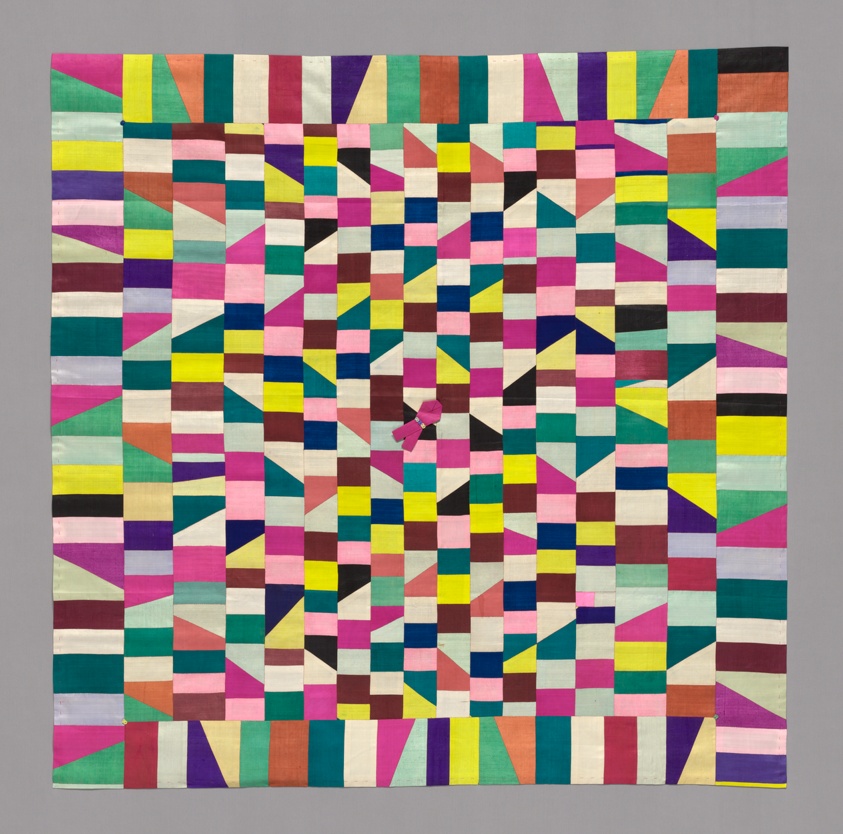
Introduction: The Pojagi as a Testament to Material Intelligence
In the lexicon of global textile heritage, the Korean Pojagi—a wrapping cloth traditionally used for carrying, storing, or gifting objects—represents a singular convergence of material discipline and aesthetic restraint. At Lauren Fashion Heritage Lab, we approach this artifact not merely as a utilitarian object, but as a profound expression of silk craftsmanship that predates and parallels the bespoke traditions of London’s Savile Row. The Pojagi examined here, constructed from silk in a plain weave, pieced with precision, and finished with attached ribbon and cord, embodies a philosophy of elegance that is both functional and transcendent. Its materiality speaks to a mastery of silk that resonates with the house codes of luxury: understated, rigorous, and deeply intentional.
Materiality: Silk, Plain Weave, and the Grammar of Structure
The foundation of this Pojagi is silk, a protein fiber revered for its tensile strength, natural luster, and ability to hold dye with remarkable clarity. The choice of a plain weave—the simplest and most ancient interlacing of warp and weft—is a deliberate act of restraint. In Savile Row tailoring, the plain weave is the canvas for worsted wools; here, it serves as the substrate for a cloth that must drape, fold, and bear weight without distortion. The silk filaments, sourced from the cocoons of Bombyx mori, are reeled into continuous threads, ensuring uniformity and resilience. This is not a fabric of ostentation; it is a fabric of quiet competence.
The plain weave structure yields a balanced, non-elastic surface that resists puckering—critical for a wrapping cloth that must maintain its geometry under tension. The silk’s natural sheen is subdued by the weave’s even texture, creating a matte finish that catches light only at the folds. This is a hallmark of classic silk craftsmanship: the material does not shout; it whispers. The hand feel is smooth yet substantial, with a slight crispness that softens with use, much like a well-worn Savile Row jacket. The weight is calibrated—neither flimsy nor heavy—allowing the cloth to cradle its contents with an almost architectural precision.
Construction: Piecing, Ribbon, and Cord as Tailored Details
The Pojagi is pieced, a technique that transforms multiple fabric panels into a unified whole. This is not mere patchwork; it is a calculated assembly that respects the grain of the silk. Each seam is aligned with the warp and weft, ensuring that the cloth hangs evenly and folds along natural axes. The piecing is executed with a finesse reminiscent of a Savile Row cutter’s hand—seams are narrow, pressed open, and virtually invisible. The stitching, likely silk thread, is fine and even, with a tension that prevents distortion. This attention to structural integrity is the hallmark of a heritage artifact designed for longevity.
The attached ribbon and cord serve both functional and ornamental roles. The ribbon, likely a silk grosgrain or satin, is stitched along the edges or corners, providing reinforcement against fraying and a tactile finish. The cord, braided from silk or a silk-cotton blend, is affixed as a tie or handle, allowing the cloth to be secured around its contents. In Savile Row terms, this is the equivalent of a hand-finished buttonhole or a pick-stitched lapel—details that signal bespoke quality. The ribbon’s width and the cord’s twist are chosen to complement the cloth’s scale; they do not overpower but rather complete the composition. The attachment method—likely a fell stitch or a backstitch—is invisible from the front, preserving the cloth’s clean surface.
Context: Classic Silk Craftsmanship and Fluid Elegance
The Pojagi’s context is rooted in Korean Confucian culture, where wrapping cloths were used in daily life and ceremonial gift-giving. Yet its materiality transcends cultural boundaries. The fluid elegance of this artifact lies in its ability to adapt: it can be folded into a pouch, draped over a shoulder, or laid flat as a presentation cloth. This versatility is a direct result of the silk’s drape and the plain weave’s stability. The cloth moves with a liquid grace, yet holds its shape when required—a paradox that defines refined craftsmanship.
In the Savile Row tradition, elegance is achieved through subtraction—removing the superfluous to reveal the essential. The Pojagi embodies this principle. There is no embroidery, no pattern, no excess. The beauty is in the silk’s natural sheen, the precision of the piecing, and the subtle contrast of the ribbon and cord. This is not a cloth that demands attention; it commands respect through its restraint. The fluidity of the silk, when combined with the structured piecing, creates a dynamic tension that is both visually and tactilely compelling. It is a lesson in how material, construction, and context coalesce into an object of enduring value.
Conclusion: The Pojagi as a Blueprint for Modern Luxury
The Pojagi, with its silk plain weave, pieced construction, and ribbon-and-cord finish, offers a masterclass in heritage design. At Lauren Fashion Heritage Lab, we recognize this artifact as a blueprint for contemporary luxury: it prioritizes material integrity over ornamentation, structural logic over fleeting trends. For the Savile Row client, the Pojagi resonates as an analogue to a bespoke suit—a garment that is built, not manufactured; that ages with grace; and that embodies the ethos of “less is more.” This wrapping cloth is not merely a relic; it is a living document of silk craftsmanship, a testament to the fluid elegance that defines true heritage.
In preserving and studying such artifacts, we reaffirm that the finest luxury is not about what is added, but about what is refined. The Pojagi, in its silent, folded state, speaks volumes.