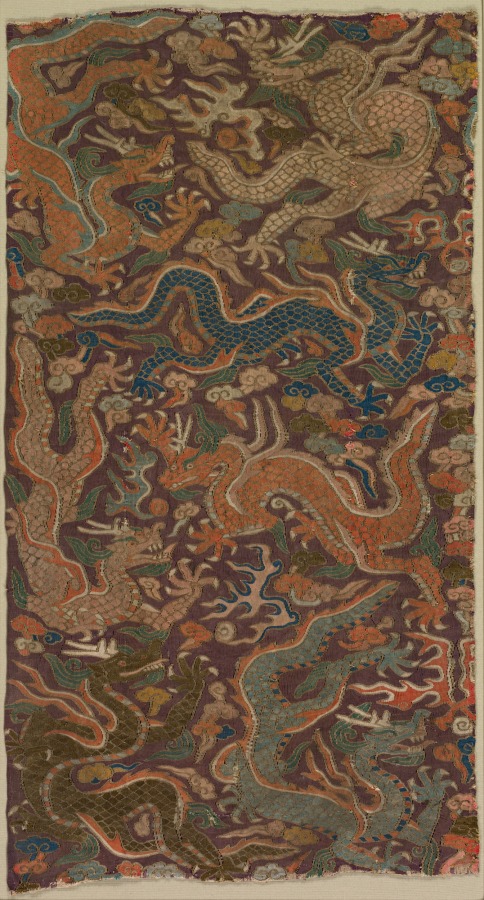
The Dragon’s Pursuit: Deconstructing the Flaming Pearl in Imperial Silk Weaving
Introduction: A Motif of Power and Transcendence
Within the hallowed archives of the Lauren Fashion Heritage Lab, we examine not merely fabric, but the encoded language of dynastic ambition. The motif of the dragon chasing a flaming pearl, rendered in the lustrous, almost liquid medium of imperial silk, stands as one of the most potent and enduring symbols in the lexicon of Chinese material culture. This is not a mere decorative flourish; it is a sophisticated narrative of celestial power, spiritual enlightenment, and the relentless pursuit of perfection—a philosophy that resonates deeply with the bespoke ethos of Savile Row. For the discerning client, understanding this artifact is to appreciate how the intangible spirit of an empire can be woven into a tangible, wearable masterpiece.
The legacy of imperial silk weaving, particularly during the Ming (1368–1644) and Qing (1644–1912) dynasties, was a state-sanctioned enterprise of unparalleled precision and secrecy. The workshops of Suzhou, Hangzhou, and Nanjing were the epicenters of this craft, where master weavers—often bound by hereditary guilds—transformed raw silk into the official regalia of the Son of Heaven. The dragon, or long, was the exclusive emblem of the emperor, a five-clawed celestial being that controlled the rains, the winds, and the very fate of the realm. The flaming pearl, or huozhu, was no mere bauble; it was a symbol of spiritual energy, wisdom, and the moon, representing the ultimate goal of immortality and cosmic harmony. The dragon’s chase is thus a metaphor for the emperor’s sacred duty: to pursue wisdom and maintain the balance between heaven and earth.
Materiality and Technique: The Silk as a Canvas for Power
The choice of silk as the medium for this narrative is not arbitrary. Silk, in its imperial context, was a material of supreme value, often referred to as “soft gold.” Its natural luster and ability to absorb the most vibrant, mineral-based dyes made it the only suitable substrate for the complex iconography of the court. The specific weaving technique used to depict the dragon and pearl was typically the kesi (cut silk tapestry) or the jin (brocade) method. In kesi, weft threads of dyed silk are individually woven into the warp, creating a tapestry-like effect with sharp, defined outlines and a subtle, reversible texture. This technique allowed for the precise rendering of the dragon’s scales, claws, and the fiery aura of the pearl, with a level of detail that mimicked painting. The jin brocade, conversely, introduced supplementary wefts of gold or silver thread, elevating the fabric to a status of near-sacred opulence. The gold thread, often made from gilded paper wrapped around a silk core, would catch the candlelight in the Forbidden City, making the dragon appear to move and breathe.
The color palette was equally codified. The ground silk was often a deep, saturated yellow—the exclusive color of the emperor—or a rich, auspicious red. The dragon itself might be rendered in brilliant gold, blue, or green, with each hue carrying specific astrological and philosophical connotations. The flaming pearl, typically a luminous orb of white, red, or gold, was surrounded by swirling, stylized flames, often depicted as ribbons or clouds. The weaver’s mastery lay in controlling the tension of the warp and the density of the weft to create a surface that was both structurally robust and visually fluid. A single robe could take months, even years, to complete, with the most skilled artisans working in teams to ensure the pattern’s flawless alignment across the garment’s seams.
Symbolic Architecture: The Chase as a Spiritual Imperative
To the uninitiated, the dragon chasing the pearl may appear as a dynamic, decorative pattern. To the scholar of heritage, it is a complex diagram of cosmic energy. The dragon, with its sinuous, S-curve body, represents the active, yang principle—masculine, creative, and expansive. The pearl, a perfect sphere, embodies the passive, yin principle—receptive, luminous, and eternal. The chase is not one of aggression but of attraction, a cosmic dance of yin and yang seeking union. This is the fundamental principle of qi (life force) and the pursuit of the Tao, or the Way. The pearl is often depicted with a swirling, spiral pattern, symbolizing the infinite cycle of creation and destruction, birth and rebirth. The dragon’s open mouth, reaching for the pearl, is a visual representation of the emperor’s aspiration to absorb this wisdom and achieve transcendence.
In the context of imperial dress, this motif was strategically placed. On a chaopao (court robe), the dragon might be positioned on the chest and back, with the pearl near the shoulder or the hem, creating a dynamic flow that guided the viewer’s eye across the garment. The number of dragons and pearls was also significant: nine dragons (a number associated with the emperor) chasing nine pearls was a common configuration, symbolizing the nine heavens and the emperor’s dominion over all realms. The placement was not merely aesthetic; it was a form of spiritual armor, a talisman woven into the very fabric of the ruler’s identity.
Savile Row Resonance: The Art of the Bespoke Narrative
The legacy of the dragon and the flaming pearl finds a profound parallel in the philosophy of London’s Savile Row. Here, the pursuit of perfection is not a fleeting trend but a hereditary discipline. The master tailor, like the imperial weaver, works with a material that demands respect—a length of cloth that must be cut, shaped, and stitched to honor the client’s form and spirit. The dragon’s chase is a metaphor for the bespoke process: the relentless, meticulous pursuit of a perfect fit, a flawless silhouette, a garment that transcends mere clothing to become an extension of the wearer’s identity.
For the modern connoisseur, a silk garment bearing this motif is not a costume but a statement of lineage. It speaks to an understanding that true luxury is not about ostentation but about meaning. The flaming pearl, in this context, becomes the client’s own aspiration—the goal of personal excellence, the pursuit of wisdom in a world of noise. The dragon is the discipline, the craft, the heritage that drives the creation. To wear such a piece is to align oneself with a tradition that values patience, skill, and the eternal chase for something greater than the self.
Conclusion: The Fabric of Eternity
The artifact of the dragon chasing the flaming pearl, woven in imperial silk, is a testament to the human desire to encode the infinite into the finite. It is a narrative of power, spirituality, and the relentless pursuit of perfection that defines both the imperial court and the Savile Row atelier. As we preserve these fragments of history in the Lauren Fashion Heritage Lab, we recognize that they are not relics but living documents. They remind us that the finest materials, when combined with the highest craft, can transcend time. For the gentleman who understands this, a silk robe is not merely a garment; it is a legacy, a pearl worth chasing for a lifetime.