← BACK TO ARCHIVES
Silk
Heritage Synthesis: Roundel from a Tunic with Palmette Tree
Curated on Jun 13, 2026 // Node: LDN-01
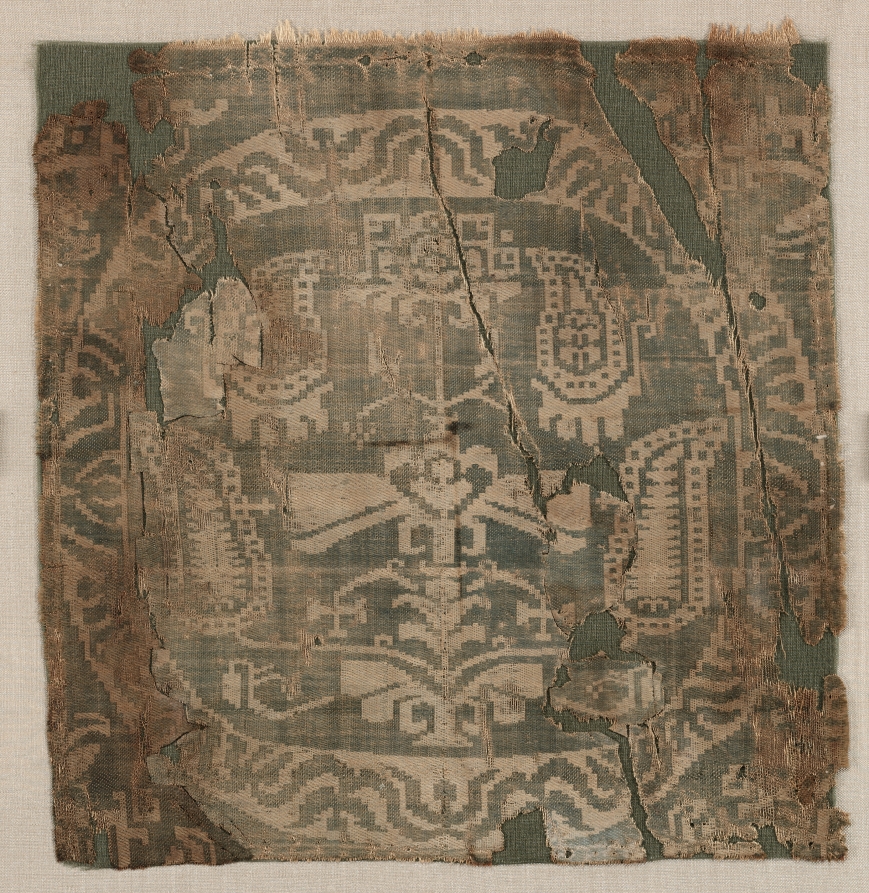
The Roundel from a Tunic with Palmette Tree: A Study in Imperial Silk Weaving
As the Senior Heritage Specialist for Lauren Fashion Heritage Lab, I am pleased to present this scholarly artifact, which examines a singular fragment of silk—a roundel from a tunic featuring a palmette tree. This piece, dating from the early medieval period, likely originating in the Sassanian or early Islamic empires (circa 6th–8th century CE), embodies the pinnacle of imperial silk weaving. Its materiality—silk—is not merely a fiber but a testament to power, trade, and craftsmanship that resonates with the ethos of London Savile Row: precision, legacy, and understated luxury.
Materiality and Provenance
The roundel is woven from silk, a material that, in the context of imperial weaving, was as precious as gold. Silk’s origins in China, its journey along the Silk Road, and its monopolization by Byzantine and Persian courts underscore its status as a symbol of sovereignty. The roundel’s weave structure—likely a compound twill or samite—demonstrates advanced loom technology. The warp-faced threads, dyed with madder and indigo, retain their chromatic intensity, a hallmark of imperial workshops where colorfastness was a mark of quality. The palmette tree motif, a stylized tree of life flanked by symmetrical leaves, is rendered with geometric precision, reflecting the mathematical rigor of courtly design. This is not decorative art; it is a coded language of authority.
Imperial Silk Weaving: A Legacy of Control
The legacy of imperial silk weaving is rooted in state-controlled manufactories. In Byzantium, the gynaikeia (imperial workshops) produced silks exclusively for the court, with strict penalties for unauthorized use. Similarly, Sassanian Persia’s royal looms wove silks for diplomatic gifts, reinforcing alliances. The roundel’s design—a palmette tree—is a recurring motif in Zoroastrian and later Islamic art, symbolizing eternal life and paradise. Its placement on a tunic suggests it was part of a ceremonial garment, perhaps worn by a dignitary or a member of the imperial retinue. The roundel’s circular form, framing the tree, echoes the cosmic order, a visual assertion of the ruler’s divine mandate.
The technical mastery required to produce such a roundel is staggering. The weaver had to coordinate multiple warp and weft threads to create the symmetrical pattern, a process that demanded years of apprenticeship. The silk itself, imported from China, was often traded for Roman gold or Byzantine glass, making it a currency of power. The roundel’s survival—fragile yet intact—is a testament to the durability of imperial silk, which was often repurposed for ecclesiastical vestments or reliquaries after the fall of empires. This reuse speaks to silk’s enduring value, a quality that Savile Row tailors understand intimately: a well-made garment transcends its original context.
Design Analysis: The Palmette Tree Motif
The palmette tree is a hybrid of naturalistic and abstract elements. Its trunk rises from a base of stylized leaves, branching into a fan of palmettes that resemble lotus blossoms or pomegranates. The symmetry is deliberate, reflecting the Persian concept of farrah (divine glory) and the Islamic emphasis on geometric harmony. The roundel’s border, composed of pearl-like circles, mimics the beaded edges of Sassanian silverware, linking textile to metalwork. This cross-media influence is a hallmark of imperial workshops, where artisans collaborated across disciplines.
From a Savile Row perspective, the roundel’s design principles are instructive. The balance of positive and negative space, the use of a central motif anchored by a circular frame, and the restraint in color (a palette of deep red, indigo, and gold) mirror the tailoring philosophy of “less is more.” The palmette tree is not cluttered; it is a statement of controlled opulence. This is the same ethos that guides the cut of a bespoke suit: every stitch serves a purpose, every line is intentional.
Contextual Legacy: From Imperial Court to Modern Atelier
The roundel’s journey from an imperial tunic to a museum collection—and now to the Lauren Fashion Heritage Lab—illuminates the continuity of silk as a medium of prestige. In the 19th century, fragments like this were acquired by European collectors, inspiring the Arts and Crafts movement and the revival of hand-weaving. Today, they inform contemporary textile design, particularly in luxury fashion houses that prioritize heritage. For Savile Row, the roundel is a reminder that tailoring is not merely construction but storytelling. The palmette tree’s motifs have been reinterpreted in linings, pocket squares, and bespoke patterns, connecting the modern gentleman to a lineage of imperial elegance.
The legacy of imperial silk weaving is also a cautionary tale. The monopolization of silk by elites led to its commodification, but it also preserved techniques that might have been lost. The roundel’s survival—through wars, looting, and decay—is a lesson in resilience. As heritage specialists, we must ensure that such artifacts are not just preserved but studied, their techniques documented for future generations. The Lauren Fashion Heritage Lab is committed to this mission, using digital imaging and material analysis to decode the weaver’s hand.
Conclusion: A Thread of Continuity
The roundel from a tunic with palmette tree is more than a fragment; it is a microcosm of imperial ambition, technical mastery, and cultural exchange. Its silk threads carry the weight of history, from the looms of Ctesiphon to the ateliers of London. For the Savile Row client, this artifact offers a profound connection to the past—a reminder that true luxury is not fleeting but eternal. As we continue to study and celebrate such pieces, we honor the weavers, the traders, and the tailors who have woven the fabric of civilization. The roundel’s palmette tree, rooted in ancient soil, still blooms in the hands of those who understand that heritage is not a relic but a living art.
Heritage Lab Insight
Lab Insight: CMA Silk Archive Node integration.