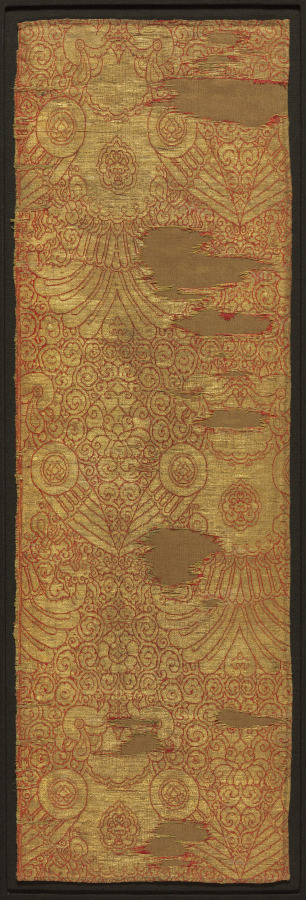
The Cloth of Gold: Displayed Falcons and the Legacy of Imperial Silk Weaving
Introduction: The Materiality of Power
The Cloth of Gold, a textile of unparalleled opulence, represents a pinnacle of human craftsmanship and imperial ambition. When we speak of the Displayed Falcons motif, we are not merely discussing a decorative pattern; we are engaging with a complex language of power, lineage, and material mastery. This heritage artifact, woven from silk and gilded thread, embodies the legacy of imperial silk weaving—a tradition that spans continents and centuries. At Lauren Fashion Heritage Lab, we approach this artifact not as a static relic, but as a living document of cultural exchange, technological innovation, and the enduring human desire to communicate status through the very fibres of our clothing.
The materiality of this piece is its first and most profound statement. Silk, derived from the cocoon of the Bombyx mori silkworm, was for millennia a closely guarded secret of the East. Its lustre, its strength, and its ability to accept the most vibrant dyes made it the ultimate luxury fibre. To weave silk with gold—be it as a wrapped thread or a flat strip—was to create a textile that was not only beautiful but also a store of wealth. The Cloth of Gold was, in essence, a portable treasury. The Displayed Falcons motif, often rendered in a heraldic pose with wings spread and talons extended, signifies dominion, vigilance, and noble lineage. In the context of imperial courts, from Byzantium to the Ottoman Empire and Renaissance Europe, such a motif was reserved for the highest echelons of society—kings, emperors, and cardinals.
The Legacy of Imperial Silk Weaving: A Technical Masterclass
The creation of a Cloth of Gold with a Displayed Falcons pattern required an extraordinary level of technical skill. The warp and weft of the silk base had to be of the finest quality, often using a compound weave structure such as a lampas or a brocade. In a lampas weave, a ground weave (usually a plain or twill) is supplemented by a second, patterned weft that floats across the surface. This allowed the gold thread to be introduced selectively, creating the falcon motif against a silk ground. The gold itself was typically gilt-silver—a thin layer of gold applied to a silver core—or gilt membrane, where gold leaf was applied to animal skin or paper, then cut into fine strips.
The legacy of imperial silk weaving is one of relentless innovation and cross-cultural pollination. The Byzantine Empire, with its state-run workshops in Constantinople, perfected the art of the Cloth of Gold, using it for imperial vestments and diplomatic gifts. The Displayed Falcons motif, with its roots in Persian and Central Asian iconography, was adopted and adapted by Byzantine weavers. When the Ottomans conquered Constantinople in 1453, they inherited this tradition and infused it with their own aesthetic, creating the magnificent seraser and serenk silks of the Topkapi Palace. These textiles, woven with silver-gilt thread and featuring stylized animal motifs, were the ultimate symbols of sultanic authority.
In Renaissance Italy, particularly in Lucca, Florence, and Venice, the art of silk weaving reached new heights. Italian weavers, many of whom had learned their craft from Byzantine and Islamic masters, produced Cloth of Gold for the courts of Europe. The Displayed Falcons motif, often combined with pomegranates, pinecones, or floral arabesques, became a staple of these luxurious fabrics. The Medici family, for example, commissioned vast quantities of such textiles for their palaces and for diplomatic gifts. The materiality of these pieces—the weight of the silk, the stiffness of the gold thread—was a tactile reminder of the wealth and sophistication of the patron.
Context: The Falcon as a Symbol of Imperial Authority
The choice of the Displayed Falcons motif is not arbitrary. In heraldry, the falcon represents nobility, courage, and the pursuit of excellence. In many cultures, falconry was the sport of kings, and the bird itself was a symbol of the ruler’s dominion over both the natural and the political world. When rendered in Cloth of Gold, the falcon becomes a statement of absolute authority. The bird’s wings are spread wide, as if to embrace the entire world, while its talons are extended, ready to seize its prey. This is a motif that speaks of power that is both benevolent and fearsome.
In the context of imperial silk weaving, the Displayed Falcons motif was often used for ceremonial garments, such as coronation robes, mantles, and altar frontals. The weight of the gold thread and the stiffness of the silk gave these garments a sculptural quality, transforming the wearer into a living icon. The light would catch the gold, creating a shimmering effect that was almost supernatural. This was not just clothing; it was a manifestation of the divine right to rule.
Preservation and Interpretation at Lauren Fashion Heritage Lab
At Lauren Fashion Heritage Lab, we treat the Cloth of Gold: Displayed Falcons artifact with the reverence it deserves. Our approach is both scientific and interpretive. We use advanced imaging techniques, such as multispectral photography and X-ray fluorescence, to analyze the composition of the silk and the metal threads. We study the weave structure to understand the loom technology used. We also consult historical documents, such as guild records and merchant ledgers, to trace the provenance of the piece.
The materiality of the artifact presents unique conservation challenges. Silk is a protein fibre that degrades over time, especially when exposed to light and humidity. The gold thread, while durable, can become brittle and break. Our conservators work meticulously to stabilize the textile, using techniques such as stitching onto a support fabric and controlling the storage environment. The goal is not to make the artifact look new, but to preserve its integrity for future generations.
Interpretively, we place the Displayed Falcons within a broader narrative of cultural exchange. This motif, born in the East, was transformed by the West, and then re-exported to the East through trade and diplomacy. The Cloth of Gold itself is a testament to the interconnectedness of the pre-modern world. It reminds us that luxury has always been a global enterprise, and that the desire for beauty and status transcends borders.
Conclusion: The Enduring Allure of Gold and Silk
The Cloth of Gold: Displayed Falcons is more than a historical artifact; it is a lesson in the power of materiality. The silk and gold that compose it are not just materials; they are symbols of human ingenuity, ambition, and artistry. The legacy of imperial silk weaving lives on in the work of contemporary designers who continue to be inspired by these ancient techniques. At Lauren Fashion Heritage Lab, we are committed to preserving this legacy, not as a museum piece, but as a source of inspiration for the future of fashion.
In the words of a Savile Row tailor, the Cloth of Gold is the ultimate bespoke fabric—a material that demands respect, skill, and a deep understanding of its history. The Displayed Falcons motif, with its heraldic power and timeless elegance, reminds us that true luxury is never about excess; it is about meaning. And in this artifact, meaning is woven into every thread.