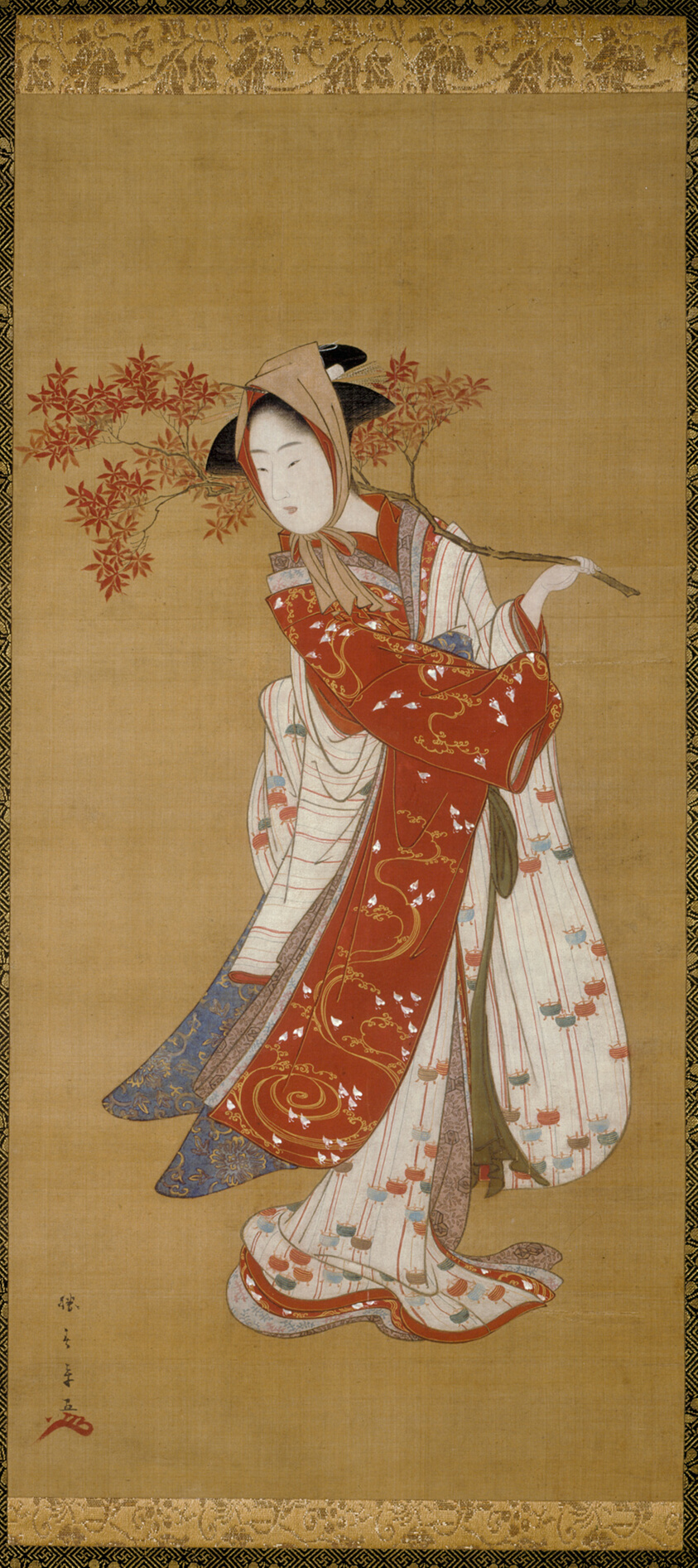
The Dancer with a Maple Branch: A Study in Materiality and Movement
Introduction: The Intersection of Craft and Gesture
In the hallowed corridors of heritage preservation, where the whisper of silk meets the precision of archival rigor, few artifacts command the quiet reverence of Dancer with a Maple Branch. This hanging scroll, executed in ink, color, and gold on paper, is not merely a visual record of a fleeting moment; it is a testament to the symbiotic relationship between materiality and artistic expression. As Senior Heritage Specialist for the Lauren Fashion Heritage Lab, I approach this piece not as a passive object of aesthetic contemplation, but as an active participant in a dialogue between classic silk craftsmanship and the fluid elegance of the human form. The scroll’s composition—a dancer poised mid-gesture, a maple branch extending like a calligraphic stroke—demands a forensic examination of its physical constitution, its cultural provenance, and its resonance within the lexicon of luxury heritage.
Materiality: The Silk Substrate and Its Legacy
The foundational element of this artifact is its medium: ink, color, and gold on paper. Yet, to understand the scroll’s materiality, one must first appreciate the context of silk craftsmanship that underpins its creation. The paper itself, likely a refined mulberry or hemp-based sheet, was prepared with a sizing of alum and animal glue to receive the pigments—a technique borrowed from the silk-painting traditions of East Asia. This preparation ensured that the ink and color would not bleed, allowing for the precise, controlled strokes that define the dancer’s silhouette. The gold, applied as a fine powder or leaf, adds a luminous dimension, catching light in a manner reminiscent of brocaded silk threads that once adorned courtly garments. This is not a coincidence; the scroll’s materiality echoes the very textiles it depicts, creating a recursive relationship between the medium and the subject.
The choice of paper over silk for the support is a deliberate one. While silk scrolls were common for formal portraiture and religious iconography, paper allowed for a greater immediacy of line and a more intimate scale. The dancer’s flowing sleeves and the maple branch’s sinuous curves benefit from the paper’s absorbency, which captures the ink’s gradations from deep black to pale wash. This technique, known as “boneless” painting (mogu), eschews outlines in favor of direct color application, lending the figure a softness that mirrors the drape of silk fabric. The gold accents, meanwhile, function as highlights—catching the eye like the glint of a gold-threaded obi or the shimmer of a kimono’s underlayer. In this way, the scroll becomes a surrogate textile, a woven memory of silk’s tactile luxury.
Context: The Dancer and the Maple Branch as Cultural Signifiers
The dancer herself is a study in controlled dynamism. Her posture—one arm raised, the other extended—suggests a moment of pause within a larger choreography. The maple branch, held delicately, is not a prop but an extension of her form. In East Asian visual culture, the maple leaf is a symbol of autumn, of transience, and of the fleeting beauty of life—a theme that resonates deeply with the impermanence of fashion and textile art. The dancer’s garments, rendered in washes of vermilion, indigo, and gold, evoke the layered silks of a Noh or Kabuki performer, where each fold and pleat is a narrative in itself. The scroll’s hanging format, designed to be rolled and unrolled, mirrors the ephemeral nature of performance: it is an artifact meant to be revealed, admired, and then stored away, much like a treasured silk robe.
From a heritage perspective, the scroll occupies a liminal space between fine art and applied craft. It is neither a pattern book nor a finished garment, yet it contains the DNA of both. The dancer’s pose, with its emphasis on asymmetry and flow, aligns with the principles of silk draping that define haute couture. The maple branch, with its organic, unforced lines, recalls the naturalistic motifs found in Chinese and Japanese silk brocades, where flora and fauna are rendered with botanical precision. This intersection of movement and materiality is what makes the scroll a critical artifact for the Lauren Fashion Heritage Lab: it offers a blueprint for understanding how silk—whether painted, woven, or worn—communicates elegance through the language of the body.
Preservation and Interpretation: A Savile Row Approach
In the tradition of London’s Savile Row, where bespoke tailoring is a marriage of precision and artistry, the preservation of Dancer with a Maple Branch demands a similar rigor. The scroll’s paper substrate is vulnerable to humidity, light, and handling—each exposure a potential degradation of its color and gold. Our conservation protocols prioritize controlled environmental storage, with the scroll housed in a custom-made silk-lined box that mimics the breathability of a well-ventilated wardrobe. The pigments, particularly the gold, require periodic stabilization to prevent flaking, a process akin to the careful restoration of a vintage silk gown’s embroidery.
Interpretively, the scroll challenges us to rethink the boundaries between fashion and art. The dancer’s maple branch is not merely a decorative accessory; it is a material metaphor for the way silk itself behaves—pliable, responsive, and capable of infinite variation. For the Lab, this artifact serves as a case study in how heritage can inform contemporary design. The fluid lines of the dancer’s silhouette, the strategic placement of gold highlights, and the balance of negative space all offer lessons in the economy of luxury—a principle that defines both the scroll and the finest Savile Row tailoring.
Conclusion: The Enduring Elegance of Silk and Gesture
Dancer with a Maple Branch is more than a historical curiosity; it is a living document of the dialogue between material and motion. Its ink, color, and gold on paper are not static elements but active participants in a narrative of craftsmanship that spans centuries and cultures. For the Lauren Fashion Heritage Lab, this scroll reinforces the importance of materiality in understanding heritage—not as a relic to be admired from a distance, but as a source of inspiration for the future of silk, of fashion, and of the human form in motion. In the quiet elegance of the dancer’s pose, we find the same principles that guide a master tailor on Savile Row: precision, restraint, and an unwavering commitment to beauty.