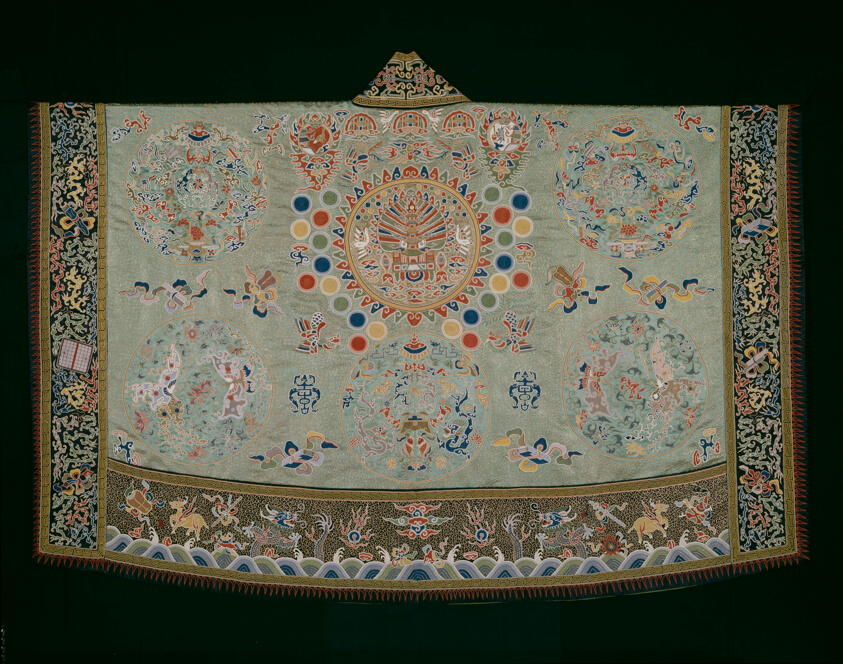
An Exegesis of Sanctified Fabric: The Taoist Priest's Vestment as an Artifact of Ultimate Refinement
To engage with a First-degree Taoist priest’s vestment is not merely to observe a ceremonial garment. It is to be granted an audience with a singular confluence of metaphysics and materiality, where the most profound philosophical abstractions are given form through the most exacting standards of textile art. This is heritage of the most rarefied order: a sartorial instrument of ritual, whose authority is derived equally from its doctrinal symbolism and its uncompromising execution in silk. In the canon of global bespoke traditions, from the hallowed workrooms of Savile Row to the ateliers of imperial weavers, this vestment stands as a peerless exemplar of purpose-driven craftsmanship.
The Foundation: Silk as Sacred Substrate
The selection of silk is the first and non-negotiable doctrinal statement. In Taoist cosmology, silk (帛, *bó*) is historically linked to offerings, to purity, and to communication with the celestial realms. Its very production—the transformation of the silkworm’s cocoon—mirrors core Taoist principles of metamorphosis, latent potential, and the emergence of refined beauty from humble origins. The materiality specified—satin weaves for the primary ground—is a deliberate pursuit of a specific visual and tactile theology. The satin weave, with its long floats of warp yarn, produces an unbroken, luminous surface that captures and reflects light with a soft, liquid sheen. This is not mere opulence; it is the cultivation of a visual *qi*, a radiant field that enhances the priest’s presence during rituals, setting him apart from the mundane world. The lining of twill damask provides structural integrity and a private luxury, a hidden order that reinforces the garment’s status as a total, considered object.
The Iconography of Metal: Embroidery as Alchemical Process
The embroidery transcends decoration to become a form of scriptural inscription. The use of silk thread in laid work and couching provides the chromatic and textural base—the earthly flora, celestial clouds, and symbolic creatures (cranes, *qilins*) that populate the vestment’s iconography. However, the introduction of silver-leaf-over-lacquered-paper strips and gold-leaf-over-lacquered-paper-strip-wrapped silk represents an alchemical elevation. Here, material is transformed. The lacquered paper provides a flexible, durable core, over which the precious metal leaf is applied. This technique, far more sophisticated than simple metallic thread, achieves a singular effect: a flat, mirror-like plane of pure, reflective metal that does not tarnish with the malleability of thread.
The application of these strips via couching is an exercise in precision that would command respect in any bespoke embroidery atelier. Each strip is laid upon the silk ground and secured by tiny, virtually invisible stitches of silk along its edges. The result is a continuous, gleaming line—the unbroken contour of a mystical symbol, the sharp edge of a ritual sword motif. This creates a dynamic interplay of light: the diffuse glow of the satin silk ground against the sharp, specular highlights of the metal. Symbolically, the gold embodies the Yang principle—heaven, light, and activity; the silver reflects the Yin—the moon, receptivity, and introspection. Their union on the vestment visualizes the primordial harmony of Taiji, the very state the priest mediates.
Cut, Drape, and Ritual Kinetics: The Architecture of Fluidity
The prescribed "fluid elegance" is not an aesthetic afterthought but a functional and doctrinal imperative. Unlike the structured, tailoring-forward ethos of a Savile Row morning coat, which seeks to sculpt the static form, the Taoist vestment is engineered for movement within ritual. Its cut is generous, its sleeves wide and flowing. This allows for the sweeping, circular gestures of ceremonial dance, the presentation of ritual objects, and the drawing of talismans in the air. The garment becomes an extension of the body’s kinetic energy, its silken folds capturing and amplifying motion, much like the trailing clouds it often depicts.
The ties, crafted from satin-weave silk, are the subtle anchors of this fluid system. They allow for a secure yet adjustable closure that respects the layers beneath and accommodates the physical demands of prolonged ceremony. The elegance, therefore, is active. It is the elegance of a waterfall’s arc, of swirling incense smoke—a beauty inherent in perfected, purposeful motion. The drape of the heavy, embroidered silk creates a columnar silhouette that denotes authority and stability, while its movement asserts a dynamic connection with the unseen forces being invoked.
Conclusion: A Garment as a Vessel
To conclude, this First-degree Taoist priest’s vestment is a heritage artifact of formidable intellectual and artistic coherence. Every element, from the molecular choice of silk filament to the macro consideration of ritual drape, is subordinated to a unified purpose: the creation of a sartorial vessel worthy of mediating between humanity and the Dao. It employs a material grammar where satin weave signifies luminous purity, where couched gold and silver enact cosmological balance, and where fluid cut facilitates sacred kinetics.
It stands, therefore, as a definitive statement of bespoke integrity. While a Savile Row tailor masters the anatomy of man to project worldly authority, the masters of this tradition master the anatomy of cosmology to project spiritual authority. The vestment is not worn; it is operated. It remains one of the most sophisticated applications of silk craftsmanship ever devised, a perfect and enduring synthesis of profound thought and peerless execution, where every stitch is a silent prayer and every fold, a theorem of the sacred.