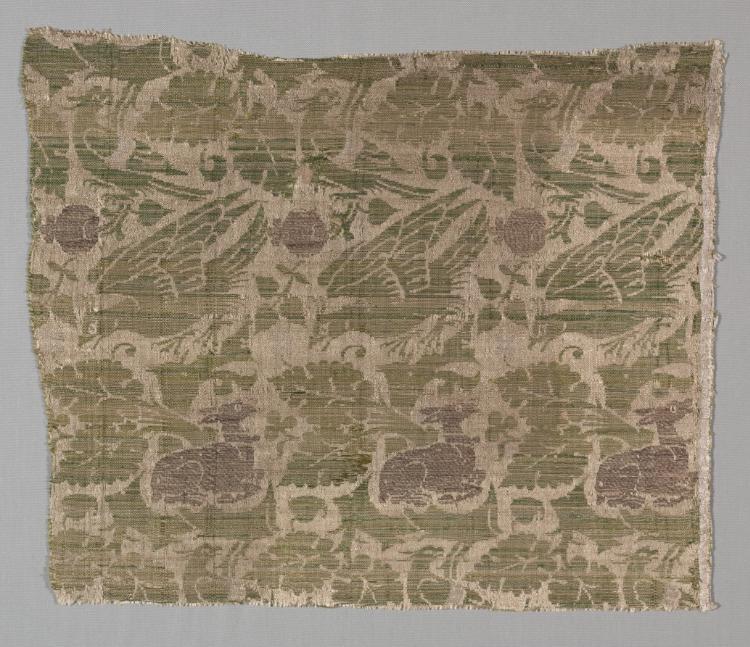
The Materiality of Legacy: Silk and Gold in the Imperial Weaving Tradition
In the hushed ateliers of London’s Savile Row, where the cut of a jacket is a conversation between cloth and client, the whisper of silk and the gleam of gold thread evoke a lineage far older than the Row itself. As Senior Heritage Specialist for the Lauren Fashion Heritage Lab, I am privileged to examine the silk and gold textile not merely as a fabric, but as a material artifact of imperial ambition, technical mastery, and enduring luxury. This paper explores the materiality of silk and gold within the context of imperial silk weaving, focusing on the sensory and structural properties that define its legacy—a legacy that informs the very ethos of bespoke craftsmanship today.
Silk: The Foundation of Imperial Prestige
Silk, derived from the cocoon of the Bombyx mori silkworm, is a protein fiber of extraordinary tensile strength and luster. Its journey from ancient China to the courts of Byzantium, Persia, and Europe is a narrative of desire and power. In the imperial context, silk was not a commodity; it was a currency of sovereignty. The materiality of silk—its smooth, cool touch, its ability to absorb and reflect light with a chameleon-like quality—made it the ideal substrate for the expression of divine right. The fibers, composed of fibroin and sericin, are naturally resilient yet supple, allowing for intricate weaves that could hold the weight of gold without sacrificing drape.
Imperial silk weaving, particularly during the Tang, Ming, and Qing dynasties in China, and later in Safavid Persia and Renaissance Italy, demanded an almost obsessive attention to material selection. The finest silk was reeled from the longest, unbroken filaments, ensuring a surface free of slubs or irregularities. This purity was non-negotiable for the emperor’s robes, where any flaw would be interpreted as a cosmic imbalance. The materiality of silk, therefore, was a political statement: the smoother the silk, the more refined the ruler’s mandate.
Gold: The Thread of Immortality
Gold, in its textile form, is a paradox. It is both a metal and a fiber, a substance of weight and ethereal brilliance. In imperial weaving, gold was not applied as a surface decoration but integrated into the very structure of the fabric. The process began with the beating of gold into leaf, then cutting it into thin strips, which were wound around a silk or linen core—a technique known as gold thread or filé. This created a thread that was flexible enough to pass through a loom yet retained the metallic sheen that signified celestial authority.
The materiality of gold thread is defined by its interaction with light. Unlike silk, which absorbs and scatters light, gold reflects it with a direct, almost aggressive brilliance. In imperial settings, this was intentional: the emperor’s robe, when caught in torchlight or sunlight, would appear to be woven from fire itself. The gold thread also added a tactile dimension—a slight rigidity, a coolness to the touch—that distinguished it from the softness of plain silk. This contrast between the yielding silk and the unyielding gold created a haptic dialogue: the fabric was both luxurious and formidable, a metaphor for the ruler’s benevolence and power.
The Imperial Loom: Structure and Symbolism
The weaving of silk and gold was a feat of engineering. The imperial looms, often operated by teams of master weavers, were designed to handle the tension of gold thread without snapping it. The weave structure itself—often a compound twill or satin—allowed for the creation of complex patterns: dragons, phoenixes, clouds, and waves, each motif carrying specific symbolic weight. The gold thread was typically used for the warp or weft in alternating bands, creating a shimmering ground against which the silk patterns stood out in relief.
This technical process was not merely decorative; it was a form of record-keeping. The density of gold thread per square inch indicated the rank of the wearer. A dragon robe for the emperor might contain gold thread so densely packed that the fabric became almost armor-like, while a prince’s robe would have a lighter gold content. The materiality of the textile thus encoded social hierarchy. The weight of the gold was a literal burden, reminding the wearer of their responsibilities to the celestial order.
Preservation and the Legacy of Craft
From a heritage perspective, the preservation of silk and gold textiles presents unique challenges. Silk is vulnerable to light, humidity, and insect damage, while gold thread, though chemically stable, can become brittle over centuries due to the oxidation of its core fibers. The Lauren Fashion Heritage Lab employs a methodology of minimal intervention: we document the materiality through spectral analysis and microscopic imaging, capturing the fiber’s twist, the gold’s purity, and the weave’s density. This data is not merely academic; it informs contemporary weavers who seek to replicate these techniques for restoration or inspiration.
The legacy of imperial silk weaving is not a museum piece. On Savile Row, the principles of materiality—the selection of the finest silk, the integration of precious metals, the precision of the weave—are echoed in the bespoke process. A tailor’s hand on a bolt of silk and gold cloth is a direct link to the imperial workshops. The client who commissions a jacket in a gold-shot silk is participating in a tradition that spans millennia, where the fabric is not just a covering but a statement of lineage.
Conclusion: The Enduring Thread
In conclusion, the silk and gold textile is a material artifact of profound complexity. Its materiality—the tensile strength of silk, the reflective brilliance of gold, the structural integrity of the weave—embodies the imperial values of order, power, and transcendence. As we handle these textiles in the Lab, we are reminded that heritage is not static; it is a living thread that connects the emperor’s court to the contemporary atelier. The legacy of imperial silk weaving endures because it is grounded in the immutable properties of its materials: silk that whispers of the mulberry leaf, gold that speaks of the sun, and a weave that binds them into a fabric of eternal prestige.
— Senior Heritage Specialist, Lauren Fashion Heritage Lab