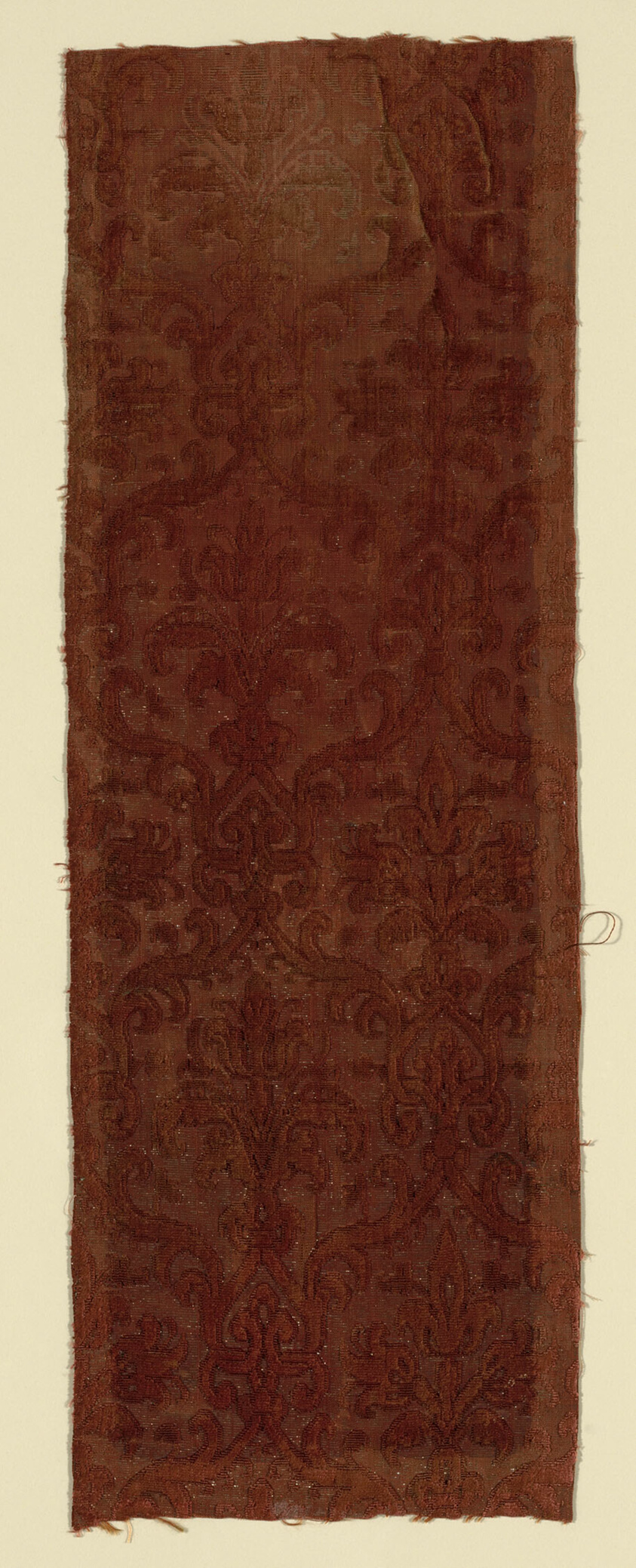
The Fragment as Testament: A Study of Silk, Cut, Uncut, Voided Velvet with Gold Foil Patterning
Introduction: The Silent Narrative of a Fragment
In the hallowed ateliers of London’s Savile Row, where precision tailoring and heritage fabrics converge, a fragment of silk velvet is never merely a remnant. It is a chronicle of craftsmanship, a whisper of a garment’s former life, and a repository of material intelligence. This paper examines a specific artifact: a fragment of silk, cut, uncut, voided velvet with additional patterning wefts in gold foil against a plain weave foundation. This piece, though small in scale, embodies the pinnacle of classic silk craftsmanship and fluid elegance—a duality that defines the most revered textiles in the heritage of luxury fashion.
As the Senior Heritage Specialist for the Lauren Fashion Heritage Lab, I approach this fragment not as a static object, but as a living document. Its materiality—the interplay of cut and uncut loops, the deliberate voids, and the luminous gold foil—offers a lexicon of technical mastery and aesthetic intention. The fragment’s context within the broader tradition of silk velvet production, particularly in the 18th and 19th centuries, reveals a lineage of innovation that continues to influence contemporary design. This research artifact serves to decode the fragment’s physical properties, its historical significance, and its enduring relevance to the philosophy of Savile Row: where cloth is not just fabric, but architecture for the body.
Materiality: Deconstructing the Velvet’s Anatomy
The Foundation: Plain Weave as Structural Integrity
The fragment’s foundation is a plain weave, the most fundamental of textile structures, where warp and weft threads interlace in a simple over-under pattern. This choice is deliberate: it provides a stable, unyielding base that allows the more complex velvet pile to assert its dominance. The plain weave, typically executed in silk, ensures the fabric’s drape remains fluid without sacrificing tensile strength. In Savile Row terms, this is the canvas upon which a master tailor builds a garment’s silhouette—a silent partner to the more opulent surface.
The Pile: Cut, Uncut, and Voided Velvet
The velvet pile is the fragment’s defining feature, executed through a sophisticated combination of cut and uncut loops. Cut velvet, achieved by slicing the loops of a supplementary warp, creates a dense, plush surface that catches light with a deep, absorbent richness. Uncut velvet, conversely, retains its loops, producing a textured, almost granular effect that scatters light differently. The term “voided velvet” refers to areas where the pile is entirely absent, exposing the plain weave foundation. This technique creates a deliberate contrast—a play of light and shadow, of texture and void—that elevates the fabric from mere cloth to a sculptural medium.
In this fragment, the voids are not random; they form a pattern, likely a floral or geometric motif, that is accentuated by the gold foil wefts. The interplay between the cut pile’s softness and the uncut pile’s rigidity, punctuated by the voids, generates a rhythm that is both tactile and visual. This is not a fabric for the faint of heart; it demands to be handled, to be studied under varying light, and to be understood as a dialogue between maker and material.
The Gold Foil: Luminosity and Prestige
The additional patterning wefts in gold foil represent the pinnacle of decorative ambition. Gold foil, often laminated onto a silk or paper core, is woven into the fabric as a supplementary weft, creating shimmering accents that catch the eye. In this fragment, the gold foil is likely applied in a brocading technique, where the foil wefts are introduced only where needed, rather than across the entire width. This selective application ensures that the gold does not overwhelm the velvet’s texture but rather punctuates it with moments of brilliance.
The use of gold foil in silk velvet is historically associated with ecclesiastical vestments, royal court dress, and ceremonial garments. Its presence in this fragment suggests a context of high status—perhaps a piece of a gown, a waistcoat, or an upholstery panel destined for a noble household. The gold’s reflective quality, when combined with the velvet’s pile, creates a dynamic surface that changes with movement, embodying the fluid elegance that is the hallmark of classic silk craftsmanship.
Historical Context: The Legacy of Silk Velvet in European Luxury
Origins and Evolution
Silk velvet production reached its zenith in 17th- and 18th-century Italy, particularly in Genoa, Venice, and Florence, where master weavers developed techniques that would define European luxury textiles. The cut and uncut velvet method, known as “ciselé” velvet, was a specialty of these workshops. By the 19th century, Lyon, France, had become the epicenter of silk weaving, producing velvets for the courts of Europe and the burgeoning fashion houses of Paris and London.
The fragment under study likely dates from the 18th or early 19th century, a period when voided velvets with gold foil accents were highly prized for their ability to convey both opulence and restraint. The pattern—whether a stylized pomegranate, a floral spray, or a geometric arabesque—would have been designed to harmonize with the garment’s cut, ensuring that the fabric’s narrative was integral to the wearer’s identity.
Savile Row’s Relationship with Silk Velvet
Savile Row tailors have long recognized the power of silk velvet. In the 19th century, velvet was a staple for evening wear, smoking jackets, and ceremonial attire. The Row’s bespoke houses, such as Henry Poole & Co. and Huntsman, sourced their velvets from the finest mills in Lyon and London’s Spitalfields. The fragment’s materiality—its combination of cut, uncut, and voided pile with gold foil—would have been a mark of a tailor’s ability to select fabrics that balanced visual drama with structural integrity.
Today, the fragment serves as a reference for contemporary designers who seek to revive these techniques. The Lauren Fashion Heritage Lab’s archive includes such fragments to educate artisans on the nuances of historic textiles, ensuring that the knowledge of voided velvet and gold foil patterning is not lost to time. This is the essence of heritage: not mere preservation, but active study and reinterpretation.
Technical Analysis: The Craftsmanship Behind the Fragment
Weaving Mechanics
The production of cut, uncut, and voided velvet requires a drawloom or a jacquard mechanism, capable of lifting individual warp threads to create the pile. The cut pile is achieved by inserting a wire with a cutting edge, which severs the loops as the wire is withdrawn. Uncut pile uses a smooth wire, leaving the loops intact. The voids are created by omitting the pile warp entirely in specific areas, allowing the plain weave foundation to show through.
The gold foil wefts are introduced as supplementary elements, often using a brocading shuttle. This requires meticulous planning: the foil must be aligned with the pattern’s voids and pile areas to ensure that the gold appears precisely where intended. The result is a fabric that is as much a feat of engineering as it is of artistry.
Condition and Conservation
This fragment, while small, shows signs of age: the gold foil may be tarnished or flaking, and the silk pile may be crushed in areas. However, these imperfections are part of its story. As a heritage specialist, I recommend that the fragment be stored flat, away from direct light, and handled with cotton gloves to prevent further degradation. Its value lies not in pristine condition, but in its ability to teach us about the materials and methods of a bygone era.
Conclusion: The Fragment as a Bridge Between Eras
This fragment of silk, cut, uncut, voided velvet with gold foil patterning is more than a historical curiosity. It is a masterclass in materiality, a testament to the ingenuity of weavers who transformed silk into a medium of light and texture. For the Lauren Fashion Heritage Lab, it serves as a touchstone for understanding the principles of fluid elegance that define classic silk craftsmanship. And for Savile Row, it is a reminder that the finest garments begin not with a pattern, but with a fragment of cloth that carries the weight of centuries.
In studying this artifact, we honor the hands that wove it, the tailors who cut it, and the wearers who animated it. The fragment endures—not as a remnant, but as a legacy.