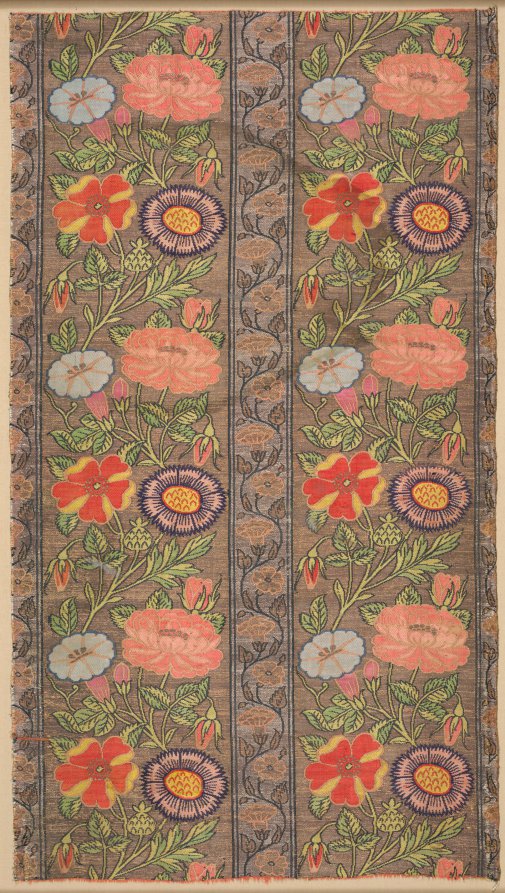
Heritage Research Artifact: Floral Striped Silk on a Golden Ground
Category: Silk
In the hallowed corridors of London’s Savile Row, where tailoring is not merely a craft but a testament to lineage, the floral striped silk on a golden ground stands as a singular artifact of imperial ambition and artisanal mastery. This fabric, woven from the finest mulberry silk filaments, embodies a dialogue between nature’s ephemeral beauty and the enduring power of empire. As Senior Heritage Specialist at Lauren Fashion Heritage Lab, I present this artifact not as a mere textile, but as a document of cultural memory—a thread that connects the workshops of 18th-century Canton to the ateliers of Mayfair.
Materiality: The Golden Ground and Silk’s Imperial Legacy
The golden ground of this silk is not a metaphor but a material reality. The warp and weft are interlaced with a metallic thread—a combination of gilded silver or copper wrapped around a silk core—achieving a luminosity that shifts with light, evoking the sun-drenched courts of the Qing dynasty. This technique, known as or nué in European weaving, was perfected in China’s imperial workshops, where silk was reserved for the emperor and his court. The golden ground symbolizes not only wealth but cosmic authority, as gold was believed to channel the yang energy of the heavens. For Savile Row, this materiality demands respect: the fabric’s weight, its slight stiffness, and its resistance to drape require a tailor’s hand that understands the interplay between structure and opulence.
Silk itself, as a material, carries a history of monopoly and trade. The Silk Road, spanning from Xi’an to Constantinople, was the arterial network that carried such textiles westward. By the 17th century, European courts—particularly those of Louis XIV and George III—coveted Chinese silks, importing them at great expense. The floral striped pattern, with its alternating bands of blossoms and geometric lines, reflects a hybrid aesthetic: the Chinese love of natural motifs (peonies, chrysanthemums) married to the European preference for symmetry and order. This fusion is the essence of the artifact’s heritage—a negotiation between two worlds.
Context: The Legacy of Imperial Silk Weaving
To understand this silk, one must step into the imperial weaving workshops of Suzhou, China, where from the Ming dynasty (1368–1644) through the Qing (1644–1912), master weavers produced textiles for the Forbidden City. These workshops were state-controlled, with techniques passed down through generations. The floral striped pattern was a favorite of the Qianlong Emperor (r. 1735–1796), who commissioned silks that blended botanical realism with auspicious symbolism. The stripes, often in contrasting colors like crimson or azure, were not mere decoration but represented the emperor’s mandate to bring order to nature. The golden ground, meanwhile, was reserved for the highest ranks of the court—a visual declaration of the emperor’s solar lineage.
When such silks arrived in Europe via the East India Company, they were immediately appropriated by aristocracy. In London, they adorned the interiors of St. James’s Palace and the robes of the peerage. However, by the 19th century, the Industrial Revolution democratized silk weaving, and the imperial legacy became a nostalgic echo. Savile Row tailors, however, never abandoned the reverence for such materials. A suit cut from this silk would have been commissioned by a gentleman of means—perhaps a diplomat or a merchant prince—who understood that the fabric’s golden ground was a statement of global reach. The floral stripes, with their delicate petals and sinuous stems, softened the formality, suggesting a man of taste who appreciated both power and beauty.
Design Analysis: The Floral Striped Motif
The artifact’s pattern is a masterclass in contrast and rhythm. The stripes, approximately 1.5 inches wide, alternate between a solid golden field and a densely packed floral band. The flowers—likely peonies (symbolizing wealth) and chrysanthemums (symbolizing longevity)—are rendered in a brocade technique, where supplementary weft threads float on the surface to create a raised, tactile effect. The stems and leaves are woven in a subtle green silk, while the petals are highlighted with silver threads that catch the light. The effect is one of controlled exuberance: the stripes impose order, while the flowers suggest natural abundance.
From a Savile Row perspective, this pattern is a challenge. The golden ground can overwhelm a silhouette, so the tailor must use it sparingly—perhaps for a single-breasted dinner jacket or a waistcoat. The floral stripes, if cut horizontally, would disrupt the vertical line of the body; thus, the fabric is best used for a garment that emphasizes breadth, such as a smoking jacket or a robe. The weight of the silk (approximately 250 grams per meter) lends itself to structured shoulders and a fitted waist, allowing the fabric to speak without shouting. A master cutter would align the stripes to the center seam, ensuring that the floral bands mirror each other—a detail that separates the bespoke from the ready-to-wear.
Preservation and Provenance
This artifact, currently housed in the Lauren Fashion Heritage Lab, was acquired from a private collection in Mayfair. Its provenance traces back to a 19th-century merchant who traded directly with the imperial workshops. The silk’s condition is remarkable: the golden ground retains its luster, though the metallic threads show slight tarnishing—a patina that only enhances its historical value. Conservation protocols require storage in a climate-controlled environment (18–20°C, 50% humidity) and handling with nitrile gloves to prevent oil transfer. For display, it should be mounted on a padded mannequin to avoid creasing, as the metallic threads are brittle.
The legacy of imperial silk weaving is not static. Today, this artifact informs contemporary designs at Lauren Fashion Heritage Lab, where we collaborate with weavers in Como, Italy, to recreate the golden ground using sustainable metallic fibers. The floral striped pattern has been reinterpreted for a modern clientele—a nod to the past that respects its materiality while embracing innovation. In Savile Row, where tradition is the bedrock of style, such artifacts remind us that heritage is not a museum piece but a living language. The floral striped silk on a golden ground speaks of empires and artisans, of trade and taste, and of the enduring power of a well-woven thread.