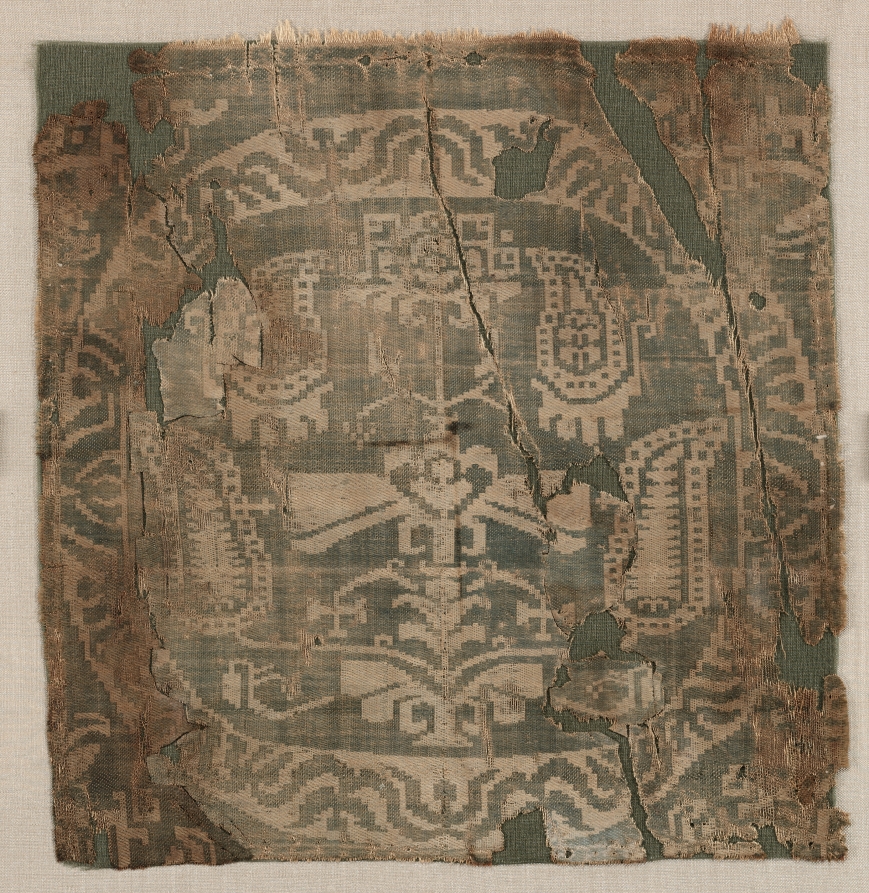
The Roundel from a Tunic with Palmette Tree: A Testament to Imperial Silk Weaving
Introduction: The Artifact as a Cultural Archive
The Roundel from a Tunic with Palmette Tree, rendered in silk, stands as a singular artifact within the annals of textile heritage. This roundel, a circular decorative panel likely once adorning a ceremonial tunic, encapsulates the zenith of imperial silk weaving—a craft that transcended mere utility to become a medium of political power, spiritual symbolism, and artistic mastery. As a Senior Heritage Specialist at Lauren Fashion Heritage Lab, I approach this object not merely as a fragment of fabric, but as a tangible narrative of empire, trade, and the enduring legacy of silk as a luxury commodity. The roundel’s materiality—silk—is its foundational identity, linking it to a lineage of production that spans from the ancient Silk Roads to the ateliers of Byzantium, Persia, and beyond. Its design, featuring a palmette tree, evokes the cosmic tree of life, a motif that resonates across cultures, yet its execution in silk underscores the exclusivity and technical prowess reserved for imperial courts.
The context of imperial silk weaving is critical to understanding this artifact. Silk was not merely a fabric; it was a currency of diplomacy, a marker of status, and a canvas for ideological expression. The roundel’s intricate weave, likely achieved through compound twill or lampas techniques, reflects the sophisticated looms and dyeing processes that were closely guarded secrets of imperial workshops. These workshops, often state-controlled, produced textiles that were distributed as gifts to allies, worn by monarchs, and used in religious ceremonies. The roundel, therefore, is a microcosm of this system—a piece of a larger garment that would have signified the wearer’s proximity to power and their role in the imperial hierarchy.
Materiality: Silk as a Medium of Imperial Prestige
Silk’s material properties—its luster, strength, and ability to absorb vibrant dyes—made it the preferred medium for imperial regalia. The roundel’s silk threads, likely sourced from domesticated silkworms (Bombyx mori), were cultivated in sericulture centers such as China, Persia, and later the Byzantine Empire. The dyeing process, using natural pigments derived from plants, minerals, and insects, produced hues that were often reserved for royalty—deep purples, crimsons, and golds. In this roundel, the palmette tree motif is rendered in contrasting colors, possibly with metallic threads to enhance its luminosity. This use of silk and metallic elements not only elevated the aesthetic but also served a functional purpose: the reflective quality of silk and metal threads would have caught light during ceremonial processions, reinforcing the divine or sovereign aura of the wearer.
The roundel’s weave structure is a testament to the technical innovation of imperial silk weaving. The compound weave, often with a warp-faced pattern, allowed for intricate designs to be repeated across the fabric, creating a sense of rhythm and order. This precision was achieved through drawlooms, which required skilled artisans to manipulate thousands of threads. The roundel, as a discrete element, would have been woven as part of a larger textile, then cut and applied to the tunic. This process underscores the value placed on silk—no thread was wasted, and every fragment was imbued with intentionality. The materiality of silk, therefore, is not just a physical attribute but a cultural and economic statement. It speaks to the global networks that supplied raw materials, the labor systems that produced the fabric, and the consumption patterns of elite patrons.
Design Analysis: The Palmette Tree as a Symbolic Motif
The palmette tree, central to the roundel’s design, is a motif with deep historical roots. Originating in ancient Mesopotamian and Persian art, the palmette—a stylized palm frond or leaf—evolved into a symbol of fertility, victory, and eternal life. In the context of imperial silk weaving, the palmette tree often represented the cosmic tree or the tree of life, connecting earthly rulers to divine realms. The roundel’s composition typically features a central tree with symmetrical branches, flanked by smaller palmettes or animals, creating a balanced, heraldic arrangement. This symmetry is not merely aesthetic; it reflects the order and stability that imperial regimes sought to project. The tree’s vertical axis suggests growth and continuity, while the circular format of the roundel implies eternity, a common theme in royal iconography.
The choice of the palmette tree for a tunic roundel is significant. Tunics, as garments, were often worn by military and court officials, and the roundel served as a badge of identity. In Byzantine and Sasanian contexts, similar roundels were used to denote rank, with specific colors and motifs reserved for the emperor or high clergy. The palmette tree, with its associations with paradise and kingship, would have been appropriate for a ruler or a high-ranking dignitary. The roundel’s placement on the tunic—likely at the shoulder or chest—would have made it a focal point, drawing the eye and reinforcing the wearer’s authority. The design’s repetition across the fabric also created a visual rhythm, echoing the repetitive patterns found in imperial architecture and manuscripts.
Context: The Legacy of Imperial Silk Weaving
The legacy of imperial silk weaving is one of cultural exchange and technological diffusion. The roundel, while a singular artifact, is part of a broader tradition that spans continents. The Silk Roads facilitated the movement of raw silk, weaving techniques, and motifs between China, Persia, India, and the Mediterranean. By the early medieval period, imperial workshops in Constantinople, Ctesiphon, and Chang’an were producing textiles that blended local styles with foreign influences. The palmette tree, for instance, appears in both Sasanian silk roundels and Byzantine silks, suggesting a shared visual language that transcended political boundaries. This cross-pollination was not accidental; it was driven by diplomacy, trade, and conquest. Silk textiles were often exchanged as gifts between rulers, serving as both luxury goods and diplomatic tools.
The roundel’s survival is a rare privilege. Silk is a fragile material, susceptible to light, humidity, and handling. Most imperial silks have been lost to time, preserved only in fragments found in tombs, reliquaries, or museum collections. The roundel’s condition—its colors, weave, and design—offers insights into the original garment’s construction and the wearer’s status. As a heritage artifact, it demands careful conservation and scholarly interpretation. At Lauren Fashion Heritage Lab, we approach such objects with a dual lens: as historical documents and as sources of inspiration for contemporary fashion. The roundel’s design principles—symmetry, symbolism, and material richness—can inform modern luxury textiles, bridging the gap between heritage and innovation.
Conclusion: The Roundel as a Living Legacy
In conclusion, the Roundel from a Tunic with Palmette Tree is more than a decorative fragment; it is a portal into the world of imperial silk weaving. Its materiality—silk—speaks to the economic and cultural systems that produced it, while its design—the palmette tree—encodes universal themes of power, divinity, and continuity. As a heritage specialist, I view this artifact as a call to preserve and reinterpret the techniques and aesthetics of imperial silk weaving for future generations. The roundel’s legacy endures not only in museum displays but in the ongoing dialogue between past and present, tradition and innovation. For those of us in the world of luxury fashion, it serves as a reminder that true craftsmanship is timeless, and that the threads of history are woven into every garment we create.