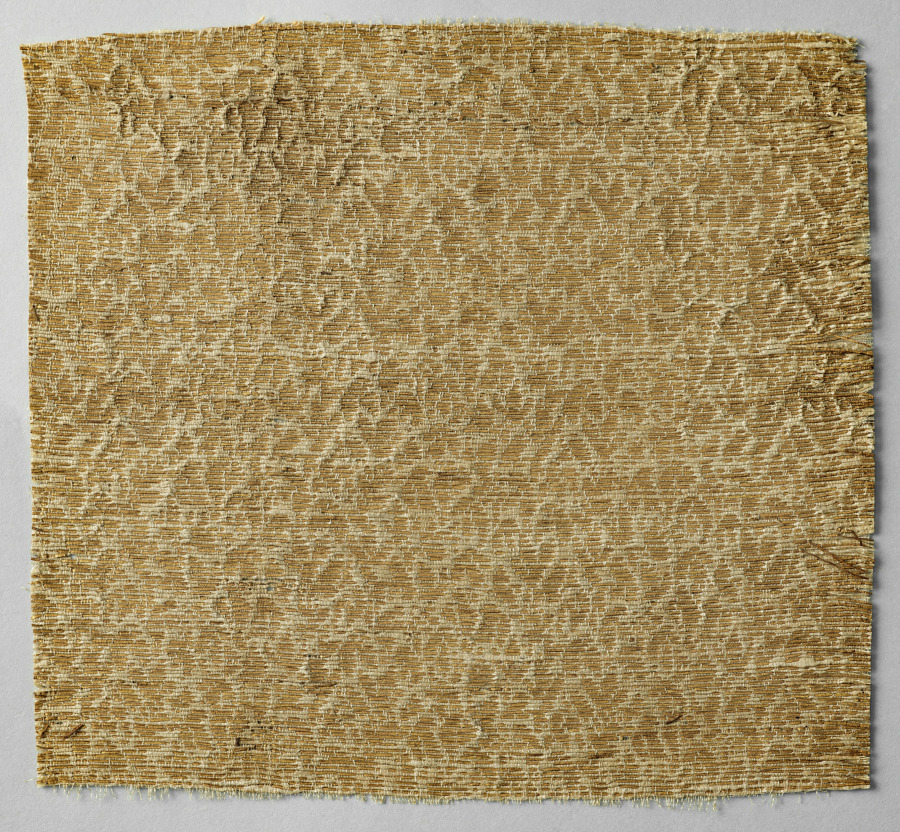
The Artifact: A Silk Fragment with Tiny Leaves
The object under examination is a fragment of silk, measuring approximately 12 inches by 8 inches, bearing a pattern of minuscule leaves rendered in a delicate, almost imperceptible weave. The leaves, no larger than a thumbnail, are arranged in a repeating, asymmetrical pattern that suggests a natural, organic growth rather than a rigid geometric grid. The silk itself is of a pale, celadon green, a colour that speaks of quiet refinement rather than ostentatious display. The fabric is lightweight, with a subtle, almost fluid drape, indicative of a high-twist yarn and a fine, dense weave. This is not a silk intended for heavy upholstery or ceremonial robes; it is a silk for a waistcoat, a cravat, or perhaps the lining of a morning coat—garments that whisper of lineage and taste, rather than shout of power and wealth.
Materiality and Provenance
The materiality of this fragment is its primary narrative. The silk is a plain-weave with a supplementary weft that creates the leaf pattern, a technique known as lampas or, in its more subtle form, brocading. The leaves are not printed or painted; they are woven into the very structure of the fabric. This is a crucial distinction. In the context of imperial silk weaving, particularly in the workshops of the Qing Dynasty (1644-1912), the pattern was not an afterthought but an integral part of the silk’s identity. The tiny leaves, likely representing the “five-leaf” or “three-leaf” motifs common in Chinese decorative arts, symbolise growth, renewal, and the ephemeral nature of beauty. The choice of silk as the substrate is equally significant. Silk was not merely a fabric; it was a currency of power, a medium of diplomacy, and a marker of social hierarchy. The imperial workshops of Suzhou, Hangzhou, and Nanjing produced silks of such exquisite quality that they were reserved for the Emperor, his court, and as gifts to foreign dignitaries.
The fragment’s condition—slightly faded, with a faint crease along one edge—suggests it was once part of a larger garment, perhaps a “dragon robe” (longpao) or a “court robe” (chaofu). The tiny leaves, while subtle, would have been part of a complex symbolic language. In imperial iconography, leaves often accompanied flowers or fruits, representing abundance and harmony. The absence of a central motif—a dragon, a phoenix, or a floral medallion—suggests this fragment came from a garment of lesser rank, perhaps a prince or a high-ranking official. The pattern’s scale is intimate, designed to be appreciated at close range, in the quiet of a private audience or the intimacy of a family gathering.
The Legacy of Imperial Silk Weaving
The legacy of imperial silk weaving is not merely a story of technical mastery; it is a narrative of cultural transmission, economic power, and aesthetic refinement. The imperial workshops were not factories in the modern sense; they were ateliers of unparalleled skill, where master weavers, dyers, and designers worked under the direct patronage of the Emperor. The production of a single robe could take months, even years, involving hundreds of artisans. The silk was sourced from the finest silkworms, the dyes from rare minerals and plants, and the patterns from ancient texts and botanical studies. The result was a fabric that was not just beautiful but imbued with meaning.
The tiny leaves on this fragment are a testament to this legacy. They are not a random pattern; they are a deliberate choice, a nod to the “hundred grasses” (bai cao) motif, which symbolised the Emperor’s connection to the natural world and his role as the cultivator of the realm. The leaves are rendered with a precision that borders on the obsessive, each vein and curve meticulously woven. This attention to detail is a hallmark of imperial silk weaving, a tradition that valued perfection over speed, and meaning over novelty.
However, the legacy is also one of loss. The imperial workshops were dismantled after the fall of the Qing Dynasty in 1912, and many of the techniques and patterns were lost or scattered. The knowledge was passed down through families, but the institutional support vanished. Today, the surviving fragments, like this one, are not just artifacts; they are fragments of a lost world. They remind us of a time when silk was not a commodity but a sacred material, and when the weaver was not a labourer but an artist.
Contemporary Resonance
For the modern connoisseur, particularly those on Savile Row, this fragment offers a lesson in restraint and authenticity. The tiny leaves are not a statement; they are a whisper. They do not demand attention; they reward it. In an era of fast fashion and digital prints, this fragment is a reminder that true luxury is not about loud logos or trend-driven designs. It is about the quality of the material, the integrity of the craft, and the subtlety of the pattern. The silk’s pale green hue, for example, is not a colour that shouts; it is a colour that complements, that harmonises with the wearer’s complexion and the occasion. It is a colour that speaks of confidence, not of insecurity.
Moreover, the pattern’s scale is a masterclass in proportion. The tiny leaves are not overwhelming; they are intimate, inviting closer inspection. This is a fabric that rewards the discerning eye, the one who takes the time to appreciate the details. In a bespoke garment, such a fabric would be a mark of distinction, a sign that the wearer understands the language of cloth. It is a language that transcends time and place, connecting the modern gentleman to the imperial courts of China, to the workshops of Suzhou, and to the ateliers of Savile Row.
Conclusion
This silk fragment with tiny leaves is more than a piece of fabric; it is a heritage artifact that encapsulates the legacy of imperial silk weaving. Its materiality—the silk, the weave, the pattern—tells a story of technical mastery, cultural symbolism, and aesthetic refinement. Its context—the imperial workshops of the Qing Dynasty—reminds us of a time when silk was a medium of power and diplomacy. And its contemporary resonance—the lessons in restraint, authenticity, and proportion—offers a timeless guide for the modern connoisseur. In the quiet elegance of its tiny leaves, we find a legacy that endures, a whisper from the past that still speaks to us today.