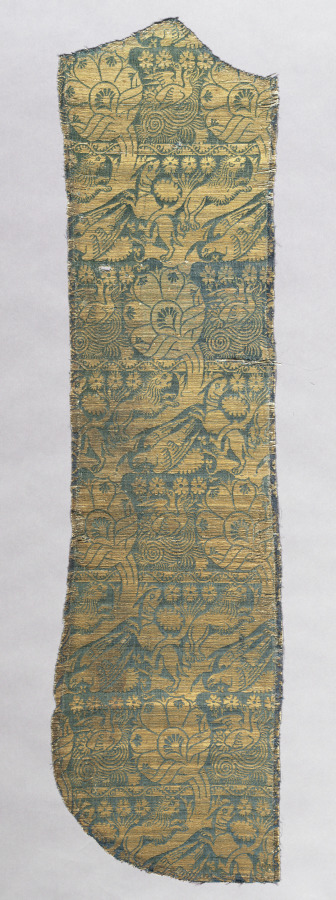
A Thread of Empire: The Chasuble Fragment with Realistic Animals as a Testament to Imperial Silk Weaving
In the hushed, wood-paneled ateliers of London’s Savile Row, where the cut of a jacket is a matter of honor and the drape of a cloth is a legacy, we understand that fabric is never merely material. It is a document. It is a statement of power, of artistry, and of the invisible hands that shaped civilization. The Chasuble Fragment with Realistic Animals, a remnant of a liturgical garment woven from the finest silk, is precisely such a document. It is not a relic of mere piety; it is a fragment of imperial ambition, a tangible echo of the Silk Road’s grand narrative, and a masterclass in the materiality of power. This artifact, though small in size, speaks volumes about the convergence of technical mastery, political authority, and artistic expression that defined the legacy of imperial silk weaving.
Materiality and the Language of Silk
To the trained eye, the silk of this fragment is not a simple textile. It is a complex, multi-layered narrative. The materiality of the piece—its warp-faced compound weave, likely a samite or lampas structure—reveals a production process that was both labor-intensive and technologically advanced. The silk itself, cultivated from the Bombyx mori silkworm, was a commodity of immense value, often reserved for the imperial court and the highest echelons of the clergy. The thread count, the tightness of the weave, and the subtle sheen of the filament all point to a workshop operating under the direct patronage of a powerful state, likely the Byzantine or Sasanian empires, or perhaps even the Tang dynasty, where such weaving reached its zenith. The fragment’s survival is a testament to the durability of this silk, a quality that made it not only a luxury but a strategic asset—a form of soft power that could be traded, gifted, or worn as a symbol of divine and temporal authority.
Iconography of the Realistic Animals
The most arresting feature of this fragment is, of course, its realistic animals. These are not the stylized, heraldic beasts of medieval European tapestry, nor the symbolic, abstract creatures of earlier textile traditions. They are rendered with a startling naturalism—a lion with a mane that ripples like wind through grass, a deer with eyes that seem to hold the stillness of a forest glade, a bird in mid-flight with feathers meticulously delineated. This realism is a deliberate choice, a departure from the geometric and floral motifs that dominated earlier silk weaving. It signals a shift in the purpose of the textile: from pure ornamentation to a medium of narrative and power projection. The animals are not merely decorative; they are emblems of the imperial hunting grounds, the exotic menageries of the court, and the dominion of the ruler over the natural world. In the context of the Roman and Byzantine empires, such imagery was a direct reference to the venationes—the grand animal hunts staged in the Colosseum—and to the emperor’s role as the supreme hunter and protector of the realm. In the East, it echoed the celestial beasts of the Chinese zodiac and the guardian lions of Buddhist and Confucian iconography. The fragment thus becomes a microcosm of the Silk Road’s cultural exchange, where motifs traveled as freely as the silk itself, absorbing new meanings while retaining their original power.
The Legacy of Imperial Silk Weaving
To understand this fragment is to understand the legacy of imperial silk weaving. This was not an industry of cottage looms; it was a state-sponsored enterprise, often housed in imperial workshops known as the gynaeceum in Byzantium or the shangfang in Tang China. These workshops were factories of luxury, where master weavers, often bound by hereditary guilds, produced textiles that were as much a currency of diplomacy as they were of fashion. The Chasuble Fragment, with its realistic animals, was likely part of a larger textile—perhaps a ceremonial robe or a church hanging—that was commissioned by a high-ranking cleric or a member of the imperial family. Its eventual use as a chasuble, a garment worn during the Eucharist, is a poignant transformation: the silk that once adorned a throne now draped an altar. This transition from court to church underscores the fluidity of power in the medieval world, where the sacred and the secular were inextricably linked. The fragment’s survival, likely as a relic or a piece of liturgical vestment, suggests that its owners recognized its value not just as a garment but as a sacred object, imbued with the authority of both empire and divinity.
Preservation and the Modern Gaze
Today, as we examine this fragment under the controlled light of a conservation lab, we are reminded of the fragility of this legacy. The silk, though resilient, has faded; the once-vibrant reds and blues have softened to ochres and indigos. The realistic animals, while still discernible, are ghostly echoes of their former selves. Yet this very fragility is what makes the fragment so compelling. It is a heritage artifact that demands a specific kind of stewardship—one that balances the need for preservation with the imperative of interpretation. In the spirit of Savile Row, where a bespoke suit is a dialogue between cloth and client, we must approach this fragment as a conversation between the past and the present. We are not merely its custodians; we are its interpreters. The fragment asks us to consider the labor of the weaver, the ambition of the patron, and the faith of the wearer. It asks us to see the silk not as a static object but as a dynamic thread in the tapestry of human history.
Conclusion: The Unbroken Thread
The Chasuble Fragment with Realistic Animals is more than a piece of silk; it is a fragment of empire, a testament to the enduring power of material culture. It reminds us that the legacy of imperial silk weaving is not confined to museums or academic monographs. It lives on in the cut of a Savile Row jacket, in the drape of a ceremonial robe, in the quiet authority of a well-made garment. The animals that adorn this fragment—realistic, vital, and eternal—are not just decorations. They are the symbols of a world that understood the profound connection between what we wear and who we are. And in that understanding, we find a thread that connects us, across centuries and continents, to the weavers, the emperors, and the faithful who once held this silk in their hands. It is a thread that, if we are careful, will never break.