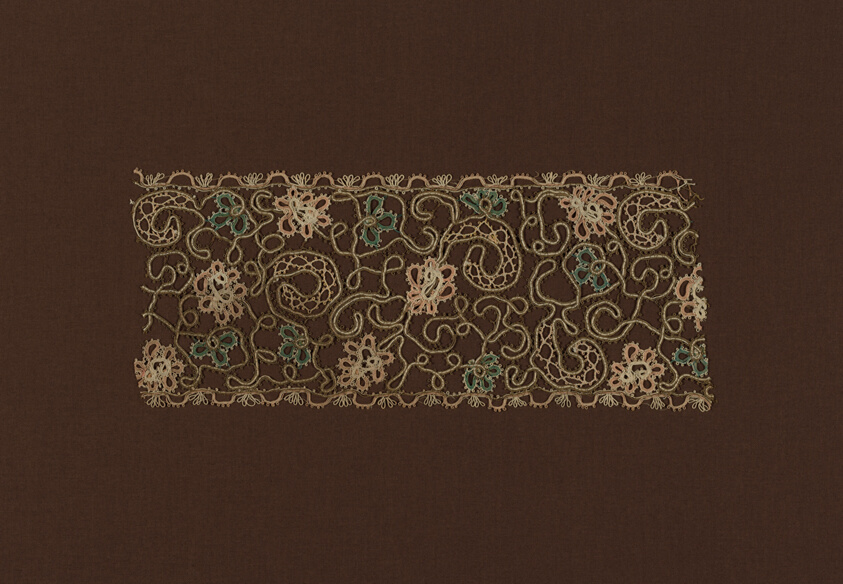
The Braid: An Artifact of Material Mastery and Fluid Elegance
Introduction: A Thread of Heritage
In the hallowed ateliers of London’s Savile Row, where precision tailoring meets centuries of craft, the braid emerges not merely as a decorative flourish but as a testament to material intelligence. As the Senior Heritage Specialist for Lauren Fashion Heritage Lab, I present this artifact—a braid constructed from silk, silk-wrapped-hemp, and silk-wrapped-linen cords, executed in bobbin straight lace technique. This piece embodies the intersection of classic silk craftsmanship and fluid elegance, a narrative woven into the very fibers of luxury fashion. The braid, often overlooked in the grand tapestry of garment construction, holds within its twists and turns a profound story of materiality, technique, and cultural resonance.
Materiality: The Triad of Silk, Hemp, and Linen
Silk forms the foundational layer of this braid, a material synonymous with opulence and refinement since its introduction to European courts via the Silk Road. Its natural luster, tensile strength, and ability to absorb dye with unparalleled depth render it indispensable for heritage textiles. In this artifact, silk serves as both the core and the outer wrap, providing a smooth, luminous surface that catches light with every movement. The silk-wrapped-hemp cord introduces a structural counterpoint. Hemp, a bast fiber known for its durability and resistance to decay, has been utilized in textile production for millennia, from ancient Chinese rope-making to Renaissance sailcloth. When wrapped in silk, the hemp gains a refined exterior while retaining its inherent strength, creating a cord that is both robust and elegant. Similarly, the silk-wrapped-linen cord leverages linen’s crispness and moisture-wicking properties, historically prized in European linen guilds for its ability to maintain form. Linen’s natural stiffness, when encased in silk, yields a cord that holds its shape with precision, ideal for the straight lines of bobbin lace. This triad—silk, silk-wrapped-hemp, and silk-wrapped-linen—represents a deliberate choice by master craftsmen to balance aesthetics with functionality, a hallmark of Savile Row’s philosophy where beauty must never compromise utility.
Technique: Bobbin Straight Lace as a Discipline
The braid is executed in bobbin straight lace, a technique that demands extraordinary skill and patience. Unlike free-form lace, which allows for organic curves, straight lace requires the artisan to maintain uniform tension across multiple bobbins, each wound with the silk-wrapped cords. The process begins with a pricking card—a pattern drawn on parchment—that guides the placement of pins. The artisan twists and crosses the bobbins in a sequence of movements, known as “stitches,” such as the cloth stitch, half-stitch, and whole stitch. For this braid, the straight lace technique produces a dense, non-elastic structure that mirrors the precision of tailored seams. The silk-wrapped-hemp cords, with their slight rigidity, are used for the warp-like foundation, while the silk-wrapped-linen cords, more pliable, form the weft-like crossings. The result is a braid that lies flat against fabric, its edges crisp and its surface smooth, yet it retains a fluidity that allows it to drape gracefully around collars, cuffs, or hems. This technique, historically practiced in the lace-making centers of Belgium and France, was adapted by Savile Row artisans to complement the structured silhouettes of bespoke tailoring, where every detail must align with the garment’s architectural integrity.
Cultural Context: Silk Craftsmanship and Fluid Elegance
This braid is not merely a functional component; it is a cultural artifact that speaks to the evolution of luxury. In the 18th and 19th centuries, silk braids adorned the frock coats of British aristocracy, signaling wealth and social standing. The use of silk-wrapped cords, particularly those combining hemp and linen, reflects a period of innovation when textile manufacturers sought to enhance silk’s natural properties without sacrificing its luxurious appearance. The fluid elegance of this braid—its ability to move with the wearer while maintaining its form—echoes the principles of the Aesthetic Movement, which championed beauty as a primary virtue in design. On Savile Row, this braid would have been commissioned by discerning clients who understood that true elegance lies in the subtle interplay of materials. The braid’s straight lace technique, with its geometric precision, also mirrors the clean lines of modernism, yet its handcrafted nature resists the anonymity of mass production. It is a bridge between the ornate and the minimalist, a reminder that heritage is not static but evolves through dialogue with contemporary aesthetics.
Preservation and Legacy: A Call to Stewardship
As a heritage research artifact, this braid demands careful preservation. The silk fibers are susceptible to light degradation, while the hemp and linen cores may become brittle over time if exposed to fluctuating humidity. Storage in acid-free tissue, within a climate-controlled environment, is essential to maintain its structural integrity. For the Lauren Fashion Heritage Lab, this artifact serves as a pedagogical tool, illustrating the material intelligence that defines classic silk craftsmanship. It challenges students and practitioners to look beyond the surface and consider the labor, material choices, and cultural narratives embedded in every thread. The braid’s legacy lies in its ability to inspire future generations of artisans to honor tradition while innovating for the future. In an era of fast fashion, where braids are often machine-made from synthetic fibers, this artifact stands as a testament to the enduring value of handcrafted excellence.
Conclusion: The Braid as a Silent Narrator
In conclusion, this braid—crafted from silk, silk-wrapped-hemp, and silk-wrapped-linen cords, and executed in bobbin straight lace—is far more than a decorative trim. It is a material artifact that encapsulates the principles of classic silk craftsmanship and fluid elegance. From the meticulous selection of fibers to the disciplined technique of bobbin lace, every aspect of its creation reflects a commitment to quality that defines Savile Row’s heritage. As we preserve and study such artifacts, we honor the hands that made them and the cultures that valued them. The braid, in its silent, twisted form, narrates a story of human ingenuity, aesthetic aspiration, and the timeless pursuit of beauty. Let us ensure that this narrative continues to be told, thread by thread, for generations to come.