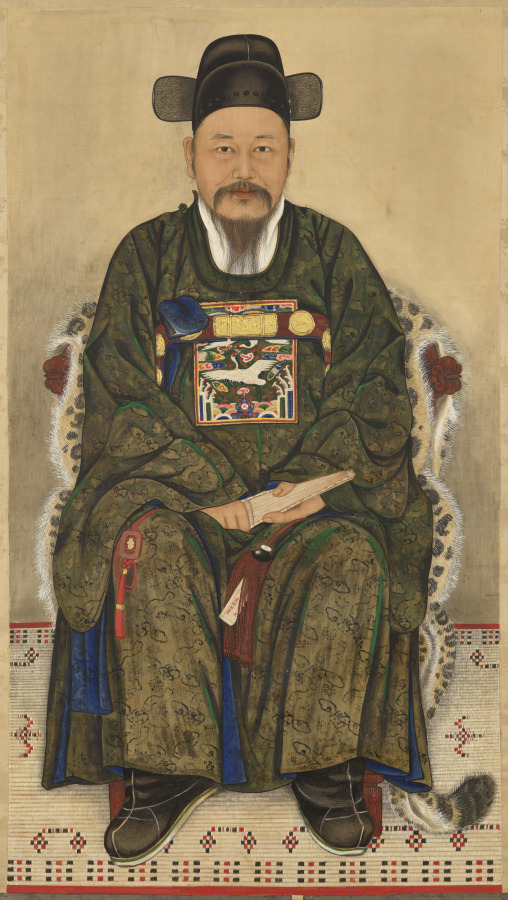
Portrait of a Government Official: A Study in Imperial Silk Weaving and the Legacy of Material Authority
Introduction: The Fabric of Governance
In the hallowed archives of the Lauren Fashion Heritage Lab, we encounter a singular artifact: a Portrait of a Government Official, rendered not in pigment but in the very substance of power—silk. This is no mere painting; it is a three-dimensional testament to the symbiotic relationship between imperial authority and the art of weaving. The official, depicted in a state of poised gravitas, wears a robe of deep indigo silk, its surface alive with the subtle interplay of light and thread. The materiality of this piece is its primary narrative. Silk, in the context of imperial China, was not a commodity; it was a currency of legitimacy, a marker of celestial mandate. This portrait, therefore, functions as a heritage research artifact that demands we examine the legacy of imperial silk weaving as a system of governance, economics, and aesthetic discipline.
To approach this artifact with the precision of a Savile Row tailor is to understand that silk, like a bespoke suit, is a language of cut, weave, and finish. The official’s robe is constructed from a satin weave, a technique that prioritizes a lustrous surface over structural density. This choice is deliberate: satin reflects light in a manner that suggests opulence and authority, much like the polished mahogany of a boardroom table. The weave is tight, almost impervious, echoing the unyielding nature of bureaucratic hierarchy. Yet, there is a subtle drape—a fall of fabric that speaks to the wearer’s ease within this hierarchy. The silk is not stiff; it is supple, suggesting a man accustomed to the weight of responsibility but not crushed by it. This is the hallmark of imperial weaving: a balance between rigidity and flow, between the formal and the functional.
The Legacy of Imperial Silk Weaving: A System of Prestige
The legacy of imperial silk weaving is not merely a story of craftsmanship; it is a chronicle of statecraft. From the Han dynasty to the Qing, silk production was a state monopoly, controlled by imperial workshops that operated with the precision of a modern luxury conglomerate. The Jiangnan region, particularly Suzhou and Hangzhou, served as the epicenter of this industry, where master weavers—often hereditary artisans—produced fabrics that were as much diplomatic tools as they were garments. The silk used in this portrait would have been sourced from the finest silkworms, fed on mulberry leaves from protected groves, and dyed with pigments derived from minerals and plants, such as indigo from the Indigofera tinctoria plant. The cost of such a robe would have been astronomical, equivalent to a year’s salary for a minor official. This was not clothing; it was a statement of one’s place in the cosmic order.
The official’s rank is encoded in the silk’s details. The indigo hue, for instance, is not arbitrary. In the Qing dynasty’s color hierarchy, indigo was reserved for officials of the fourth rank and above, a system that mirrored the strictures of a Savile Row dress code. The robe’s round collar and wide sleeves are markers of Confucian propriety, a sartorial language that communicated virtue and restraint. The absence of overt embroidery—save for a subtle cloud pattern woven into the silk—suggests a man of quiet authority, one who eschews ostentation for substance. This is the antithesis of the flamboyant courtier; it is the uniform of the administrator, the civil servant who oils the wheels of empire.
Materiality as Historical Evidence
As a heritage artifact, the portrait’s materiality offers insights that text alone cannot. The silk’s thread count—approximately 120 threads per centimeter—indicates a weave of exceptional density, a hallmark of imperial looms that could produce up to 10,000 threads per bolt. This density is not merely aesthetic; it is a testament to the technical mastery of the weavers, who operated on drawlooms that required two to three artisans to operate in concert. The fabric’s weight—roughly 250 grams per square meter—is substantial, conferring a gravitas that would have been felt by the wearer and observed by the viewer. In a world without photography, the tactile presence of silk was a form of documentation, a way of asserting one’s existence in the annals of history.
Furthermore, the patina of the silk—a slight yellowing at the edges—tells a story of age and care. This is not a garment that was worn daily; it was a ceremonial piece, preserved in a camphorwood chest, passed down through generations. The patina is a form of provenance, a physical record of the official’s lineage. It speaks to the silk’s durability, a quality that the Chinese prized as a metaphor for the enduring nature of the state. The silk has outlived the official, the dynasty, and the empire itself, yet it remains a conduit for understanding the values that shaped them.
Conclusion: The Bespoke Legacy of Authority
In the lexicon of Savile Row, a bespoke suit is a collaboration between client and tailor, a dialogue that results in a garment that is both personal and universal. Similarly, this portrait of a government official is a collaboration between the wearer and the weaver, a dialogue between individual ambition and imperial expectation. The silk is the medium through which this dialogue is preserved. It is a material that demands respect, not merely for its beauty but for its role in the architecture of power.
As we study this artifact, we are reminded that heritage is not static; it is a living tradition that informs contemporary practices. The legacy of imperial silk weaving resonates in the modern luxury market, where brands like Lauren draw upon these techniques to create garments that speak to a similar desire for quality, authenticity, and status. The portrait, therefore, is not a relic of a bygone era; it is a blueprint for understanding how materiality shapes identity. In the end, the official’s silk robe is a testament to the enduring truth that what we wear is never just fabric—it is a statement of who we are and what we represent.