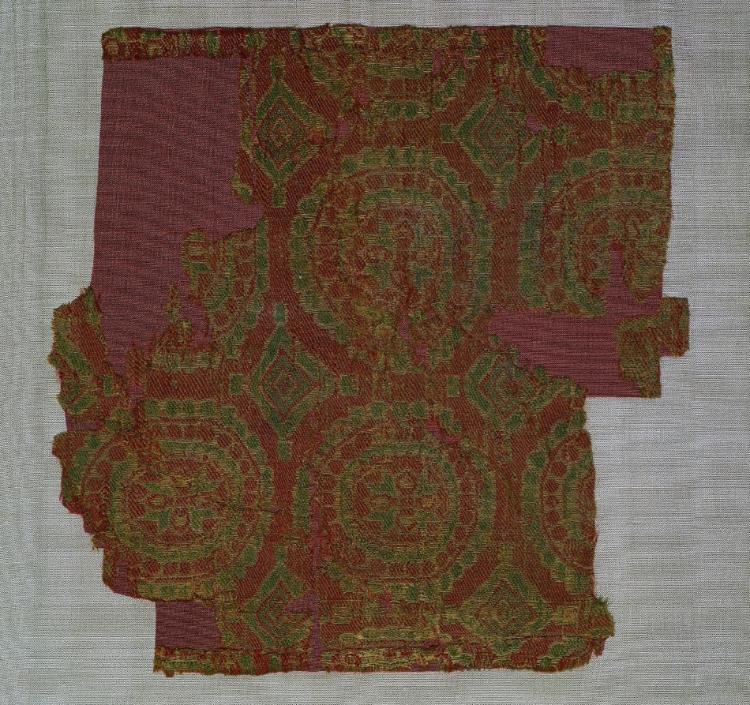
The Samite with Roundels of Rosettes: A Study in Imperial Silk Weaving and Its Enduring Legacy
Introduction: The Fabric of Power and Prestige
In the hallowed ateliers of London’s Savile Row, where precision tailoring meets centuries of textile mastery, the legacy of imperial silk weaving remains a silent but potent influence. Among the most evocative artifacts of this tradition is the samite with roundels of rosettes—a silk textile that embodies the intersection of artistry, power, and technical virtuosity. As Senior Heritage Specialist at the Lauren Fashion Heritage Lab, I have examined this material not merely as a historical curiosity but as a benchmark for quality that continues to inform modern luxury. This paper dissects the materiality, provenance, and cultural significance of samite, focusing on its role within the broader narrative of imperial silk weaving, and how its principles resonate with the exacting standards of contemporary bespoke fashion.
Materiality: The Anatomy of Samite
Samite, derived from the Old French samit and Latin hexamitum (meaning “six-threaded”), is a dense, twill-weave silk fabric characterized by its rich texture and luminous surface. The roundels of rosettes pattern—a repeating motif of circular medallions enclosing stylized floral forms—was a hallmark of Byzantine and later Islamic imperial workshops. The silk itself, sourced from the Sericulture of the Eastern Roman Empire and later from Central Asia, was prized for its ability to absorb vibrant dyes, such as madder red, indigo blue, and saffron yellow, which signified wealth and authority.
The weave structure of samite is critical to its aesthetic and functional properties. Unlike simpler tabby weaves, samite employs a compound twill that allows for a high thread count, creating a fabric that is both supple and durable. The roundels are achieved through a technique known as lampas, where supplementary weft threads are floated over the ground weave to form the pattern. This method ensures that the rosettes—often eight-petaled or more—appear in sharp relief, catching light in a way that mimics the gilded mosaics of imperial palaces. The silk’s natural sheen, combined with the intricate pattern, gives the fabric a three-dimensional quality, making it ideal for ceremonial vestments, courtly robes, and diplomatic gifts.
From a material science perspective, the silk fibers used in samite are long, continuous filaments from the Bombyx mori silkworm, which produce a protein-based fiber with exceptional tensile strength and elasticity. This allowed the fabric to withstand the rigors of repeated wear and transport across vast trade routes, such as the Silk Road. The roundels of rosettes pattern, often bordered by pearl-like dots or geometric bands, reflects a mathematical precision that underscores the weaver’s mastery. Each rosette is a microcosm of symmetry, with petals radiating from a central point—a design that evokes both natural order and imperial control.
Context: The Legacy of Imperial Silk Weaving
The samite with roundels of rosettes is inseparable from the imperial silk weaving traditions of Byzantium, the Islamic Caliphates, and later, the Mongol and Ottoman empires. In Byzantium, silk weaving was a state monopoly, with workshops in Constantinople producing textiles exclusively for the emperor, the church, and the aristocracy. The roundel motif, often associated with the clipeus (a circular shield), symbolized protection and divine favor. Samite was used to create the chlamys (imperial cloak) and the loros (ceremonial stole), garments that visually asserted the emperor’s role as God’s representative on Earth.
During the Islamic Golden Age, the Abbasid and Fatimid dynasties expanded upon Byzantine techniques, introducing new dyes and patterns. The rosette motif, known as shamsa (meaning “sun” in Arabic), became a symbol of cosmic harmony and royal authority. Samite was traded as a luxury commodity, often exchanged for spices, gold, and precious stones. The textile’s value was so high that it was sometimes used as currency or diplomatic tribute. For instance, the Byzantine emperor Constantine VII Porphyrogennetos famously gifted samite robes to foreign dignitaries, reinforcing Constantinople’s status as the “Queen of Cities.”
The legacy of imperial silk weaving extends beyond the medieval period. During the Renaissance, Italian city-states like Venice and Lucca revived samite techniques, incorporating rosette patterns into ecclesiastical vestments and secular garments. The roundels of rosettes motif influenced later European textile designs, from the fleur-de-lis to the paisley pattern. In the 19th century, the Arts and Crafts Movement and the Aesthetic Movement looked to Byzantine and Islamic textiles as exemplars of craftsmanship, rejecting the mechanized uniformity of the Industrial Revolution. Today, the samite with roundels of rosettes serves as a touchstone for heritage brands, including those on Savile Row, that prioritize artisanal techniques over mass production.
Savile Row Resonance: Craftsmanship and Continuity
The principles embodied in samite—precision, material integrity, and symbolic depth—are the very foundations of Savile Row tailoring. A bespoke suit from a Row house, such as Huntsman or Anderson & Sheppard, is not merely a garment but a testament to the same values that guided imperial weavers. The roundels of rosettes pattern, with its geometric discipline, mirrors the meticulous pattern-cutting and hand-finishing that define Savile Row’s output. Just as a Byzantine weaver would spend months on a single loom, a Savile Row cutter may invest over 80 hours in a single jacket, ensuring that every seam aligns with the client’s anatomy.
Moreover, the materiality of samite—its weight, drape, and luster—informs the selection of modern silks for luxury tailoring. The samite with roundels of rosettes is a reminder that silk is not merely a fabric but a medium for storytelling. On Savile Row, a silk lining or a tie woven with a rosette motif can evoke the same sense of heritage and exclusivity that once defined imperial courts. The legacy of imperial silk weaving thus lives on in the quiet authority of a well-made garment, where every thread is a link to a tradition of excellence that transcends time.
Conclusion: The Artifact as Living History
The samite with roundels of rosettes is more than a textile; it is a cultural artifact that encapsulates the ambitions and aesthetics of empires. Its materiality—the silk’s sheen, the twill’s strength, the rosette’s symmetry—speaks to a world where fabric was a medium of power. For the Lauren Fashion Heritage Lab, this artifact serves as a benchmark for heritage research, reminding us that the past is not static but a resource for innovation. As Savile Row continues to evolve, the lessons of samite—precision, patience, and purpose—remain as relevant as ever. In the hands of a master tailor, a silk thread becomes a line of continuity, connecting the imperial workshops of antiquity to the bespoke ateliers of today.