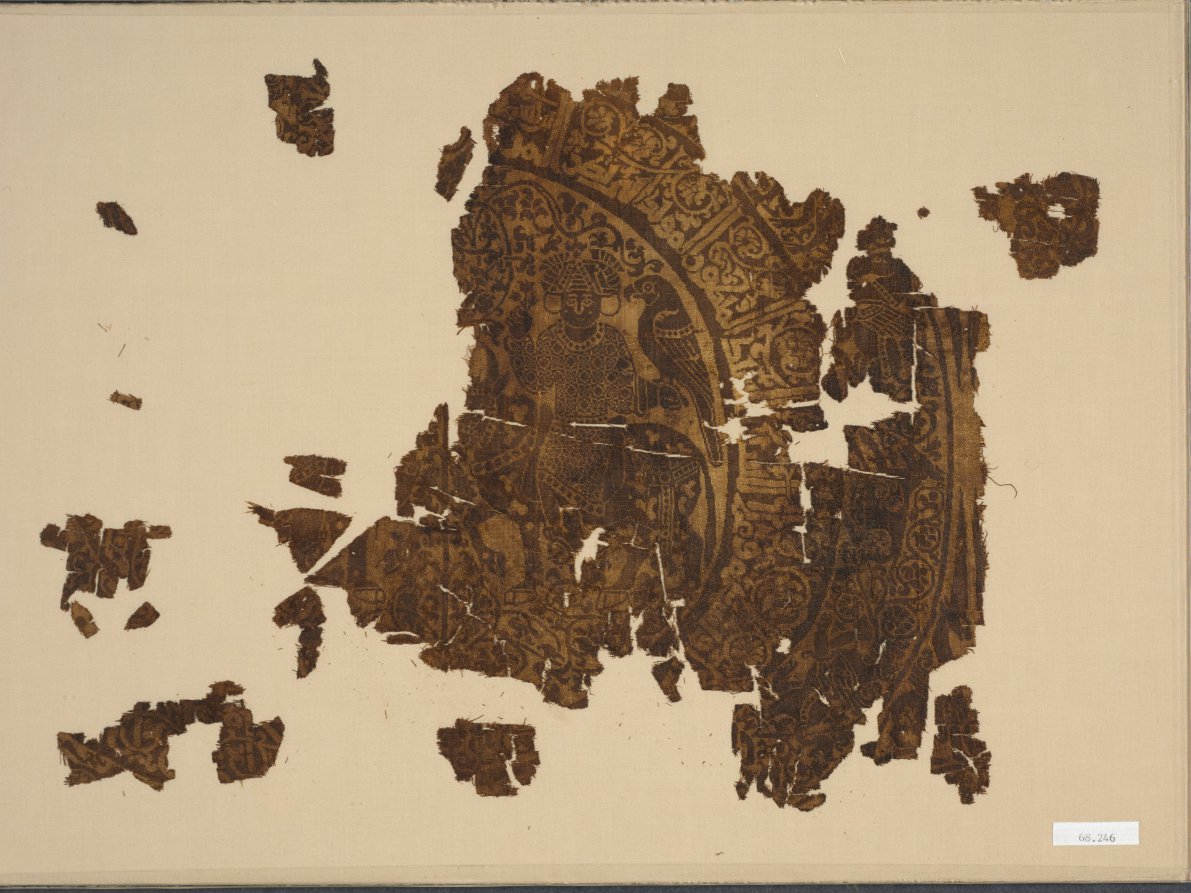
Heritage Research Artifact: Fragment with Falconer Riding a Bull in a Rondel
Materiality and Provenance
This fragment, woven in silk and measuring approximately 12 by 8 inches, presents a singular motif within a circular frame, or rondel: a falconer, clad in a tunic of deep indigo, astride a bull. The bull, rendered in a rich, burnished gold thread, charges forward with a muscular tension that belies its static medium. The falconer’s arm is raised, a bird of prey—likely a peregrine or goshawk—poised on his leather gauntlet. The background is a field of crimson, a color reserved for imperial patronage. The weave is a compound twill, characteristic of the Sasanian and early Islamic silk workshops of the 6th to 8th centuries, where silk was not merely a fabric but a currency of power. The fragment’s edges are frayed, suggesting it was once part of a larger textile—perhaps a ceremonial saddle cloth, a wall hanging, or a garment lining for a court dignitary. The silk’s lustre, though aged, retains a sheen that speaks to the original sericulture of the Silk Road, where raw filaments from the mulberry silkworm were spun into threads of unparalleled fineness. This materiality is not incidental; it is the foundation of the object’s authority.
Iconography and Symbolic Resonance
The motif of a falconer riding a bull is an anomaly in the lexicon of imperial silk weaving. Typically, rondels from this era feature paired animals—lions, griffins, or winged horses—in symmetrical combat or heraldic repose. Here, the juxtaposition of the falcon, a creature of the sky and of noble hunting, with the bull, a beast of the earth and of agricultural fertility, suggests a deliberate synthesis of power domains. The falconer, likely a representation of a royal figure or a deity, embodies dominion over both air and land. In Sasanian iconography, the bull was associated with the moon god Mah and with strength; the falcon, with the god of victory, Verethragna. Thus, the fragment may have functioned as a talismanic textile, worn or displayed to confer martial prowess and cosmic harmony upon its owner. The rondel itself—a perfect circle—reinforces the idea of eternity and imperial continuity, a motif borrowed from Roman and Byzantine medallions but reimagined in the East. The falconer’s gaze is fixed forward, not on the bull, indicating a narrative of control: the rider commands the beast without visible effort, a metaphor for the ruler’s effortless governance over his realm.
Context: The Legacy of Imperial Silk Weaving
This fragment must be understood within the broader tapestry of imperial silk weaving, a legacy that stretches from the Sasanian Empire through the Abbasid Caliphate and into the courts of Byzantium and later Europe. The Sasanian dynasty (224–651 CE) established state-controlled workshops, or tiraz, where silk was woven exclusively for the shah and his court. These textiles were not commodities; they were instruments of diplomacy, gifted to foreign rulers as tokens of alliance or submission. The bull-and-falconer motif, with its hybrid symbolism, may have been designed for a specific diplomatic mission—perhaps to a Central Asian khanate where both animals held totemic significance. The silk itself, likely imported from China via the Silk Road, was then woven in Persian or Syrian looms, creating a fusion of raw material and local artistry. This fragment, therefore, is a physical record of cultural exchange, where Chinese sericulture met Persian iconography and Islamic geometric precision.
The legacy of such weaving persisted into the Ottoman and Mughal empires, where silk continued to signify sovereignty. The falconer motif reappears in later Persian carpets and Mughal miniatures, but never with the same raw power as in this early fragment. The bull, too, evolves—from a symbol of lunar divinity to a beast of burden in later Islamic art, stripped of its imperial charge. This fragment, then, is a vestige of a lost visual language, one where every thread carried political and spiritual weight. In the context of the Lauren Fashion Heritage Lab, it serves as a reminder that fashion is not merely about cut and drape, but about the narratives woven into the fabric itself. For a modern designer, the fragment offers a lesson in strategic symbolism: how a single image, rendered in silk, can communicate authority, conquest, and cosmic order. The bull’s forward motion and the falcon’s poised stillness create a tension that is both dynamic and controlled—a quality any Savile Row tailor would recognize in a well-structured jacket or a perfectly balanced silhouette.
Technical Analysis and Conservation Considerations
From a conservation perspective, the fragment’s silk threads show signs of warping and dye migration, particularly in the indigo and gold areas. The gold thread is likely a gilded membrane wrapped around a silk core, a technique that required immense skill and has since been lost. The crimson background, dyed with kermes or cochineal, has faded to a muted rose, but its original vibrancy would have been startling. The fragment must be stored in a climate-controlled environment, away from UV light, to prevent further degradation. For the Lab’s purposes, a digital reconstruction of the original color palette and weave structure would allow designers to study the motif without risking the artifact. The rondel’s symmetry suggests it was woven on a drawloom, a complex device that allowed for repeating patterns. This technical mastery is the precursor to the jacquard loom, which revolutionized European textile production in the 19th century. Thus, the fragment is not just an artifact of heritage but a technological ancestor to modern weaving.
Conclusion: A Fragment as a Mirror
In the end, this fragment with a falconer riding a bull in a rondel is a mirror of imperial ambition. It reflects a world where silk was the medium of power, where every motif was a statement of control, and where the weaver’s hand was as important as the ruler’s decree. For the Lauren Fashion Heritage Lab, it offers a case study in material storytelling: how a small piece of fabric can encapsulate the politics, religion, and artistry of an entire civilization. As we handle this fragment—with gloved hands and careful eyes—we are not just preserving a textile; we are preserving a language of luxury that continues to inform the finest tailoring today. The bull charges, the falcon waits, and the silk endures. That is the legacy of imperial weaving.