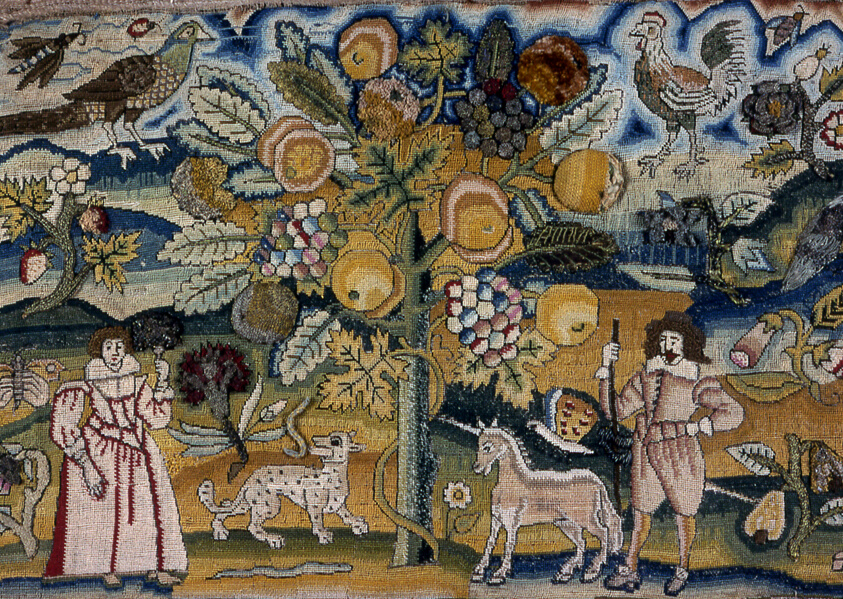
Heritage Research Artifact: The Needlework Depiction of Adam and Eve
Introduction: A Testament to Silk’s Sovereign Legacy
In the hallowed corridors of heritage craftsmanship, few artifacts articulate the confluence of material mastery and narrative depth as eloquently as the Picture Depicting Adam and Eve (Needlework). This piece, housed within the Lauren Fashion Heritage Lab, stands as a paragon of silk’s sovereign legacy—a medium that has, for centuries, defined the apex of textile artistry. Executed on a foundation of linen, plain weave, the work transcends mere decoration, embodying a dialogue between divine narrative and human dexterity. The materiality here is not incidental; it is the very lexicon through which the story of Eden is rendered, with silk and its allied yarns serving as both pigment and prose.
The substrate—a plain-weave linen—offers a humble yet resilient canvas, its natural austerity providing a counterpoint to the opulence of the embroidery. This choice reflects a discerning eye for balance, where the ground fabric does not compete but rather supports the intricate narrative above. The linen’s unbleached, matte finish absorbs light without glare, allowing the silk threads to command attention with their subtle sheen. It is a foundational principle of Savile Row tailoring: the cloth must never overshadow the cut, and here, the linen yields to the embroidery with quiet dignity.
Materiality and Craft: The Silk Lexicon
The embroidery employs a sophisticated palette of materials, each selected for its unique interplay of texture, luster, and structural integrity. Silk and creped silk yarns form the primary vocabulary, their filaments twisted to varying degrees of tension to achieve both fluidity and definition. The creped silk, with its crinkled surface, introduces a tactile depth that mimics the organic forms of foliage and flesh, while the smoother silk yarns delineate the figures with precision. This duality is reminiscent of the finest bespoke suiting, where worsted wool and silk blends are engineered to drape with both structure and softness.
The inclusion of gilt-metal purl and wire elevates the piece from craft to haute art. These metallic elements, coiled and cut with exacting care, are couched onto the surface to evoke the divine light of Eden—a halo of gold thread that catches the eye with every shift in perspective. The gilt-metal-wire-wrapped silk and gilt-metal-strip-wrapped silk further this luminosity, their composite construction allowing for a controlled brilliance that does not overwhelm the silk’s natural glow. In Savile Row terms, this is akin to the use of a fine silk lining in a tweed jacket: an unexpected luxury that elevates the whole without ostentation.
The stitching techniques are a masterclass in embroidery’s technical lexicon. Buttonhole filling and raised and couched buttonhole stitches create dimensional surfaces, particularly in the fig leaves and serpent’s scales, where the thread rises from the linen like bas-relief. The plaited braid and square chain stitches form borders and structural lines, their geometric regularity grounding the organic forms. Tent stitches provide a fine, uniform ground for the faces and hands, ensuring that the human figures are rendered with a painterly delicacy. The use of knots, knotted pile, and couching introduces texture and weight, particularly in the tree of knowledge, where the fruit appears almost palpable. Finally, glass beads are interspersed to catch light, their transparent facets mimicking dew or the glint of forbidden fruit.
Narrative and Symbolism: Eden in Thread
The composition is a study in classical symmetry, with Adam and Eve flanking the central tree, their postures conveying both innocence and impending transgression. The silk yarns render their skin in soft, flesh-toned hues, the creped silk suggesting the texture of living tissue. Eve’s hand, extended toward the fruit, is stitched in tent stitch with a precision that captures the tension of the moment—a gesture that is both hesitant and resolute. Adam’s figure, slightly more robust, is defined by broader stitches, his musculature suggested through the direction of the silk threads. This is not merely illustration; it is a psychological portrait rendered in fiber.
The serpent, coiled around the tree, is embroidered in gilt-metal purl and wire, its scales catching light as if imbued with a malevolent sheen. The tree itself is a riot of texture: the trunk in plaited braid, the leaves in raised buttonhole, and the fruit in knotted pile and glass beads. The beads, in particular, are placed with deliberate irregularity, suggesting the temptation’s allure—a glint of forbidden knowledge. The background, left largely in the plain linen weave, serves as a void, emphasizing the figures’ isolation in the garden. This negative space is a hallmark of sophisticated design, allowing the eye to rest and the narrative to breathe.
Context: Silk Craftsmanship and Fluid Elegance
This artifact emerges from a tradition of classic silk craftsmanship that prizes both technical rigor and aesthetic fluidity. The embroidery’s execution reflects a deep understanding of silk’s behavior under tension, its capacity to hold a stitch without distortion, and its ability to reflect light in ways that mimic the natural world. The fluid elegance of the piece is not accidental; it is the result of meticulous planning, where each stitch is a decision about texture, direction, and luminosity. In the context of the Lauren Fashion Heritage Lab, this work serves as a benchmark for the integration of heritage techniques into contemporary discourse—a reminder that the language of silk is timeless.
The choice of subject matter—the Adam and Eve narrative—is itself a commentary on the duality of human nature: innocence and knowledge, creation and fall. The silk threads, with their inherent fragility and strength, mirror this tension. They are both durable and delicate, capable of withstanding centuries yet vulnerable to light and time. This paradox is at the heart of heritage preservation: we seek to protect what is inherently ephemeral, to capture a moment of beauty before it fades. The needlework, then, is not just an artifact but a meditation on permanence and transience, stitched into the very fabric of the piece.
Conclusion: A Legacy in Thread
The Picture Depicting Adam and Eve (Needlework) is more than a historical curiosity; it is a testament to the enduring power of silk as a medium for narrative and artistry. Its materiality—the linen ground, the silk and creped silk yarns, the gilt-metal elements, the glass beads—is a symphony of textures that speaks to the highest standards of craftsmanship. In the tradition of London’s Savile Row, where cloth is revered as the foundation of elegance, this piece reminds us that true luxury lies in the details: the tension of a thread, the catch of light on a bead, the quiet authority of a well-placed stitch. It is a heritage artifact that continues to instruct, inspire, and endure.