The Lattice of Beasts: A Study in Imperial Silk and the Geometry of Power
Materiality and the Imperial Thread
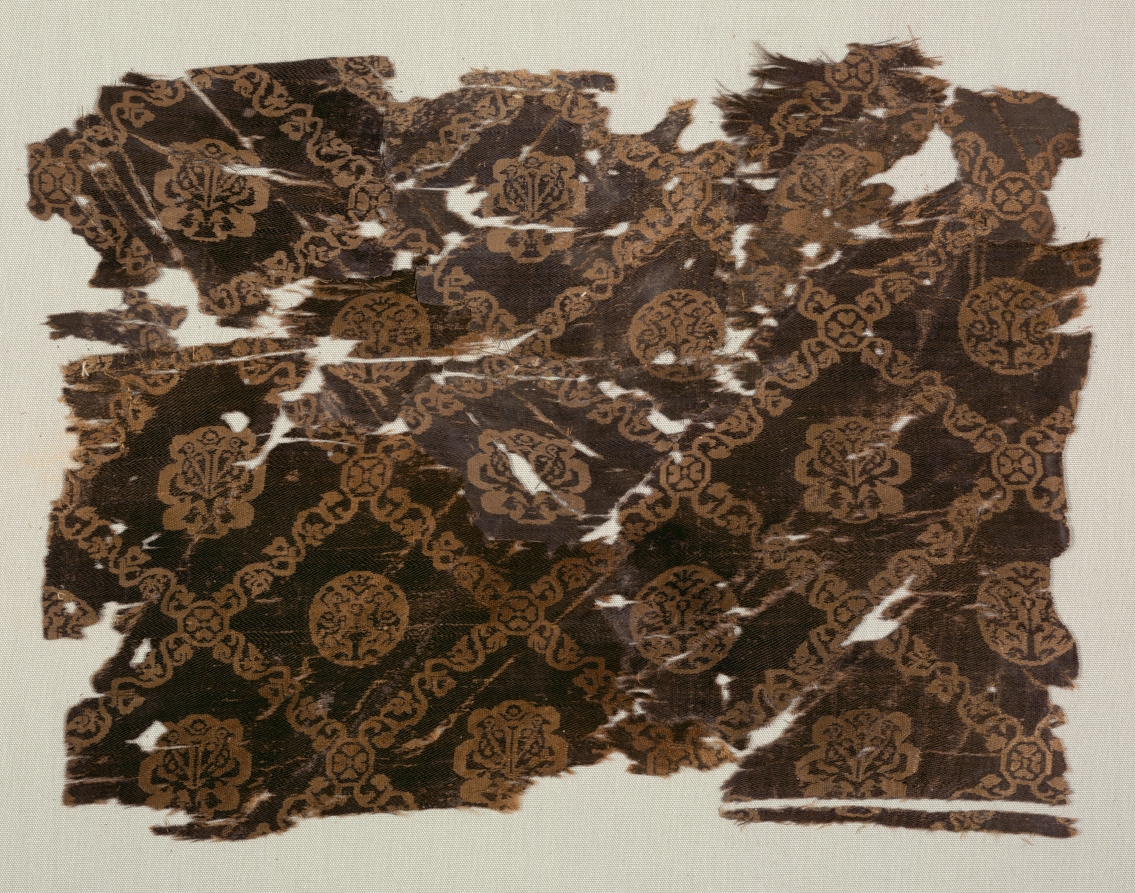
The artifact under examination—a silk textile featuring a lattice of animals enclosed within medallions—represents a pinnacle of imperial silk weaving, a craft that transcends mere textile production to become a language of power, cosmology, and cultural memory. As a Senior Heritage Specialist at the Lauren Fashion Heritage Lab, I approach this piece not merely as a fabric but as a document of dynastic ambition, where the materiality of silk itself serves as the primary narrator. The silk, with its lustrous sheen and tactile resilience, was the chosen medium of emperors, a thread that wove together the political, spiritual, and aesthetic aspirations of ancient China. Its production, centered in the imperial workshops of cities like Suzhou and Nanjing, demanded an almost monastic discipline: the silkworms were reared on mulberry leaves in controlled environments, the threads were reeled with precision, and the dyes—derived from minerals, plants, and insects—were applied with a reverence for color that bordered on alchemy. The lattice pattern, a geometric framework of intersecting lines, is not arbitrary; it mirrors the cosmic order, the grid of heaven and earth, while the medallions—roundels of varying sizes—function as microcosms of imperial authority. Each animal within these medallions—be it the dragon, the phoenix, the qilin, or the lion—is a cipher for specific virtues: the dragon for imperial power, the phoenix for grace and renewal, the qilin for wisdom and justice. The lattice thus becomes a map of the moral universe, a textile codex that the emperor wore as a second skin.
The Legacy of Imperial Silk Weaving
The legacy of imperial silk weaving is one of meticulous craftsmanship and symbolic rigor. During the Ming (1368–1644) and Qing (1644–1912) dynasties, the imperial silk workshops were state-controlled entities, producing textiles exclusively for the court, the nobility, and diplomatic gifts. The weavers, often hereditary artisans, worked on drawlooms that required two operators—one to manipulate the pattern cords, the other to throw the shuttle—a collaboration that mirrored the hierarchical harmony of the state. The lattice of animals in medallions pattern, known in Chinese as *tuanhua* or *tuanshou*, was particularly favored for court robes, especially the *chaofu* (court dress) and *jifu* (auspicious dress). The medallions, often arranged in a symmetrical grid of three, five, or nine rows, were not merely decorative; they signified rank. A nine-dragon robe, for instance, was reserved for the emperor, while five-clawed dragons were for princes, and four-clawed dragons for lesser nobles. The animals themselves were chosen for their auspicious connotations: the bat (for happiness), the deer (for longevity), and the crane (for immortality) often appeared alongside the more regal beasts. The lattice, with its strict geometry, imposed order on this menagerie, suggesting that even the wildest forces of nature were subsumed under imperial rule. This is not a chaotic jungle; it is a curated zoo of power.
Savile Row and the Art of Tailored Heritage
From a Savile Row perspective, the lattice of animals in medallions silk is a masterclass in pattern engineering and sartorial authority. The Row, with its tradition of bespoke tailoring, understands that fabric is not just a covering but a structure. The lattice pattern, with its repeating medallions, demands precision in cutting and matching—a skill that separates the master cutter from the mere tailor. When a Savile Row house like Huntsman or Anderson & Sheppard works with such a silk, the pattern must be aligned at the seams, the medallions centered on the lapels, and the lattice flow uninterrupted across the back. This is not a fabric for the faint-hearted; it requires a client who understands that clothing is armor. The imperial silk, with its weight and drape, lends itself to structured garments—a double-breasted dinner jacket, a smoking jacket, or a formal overcoat. The medallions, when placed strategically, draw the eye to the shoulders and chest, creating a silhouette of power. The lattice, with its grid, elongates the torso, while the animals—if the pattern is large-scale—become conversation pieces, signaling a connoisseurship of history. On Savile Row, this silk is not merely worn; it is performed. The client, whether a financier, a diplomat, or a collector, steps into the role of the emperor, albeit in a modern, democratic context. The legacy of imperial weaving is thus reinterpreted: the dragon no longer represents divine rule but personal sovereignty, the phoenix not imperial consort but individual grace.
Preservation and the Future of Heritage Textiles
Preserving such an artifact requires a deep understanding of its material and symbolic DNA. At the Lauren Fashion Heritage Lab, we employ climate-controlled storage, UV-filtered lighting, and minimal handling protocols to prevent degradation. The silk, being a protein fiber, is susceptible to light, humidity, and pests; we monitor these factors with digital sensors. For conservation, we use techniques such as wet cleaning with deionized water and gentle detergents, or dry cleaning with specialized solvents, depending on the dye stability. The lattice pattern, often woven with gold or silver threads, requires additional care, as these metallic elements can tarnish or corrode. But preservation is not merely about stopping decay; it is about enabling interpretation. We digitize the artifact using high-resolution photography and 3D scanning, creating a virtual twin that can be studied, replicated, and even reimagined. This digital archive allows designers on Savile Row to access the pattern for contemporary garments, ensuring that the legacy of imperial silk weaving continues to evolve. The lattice of animals in medallions is not a relic; it is a resource. It speaks to a time when textiles were the ultimate expression of power, and it challenges us to consider what we wear as a statement of our own values. In an era of fast fashion and disposable fabrics, this silk reminds us that true luxury is rooted in history, craft, and meaning. The medallions, with their beasts, are not just decorations; they are emblems of a world order that, while distant, still resonates in the cut of a jacket or the fall of a lapel. As we preserve this artifact, we preserve a language of authority that, on Savile Row, remains as relevant as ever.